Digital Marketing Consultant
14+ years helping businesses in US, UK, Canada, Australia, UAE & India grow through SEO and AI-powered marketing.
Information
WEBSITE REDESIGN + SEO/GEO CASE STUDY • BRAND STUDIO • MUMBAI & SEOUL • WIX TO WORDPRESS
The 8th Archer came to me through a ChatGPT referral with a beautiful Wix site, an authority score of 2 out of 100, 2,500 mostly junk backlinks and no page that ranked for anything except its own name. This is what the rebuild involved, what it fixed, what it did not, and the baseline from which the SEO and GEO programme starts on 9 November 2026.
SUMMARY
SEO and GEO consultant Kulbhushan Pareek moved the8tharcher.com, a brand strategy and identity studio with offices in Mumbai and Seoul, from Wix to WordPress between 14 September and 2 November 2026. The site was replanned from 19 pages and 11 image galleries into a 44-page architecture: eight service pages, a six-page market-entry cluster for India, the USA, the Gulf and South Korea, eleven case studies written as briefs and outcomes rather than galleries, and seven retained blog posts. 41 URLs went live, each with one H1, a unique title and description and breadcrumb schema; three case studies are held as drafts until the client supplies content.
All 47 live Wix URLs redirect to their new page in one hop. 24 addresses that never existed, but carried spam directory links from the previous vendor, return 410 Gone so the link profile does not follow the brand. The site ships with an llms.txt, AI crawlers allowed, Organization and WebPage schema, self-hosted fonts (zero requests to Google Fonts), security headers and GA4. The Wix-era baseline is 53 organic clicks in three months, almost all for the brand name. The SEO and GEO retainer starts 9 November 2026; this page is updated with dated results.
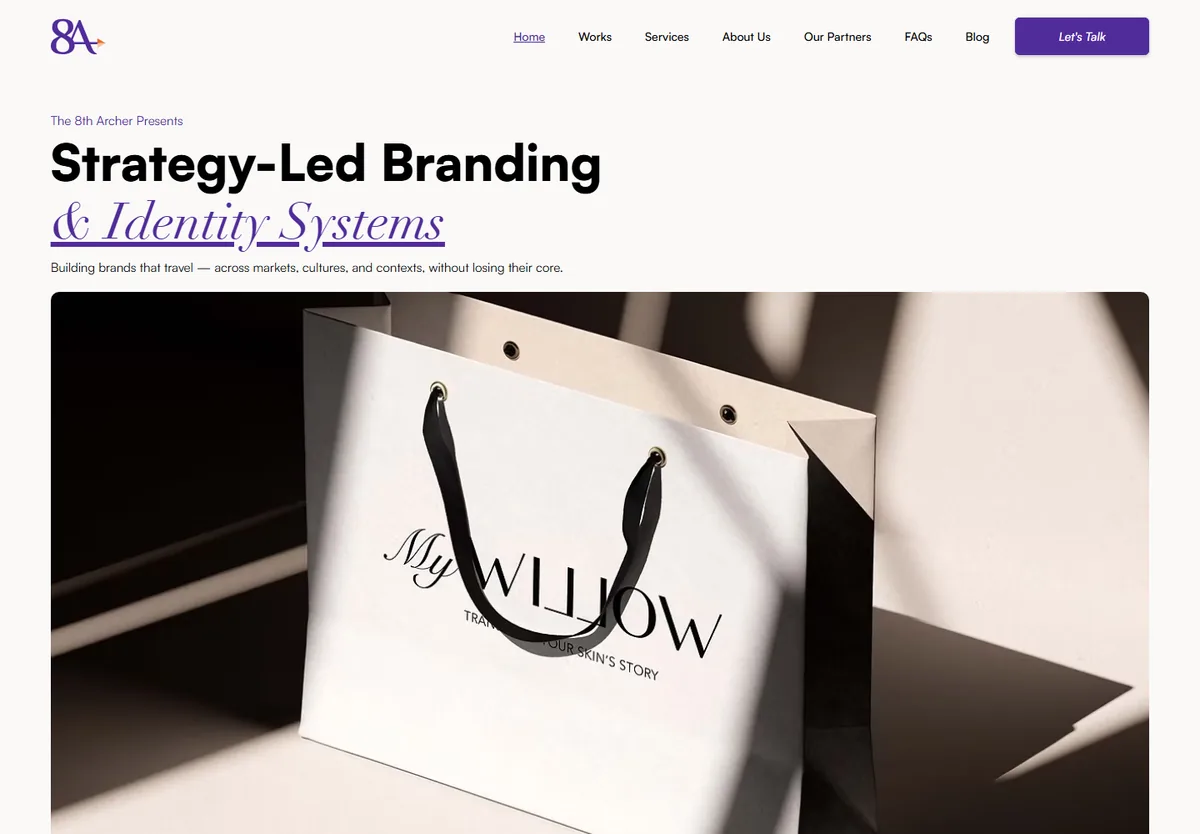
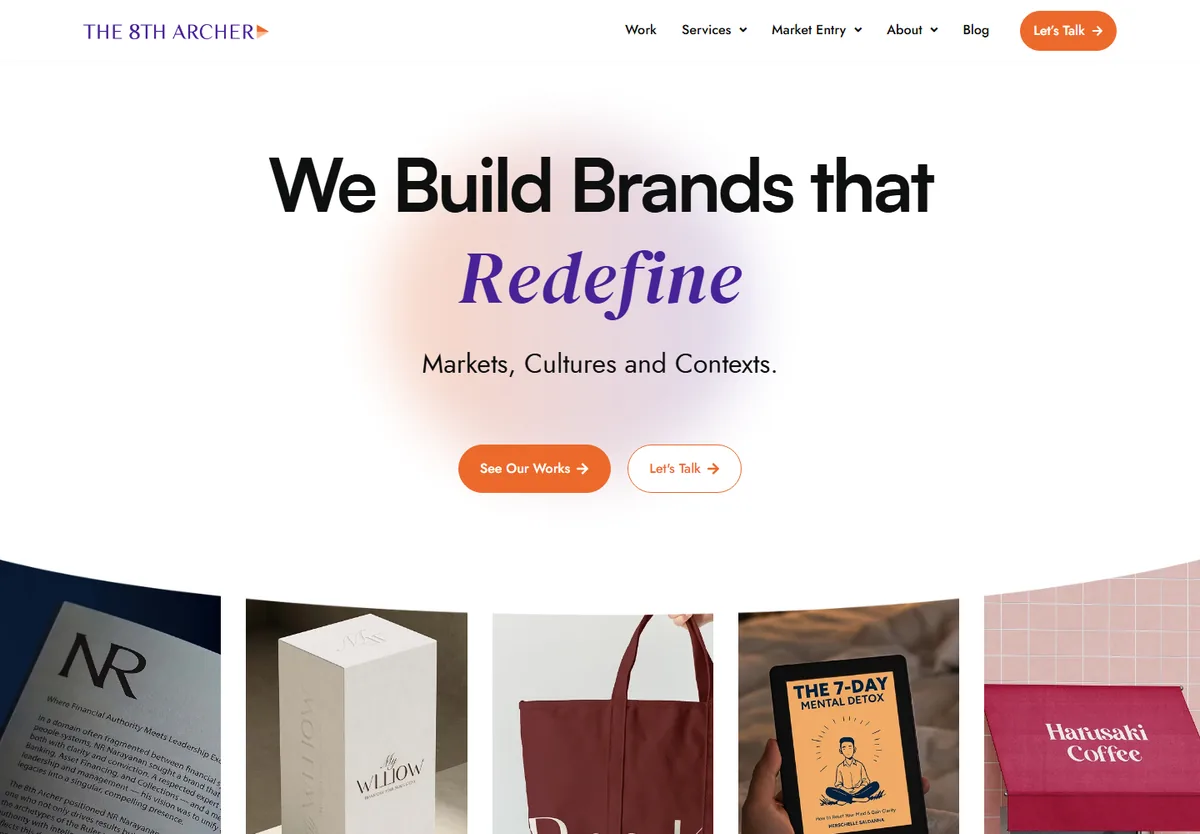
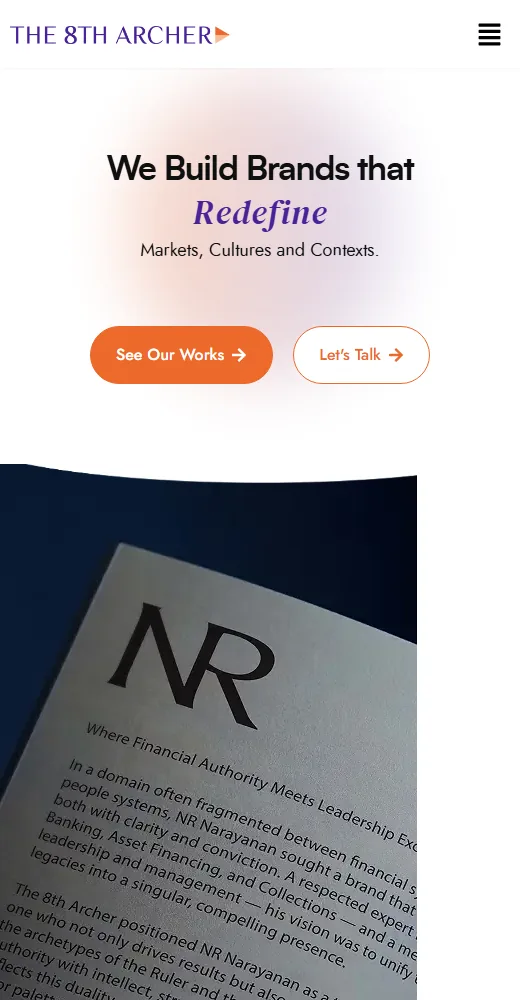
Left: the Wix homepage as crawled on 10 September 2026. Right: the WordPress homepage on 7 November 2026, five days after go-live. The brand assets, project photography and purple are the client's own; what changed is the structure underneath them.
The studio had genuinely rare positioning: an Indian brand studio with real Korean depth, at a moment when India and South Korea are pushing bilateral trade from about $27 billion toward a $50 billion target. What it did not have was a website anyone outside its own network could find.
After a year live and two years of a previous SEO vendor's work, the Wix site had a SEMrush authority score of 2 out of 100, roughly 15 organic clicks a month (almost all for the brand name), one non-brand keyword anywhere in Google, zero citations in ChatGPT, Gemini or Google AI Overviews, and 2,500 backlinks from 229 domains, most of them directory farms.
The founder's brief was explicit: a creative agency's site has to look like a design studio built it, with minimal text and strong visual storytelling. Search engines want readable, structured content. The job was to deliver both without compromising either, and to do it without taking the live site down for a day.
I went through the previous vendor's tracker line by line and cross-checked it against the live site before proposing anything. Not to criticise it for its own sake, but because it explained why the spend produced nothing and told us exactly what not to repeat.
| Finding | Measured | Why it mattered |
|---|---|---|
| Authority score | 2 / 100 (SEMrush, 27 Aug 2026) | "Lacks organic traffic." A year live with nothing compounding. |
| Organic search clicks | 53 in 3 months (GSC, Aug to Oct 2026), 646 impressions | About 15 clicks a month. 34 queries, led by "bna kim" (a client project) and "the archer". Not one commercial query. |
| Keywords in the top 10 | 4 of 49 tracked, all the brand name or its own tagline | "Branding company India", "brand consulting", "packaging design services" never ranked once in two years of reports. |
| Backlinks | 2,500 from 229 domains | Directory farms and bookmarking sites. Two genuine links in the whole profile: Behance and a Mid-Day feature. |
| Links built to pages that do not exist | 72 of 75 directory links in the final three weeks | Pointed at /services-1 through /services-25. Only /services-1 was a real page; the other 24 returned 404. One of the directories was an escort directory. |
| Blog | 17 posts, last published 2 Dec 2025 | Right topics (Korea market expansion, India market entry), nine months of silence, no answer-first structure, no FAQ, no schema. |
| Domain consolidation | 3 hosts indexed: the8tharcher.com, www, and http:// | Whatever authority existed was split three ways. |
| Metadata | Title tag India-only; 13 pages with no meta description | "Visionary Brand Design Company Mumbai" on a studio courting the USA and the Gulf. The FAQ, privacy policy and all 11 portfolio pages had no description at all. |
| Korea tracking | Rankings measured on Google Korea, last updated Dec 2024 | Koreans mostly search on Naver. First place on the wrong engine produces no visitors. |
| AI visibility | 0 citations in ChatGPT, Gemini, Perplexity or AI Overviews | In a buyer journey that had just produced this very enquiry through ChatGPT. |
The lesson built into this engagement: volume of activity is not progress. A report showing 50 submissions a week looks like work. Four brand-name keywords and 2,500 broken links was the actual result. Everything below is built the opposite way round: foundation first, then content, then a small number of links that are genuinely earned.
Wix is not a bad product. It was the wrong product for what the studio needed next: rank in several countries, control how AI systems read each page, and add case studies at speed without paying someone every time. The founder's own words on the call were that staying on Wix was causing more harm than good.
The alternative she raised was upgrading Wix. The honest answer was that the limits were structural, not a plan tier: the platform's location setting was defaulting the whole site to Mumbai while the strategy targeted Korea and the USA, multilingual work needed paid tokens, and the schema, crawl and URL control a multi-market build depends on is exactly where Wix's tooling runs out of road. WordPress also keeps the door open for the CRM and lead-routing integrations the studio wanted later.
Full control over schema markup, crawl directives, URL structure, redirects and page speed. On Wix each of those was partial, locked, or an add-on.
Multilingual pages, structured data and integrations stop being subscription line items. Hosting, domain and every login sit in the client's own name and account, so they are never locked in to me either.
Case studies are a WordPress post type with a defined template. New work goes in as a page with images and project details; the grid, filters and schema update themselves.
The new site was built and tested on a private staging address while Wix kept running. The client approved it on a review link before DNS changed, and Wix stayed reachable for rollback.
The decision that matters most for international enquiries is the page plan. The Wix site had eleven content pages, all written for one city. The new architecture groups pages by the job each one does.
Home repositioned as global rather than Mumbai-only. About with both founders marked up as people. A new Approach page, a new Press page in the footer with a homepage credibility strip, FAQ rebuilt with FAQ schema, Terms added for international clients.
Brand strategy and positioning, identity and logo design, packaging, podcast branding, plus two pages that did not exist: Rebranding and brand refresh (three blog posts had nowhere to send readers) and Brand naming and storytelling. Four thin digital-marketing pages were retired and redirected.
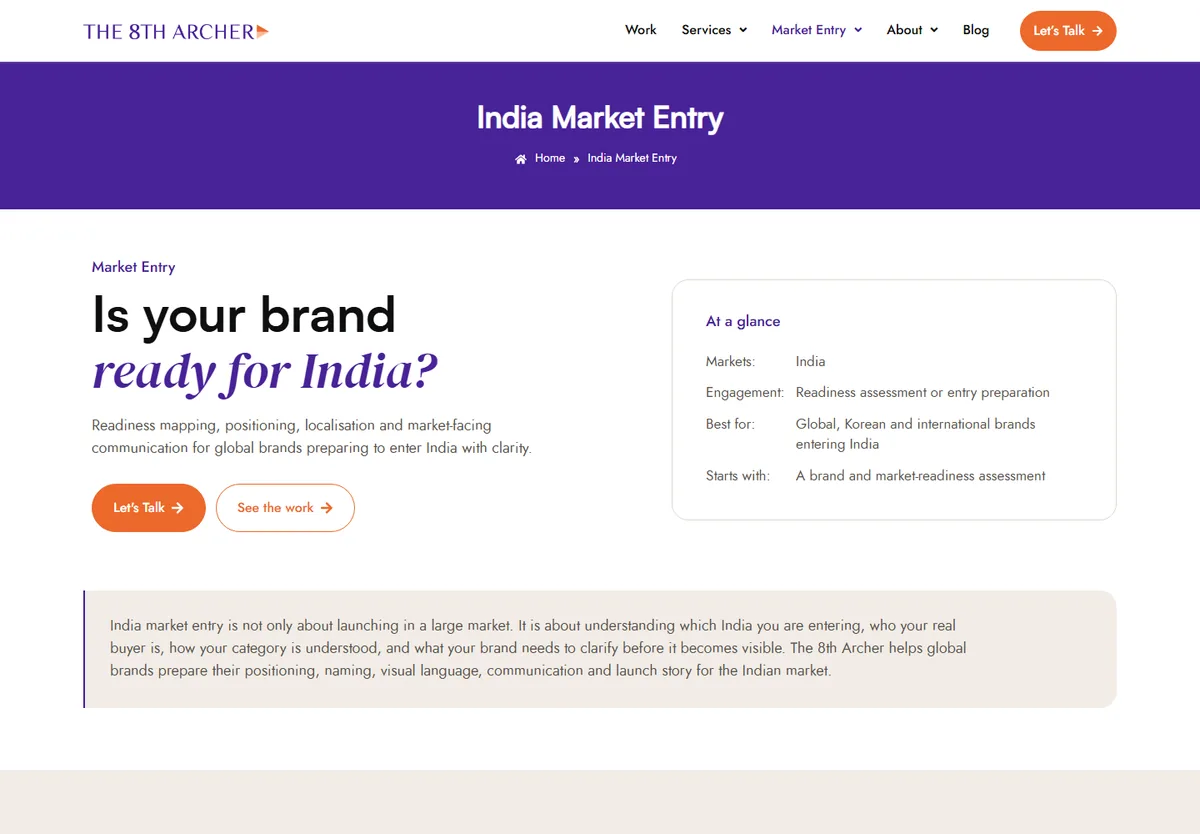
The international lead engine, all new: a Market readiness and entry hub as a top-level menu item, India market entry for global and Korean brands, USA, the Middle East and GCC, South Korea (built now, activated in phase two with Naver work) and Cross-cultural brand localisation.
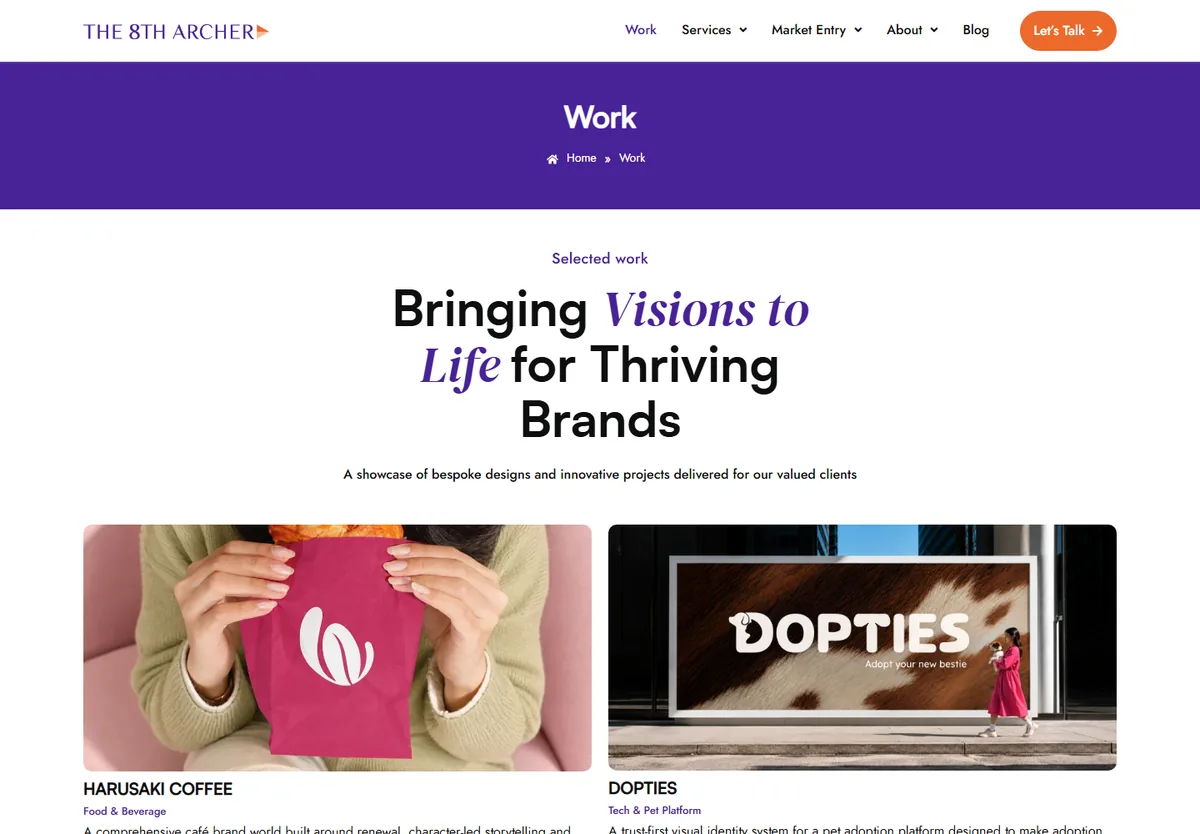
Every portfolio entry rebuilt from an image gallery into a case study with the brief, the thinking, the work and the outcome, filterable by service and market. Two Herschelle Saldanha pages merged, the ebook kept separate under its title, a new project (Dopties) added. Nine live, two in draft.
Of 17 posts, the client kept seven and dropped ten. Retained posts moved from /post/ to /blog/ with original publish dates and cover images, each linked into the service or market page it supports. Dropped posts redirect to the service page on the same topic, with the content kept as drafts in case Search Console later shows one earning real traffic.
Colour rules written for contrast, not taste: ink on white at 19.2:1, violet links at 10.7:1, ember as a fill only because it fails as text. DM Serif Display for accents, Satoshi and Jost for everything else. The client's designer reviewed templates at three gates and sent one consolidated feedback list per round.
The client approved the technical foundation being built from day one inside the build fee, rather than retrofitted across 44 pages under the retainer. That sequencing is the whole strategy. Everything in this table was live on 2 November 2026 and is verifiable with a browser.
| Layer | Wix, September 2026 | WordPress, 2 November 2026 |
|---|---|---|
| Canonical host | Three hosts indexed separately | One: https://the8tharcher.com, www and http redirect to it, SSL valid |
| Redirects | None needed yet; Behance link pointing at a dead page | 72 rules. 47 old URLs reach their page in one hop; 24 never-existent spam targets return 410 |
| Titles and descriptions | India-only title; 13 pages with no description; two posts byte-identical | 45 unique titles and descriptions seeded; Wix titles that had earned anything kept for continuity |
| Headings | Not controlled | Exactly one H1 on all 41 URLs, verified by crawl |
| Structured data | None | Organization with real social profiles, WebSite, WebPage, BreadcrumbList, BlogPosting via Rank Math |
| XML sitemap | Wix default | Posts and pages only, internal template types excluded, submitted to Search Console; the dead Korean sitemap removed |
| AI search (GEO) | Nothing | /llms.txt describing the studio, services and markets; GPTBot, ClaudeBot, PerplexityBot and Google-Extended allowed; answer-first templates |
| Fonts | Platform-served | Satoshi, Jost and DM Serif Display self-hosted; 0 requests to Google Fonts on all 41 pages |
| Images | Platform-managed | Originals protected from automatic recompression by a locked configuration; 5 to 14 MB client uploads resized before use |
| Security | Platform-managed | HSTS, X-Frame-Options, nosniff, Referrer-Policy; XML-RPC off; user enumeration blocked; login rate limiting; file editing disabled |
| Analytics | GA4 held by the previous vendor | GA4 installed with the owner's sessions excluded; Search Console sitemap submitted; GSC access from the previous vendor still being chased |
| Leads | Form emailed to a personal Gmail address | Form delivers to the studio's own mailbox with a clean subject and sender; enquiry source captured |
| QA at launch | Not measured | 41 pages at 390 px and 1440 px: 0 failed requests, 0 JS errors, 0 broken images, 0 failed fonts, 0 horizontal scroll |
Fifteen working days of build effort, spread across seven calendar weeks. The gap is content: the build sheet starts the clock from the day the advance and the content pack are both in, and the content arrived in stages.
The enquiry arrived via ChatGPT. I walked the founder through the SEMrush data, the backlink forensics and the GEO gap on the call itself, so she was looking at the methodology rather than a pitch about it.
Two parts, in order: a new website built in parallel with Wix, then an SEO and GEO engine aimed at India, the Middle East and the USA. Korea and Japan deliberately held back to phase two. Build fee priced separately from the retainer.
An 18-point design meeting settled the theme (Liko, Home 4, light), the purple, the accent typeface and the tagline. The client answered all 13 open decisions in one email and accepted every recommendation.
A developer onboarded with a self-contained handover pack: fourteen numbered documents, the 68-row redirect CSV, the 44-page build list with every title and H1, and starter child-theme code.
A crawl of staging found no SEO plugin, no meta tags, no H1 on inner pages, a hub page at the wrong slug and WooCommerce installed on a site with no shop. All P0 items fixed before the service and case study pages were built, when fixing them was cheap.
46 redirect rules imported and tested on 94 URLs. Six posts migrated with original dates and covers. 45 titles and descriptions seeded so nothing went live blank. The contact form, heading levels and animation sequence corrected against the client's feedback list.
Full database import, URL replace across 11,310 rows, Rank Math configured, llms.txt published, Google Fonts removed, the homepage gallery curve restored from a broken theme reference, demo content and the importer deleted.
The domain moved to the new nameservers. The cutover briefly served the old staging copy and reset the client's Google Workspace mail records; both were caught and corrected the same day (see the next section). Indexing was switched on, the sitemap submitted, GA4 and login protection installed.
Baseline, indexing checks, technical items from launch, AI-readability work and the content plan for India, the USA and the Gulf. Results are added to this page with dates.
The calendar ran long. The scope was 15 working days of build, and that is what the build took. The calendar ran from 14 September to 2 November because case study copy, founder bios and a brand-new project arrived in stages, and because a creative agency reviews design properly. I would make the same trade again, but I now write the content deadline into the schedule as a hard date, not a dependency.
The DNS cutover had a bad day. When the nameservers moved, Hostinger routed the domain to the old staging copy on my own account instead of the finished site on the client's account, and the new DNS zone came up with default mail records in place of the client's Google Workspace settings. Both were diagnosed from the live headers and fixed the same day. The lesson is already in my runbook: copy every mail record before touching nameservers, and confirm which site a host serves by hostname, not by IP.
Three pages are still drafts. Two case studies (Atelierr 289 and Madhav Agasti) and the Approach page wait on client content. Their old portfolio URLs redirect to the work index for now and will be pointed at the finished pages when they publish.
Search Console history is still with the previous vendor. I verified a new property and submitted the sitemap, so nothing is blocked, but the two-year history would have made the "which dropped posts earned traffic" check faster. If you are changing vendors, get Owner access to Search Console and Analytics before the old contract ends.
Most case studies show you the chart after it went up. This one records the starting line in public, dated, so the next update can be judged against it. Figures below are from the client's own Search Console and GA4, pulled on 7 November 2026.
Organic Clicks
53 Aug to Oct 2026, Wix (3 months)Impressions
646 Aug to Oct 2026, Wix (3 months)Queries Seen
34 Nearly all brand or client-project namesCommercial Rankings
0 No page in the top 100 for a buying queryToo early to mean anything, and published only so the next update has a starting point. Position 3.8 on brand queries is normal; the programme is measured on non-brand queries from three markets.
The pattern transfers to any business whose site looks good, says little, and is held back by its platform. It transfers best when the buyer researches before they call, which is every B2B service.
Closest fits:
Poor fits: a site that is already on WordPress with clean structure (fix the content, not the platform), and anyone who needs enquiries in the next 30 days. For that, paid ads are the faster lever and I will say so on the call.
Every migration that loses rankings lost them at the URL map, not the design. Crawl every live URL before you start, decide where each one goes, build the redirects on day one so every internal link already resolves, and test the map on staging and again on the live domain. Then, and only then, change DNS.
The obvious move was to redirect the 24 spam-link targets into the new services page and "harvest the equity". We returned 410 instead. Funnelling link-farm and escort-directory signals into a luxury studio's new site would have poured in exactly what the next three months are spent disavowing.
Keep every page visually led, and put the depth in structured sections lower down: a short answer block, an FAQ, a case study outcome. Language models read those blocks well, human visitors who want detail find them, and nothing gets bloated with filler. If you want GEO built into a redesign, it is the same page templates designed differently, not a second project.
Crawl, page map, redirect map, rebuild on a theme matched to your brand, migrate with zero downtime, hand over every login in your name.
Learn moreCanonical host, schema, sitemaps, headings, metadata, speed and security built into the templates rather than patched on later.
Learn morellms.txt, AI crawler access, answer-first content and monthly citation tracking across ChatGPT, Claude, Gemini and Perplexity.
Learn moreMarket-entry and service pages, plus articles structured to be quoted, written to the client's tone and reviewed before publishing.
Learn moreSee where your own site stands on the same checks used here: title, H1, schema, AI crawler access, llms.txt, HSTS and 25 more. No signup.
Learn moreWhen the timeline is 30 days, not six months: Google Ads and Meta Ads run end-to-end, as in the UAE furniture case study.
Learn moreSend me your current URL and what you want the site to do next. Within 24 hours I come back with a first read: whether the platform is the ceiling, what a redirect map would involve, and whether SEO, GEO or paid ads is the right first lever for your timeline.
Prefer WhatsApp?
Chat on WhatsAppReply within 24 hours. No bots, no sales deck.
If the agency needs to rank outside one city, control schema and crawl directives, add case studies without paying a developer, or be cited by AI assistants, yes. Wix is a reasonable product for a brochure site, but in this engagement it capped every technical lever the strategy depended on: no clean control of structured data, a Mumbai-only location setting while targeting three countries, three hosts indexed as separate sites, and paid add-ons for multilingual work. The client's own verdict on the strategy call was that staying on Wix was doing more harm than good.
This rebuild was scoped as 15 working days of build time for 44 pages, with three approval gates. The calendar ran longer, from the 14 September 2026 kickoff to go-live on 2 November 2026, because the content pack arrived in stages and the client's designer reviewed every template. Plan the build around content readiness, not the developer's availability. The technical migration itself, moving the finished site to the client's hosting and switching DNS, took under a day.
Not if every old URL is mapped before DNS changes. All 47 live Wix URLs were crawled on 10 September 2026 and each one was redirected to its new page in a single hop, tested on staging before the switch and again on the live domain. The old Wix titles that had earned any ranking were kept on their new pages for continuity. Twenty-four addresses that never existed but carried spam links were given a 410 Gone response on purpose, so none of that link profile followed the brand to the new site.
The tracker followed 49 keywords; after two years only the brand name and the studio's own tagline ranked in the top ten. Seventy-two of the 75 directory links built in the final three weeks pointed at addresses that returned a 404, and the directories included link farms and an escort directory. Korean rankings were measured on Google Korea, which most Koreans do not use. No new page was created in two years. The lesson built into this engagement: foundation first, then content, then a small number of earned links.
Four things, all shipped at launch: an llms.txt file that describes the studio, its services and its market-entry pages in plain language; AI crawlers such as GPTBot, ClaudeBot and PerplexityBot explicitly allowed in robots.txt; Organization, WebPage and BreadcrumbList schema on every page through Rank Math; and page templates with an answer-first opening and short question-and-answer blocks that language models can quote. The enquiry that started this project came through ChatGPT, so this was not optional.
A single canonical host with the www and http variants redirecting to it, 72 redirect rules covering every old URL, one H1 and a unique title and meta description on all 41 launched URLs, an XML sitemap submitted to Search Console, self-hosted fonts with zero requests to Google Fonts, LiteSpeed caching with the original images protected from automatic recompression, security headers including HSTS, XML-RPC disabled, login rate limiting, and GA4 installed with the owner's traffic excluded.
The SEO and GEO retainer starts on 9 November 2026. Month one covers the Search Console and Analytics baseline, indexing and redirect monitoring, fixing anything launch surfaced, and a content plan for the priority markets: India, the USA and the Gulf. The Wix-era baseline is already recorded on this page: 53 organic clicks in the three months before launch, almost all for the brand name. This page is updated with dated results as the programme runs.
The build is quoted as a fixed fee scoped to the page count and templates, and the SEO and GEO programme as a monthly retainer with a minimum term, so the two are priced separately and the site is never held hostage to the retainer. Client fees are confidential and not published. Book a call with your current URL list and I will come back with a scoped quote and a redirect map estimate.
Have a different question? Send me a message or use the form above.