How To Build Backlinks That Get You Cited By ChatGPT And Perplexity
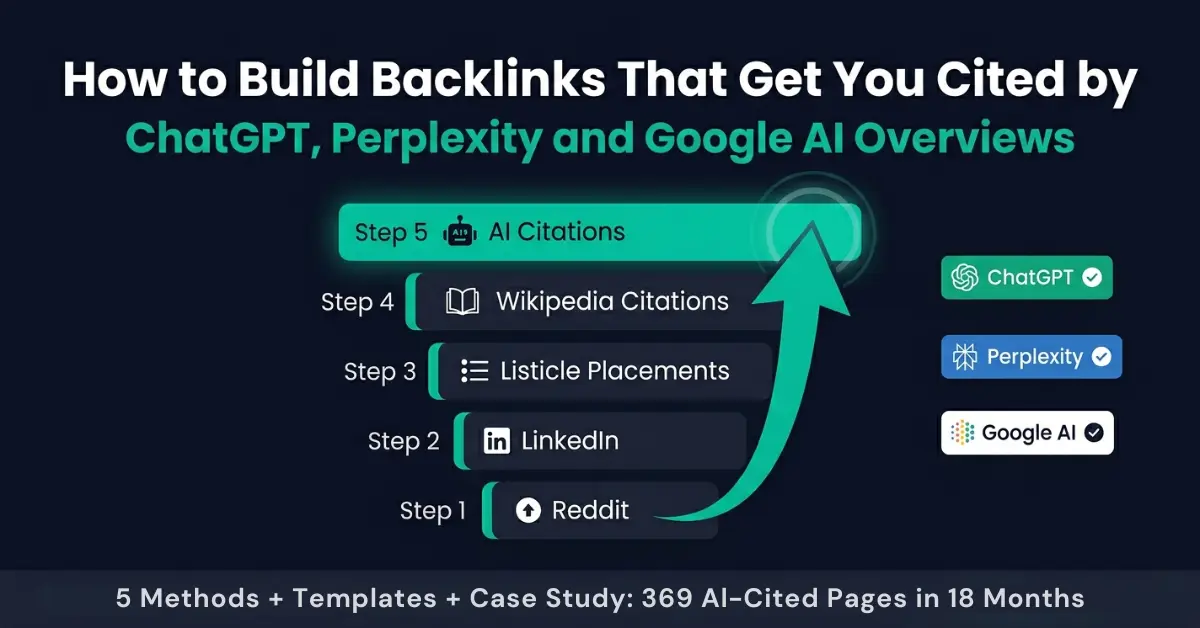
Traditional backlinks improve your position in Google’s ranked list of results. LLM backlinks determine whether your brand gets mentioned when someone asks ChatGPT, Perplexity, or Google AI Mode a question you should be answering. Read more about how AI Mode changed organic visibility
These two outcomes require different strategies, different platforms, and different content formats. A site with 500 high-DA backlinks and zero Reddit presence, zero LinkedIn content, and zero review platform listings will rank well in Google and be nearly invisible in AI responses. A site with 50 targeted platform presences and well-structured content can earn consistent AI citations with a domain authority of 30.
This guide gives you the 5 proven methods for building the backlinks and platform presences that earn LLM citations. Each method includes the exact structure that works, a copy-paste outreach template, and the specific result to expect and when. At the end, a verified case study shows what these methods produce on a real campaign over 18 months.
What This Guide Covers
Key Takeaways
-
80% of LLM citations come from pages that do not rank in Google’s top 100 for the original query, according to Ahrefs research from August 2025. LLM visibility and Google visibility are parallel goals that require separate but overlapping strategies.
-
Reddit is the most cited domain across all five major AI platforms. A Reddit answer that earns 50 or more upvotes in a relevant thread has a higher probability of AI citation than a blog post ranking at position 5 in Google for the same topic.
-
LinkedIn’s citation frequency in ChatGPT doubled between November 2025 and February 2026 according to Profound research. Authors who published more than five times per week in the four weeks before a citation appeared account for 75% of cited LinkedIn posts per Semrush data.
-
Listicle content earns 21.9% of all AI citations, the highest rate of any content format, according to Wix research from March 2026. Getting listed in existing listicle content on high-authority platforms is faster than building new content from scratch.
-
Perplexity shows citation improvements within days of publishing because it searches the live web on every query. Google AI Overviews typically show new citations within 2 to 4 weeks. Training-data-based citation requires content to be live and well-cited before the next model training cycle.
Why LLM Link Building Is Different From Traditional SEO
Traditional SEO link building works on a single principle: domain authority transfers through links. A link from a high-DA site tells Google that your site is trustworthy enough to be endorsed by an authority. Google’s algorithm weights this endorsement and lifts your search rankings. Links from relevant sites carry more weight than those from unrelated sites, which is why high quality backlinks matter more than sheer volume. The quality of the linking domain is the primary variable. The anchor text, the placement context, and the relevance of the linking page are secondary variables. Links from irrelevant sites can hurt your SEO rankings, and buying backlinks can trigger Google penalties.
LLM citation operates on three principles that are entirely separate from domain authority transfer. The first is retrieval index presence: your content must be accessible to the AI platform’s specific retrieval system. ChatGPT uses Bing’s index. Perplexity uses its own real-time crawler. Google AI Mode uses Google’s index. Claude draws from training data. Being indexed in Google tells you nothing about your visibility in ChatGPT’s retrieval step.
The second principle is platform authority recognition: AI systems learned during training to treat specific platforms as reliable sources for specific query types. Reddit is recognized as reliable for community and experiential questions. LinkedIn is recognized as reliable for professional expertise claims. Wikipedia is recognized as reliable for factual and definitional queries. A well-reasoned post on Reddit can earn a ChatGPT citation that a high-DA backlink to your site cannot produce, because the platform recognition signal is separate from your site’s authority.
The third principle is content extractability: the passage within your content that directly answers the query must be structured so it can be retrieved and quoted independently of the surrounding content. Retrieval-Augmented Generation systems pull individual paragraphs, not full articles. A paragraph that starts with a direct answer and contains a named statistic is more likely to be retrieved and cited than a paragraph that arrives at its point after two sentences of context.
These three principles together mean that LLM link building is not a replacement for traditional link building. It is a parallel track that requires platform presence, content structure, retrieval index management, and a healthy backlink profile in addition to, not instead of, the domain authority signals traditional SEO builds. Traditional visibility on search engine results pages still correlates with quality backlinks at scale: 96% of top-ranking websites have over 1,000 backlinks from unique domains.
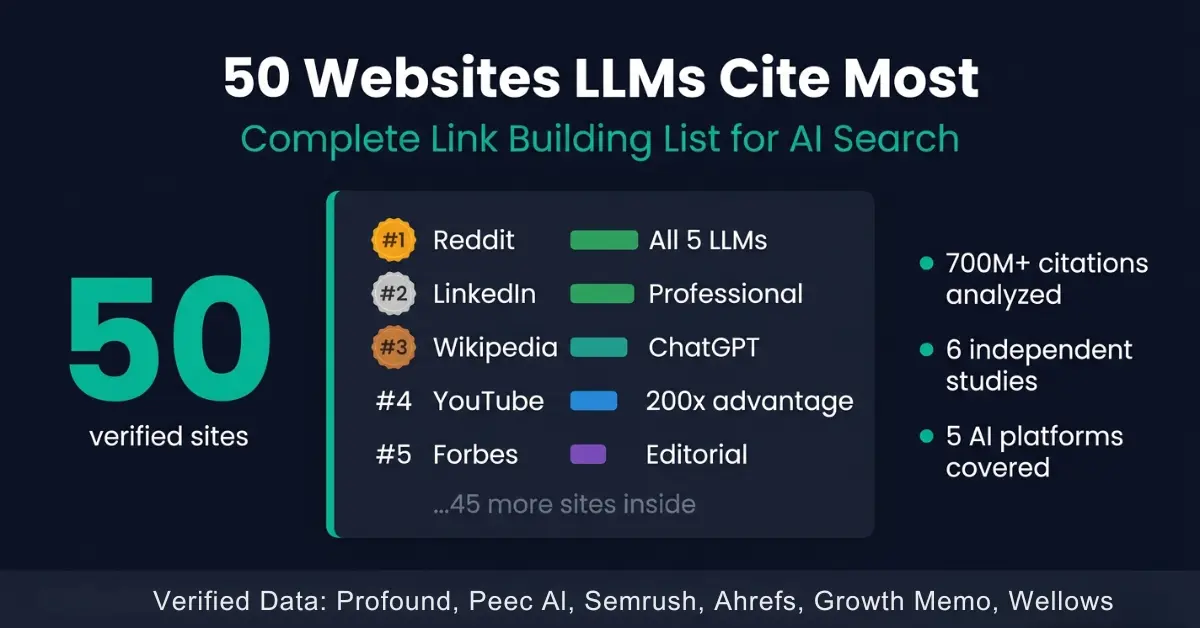
For the full context of how AI retrieval systems select sources and what the 50 highest-cited platforms are, the companion article 50 websites LLMs cite most covers the complete citation database with per-platform data from six independent research studies covering over 700 million citations.
4 The 3 Prerequisites Before Any High Quality Backlinks Link Building Starts
Building platform presence before your content is citation-ready is the most common reason LLM link building campaigns fail to produce measurable results. Platform presence sends traffic and signals to your content. If that content cannot be extracted at the passage level, the traffic disappears without producing citations. These three prerequisites ensure your content is ready to convert platform signals into AI citations before you invest time in any of the five methods below.
Prerequisite 1: Submit Your Site to Bing Webmaster Tools
ChatGPT’s real-time retrieval uses Bing’s index, not Google’s. If your site is not submitted to Bing Webmaster Tools, ChatGPT cannot find your content in its retrieval step regardless of your Google rankings or your Reddit presence. This is the most commonly missed technical requirement in AI visibility strategies built by SEOs who have worked exclusively in Google’s ecosystem.
Go to bing.com/webmasters, connect your Microsoft account, and add your site. Submit your sitemap. Bing will typically index your submitted content within 48 to 72 hours. Verify Bing indexing by searching site:yourdomain.com in Bing directly. This step takes 15 minutes and unlocks ChatGPT citation eligibility for your entire content library.
Prerequisite 2: Restructure Your Content for Passage-Level Extraction
Every page you plan to drive AI citation traffic to needs to pass the passage-level extractability test before any link building starts. The test is simple: read the first sentence of every H2 section on the page. If that first sentence states the direct answer to the question implied by the heading, the passage is extractable. If the first sentence provides context, background, or setup before reaching the answer, it is not extractable and will not be cited even when AI retrieval systems retrieve the page.
According to Growth Memo research from February 2026 covering 1.2 million verified ChatGPT citations, 44.2% of all LLM citations come from content in the first 30% of a page. Restructuring the opening sections of your target pages to lead with direct answers is the single highest-impact content change for citation frequency improvement. The complete restructuring process with before-and-after examples is covered in the .
Prerequisite 3: Confirm FAQPage Schema on All Target Pages
FAQPage JSON-LD schema is the most direct technical signal you can give AI systems that a specific passage is intended to answer a specific question. Before building any external platform presence, validate that your top 5 target pages have FAQPage schema implemented and passing Google’s Rich Results Test with zero errors. Schema errors that look minor in a Rich Results report can completely prevent the schema from being read by AI systems. Fix every error before starting external link building.
Method 1: Reddit Strategy
Reddit is the most cited domain across all five major AI platforms according to Peec AI analysis of 30 million citations published in March 2026. Perplexity cites Reddit in approximately 46.7% of responses where community perspectives are relevant. ChatGPT cited Reddit in close to 60% of prompt responses before the September 2025 citation shift, and it remains the most cited social platform in ChatGPT’s outputs today. Google AI Mode consistently cited LinkedIn and Reddit as its top two social platform sources throughout the Semrush 13-week study.
Why Reddit Gets Cited
Reddit’s upvote and award system creates a quality filter that AI systems learned to respect during training. A highly upvoted answer to a specific question is a community-validated signal that the answer is correct, useful, and trustworthy. When Perplexity or ChatGPT retrieves Reddit content for a query, it is not just retrieving text. It is retrieving text that humans have collectively verified as valuable. That community verification signal is a form of authority that no domain authority metric captures.
The Citation-Generating Reddit Approach
The Reddit approach that consistently earns AI citations follows a five-step process that prioritizes community value over promotional intent. Any deviation toward promotional intent, particularly in the early stages of building a Reddit presence, will generate downvotes and community flags that actively suppress citation probability.
Step 1: Account karma building (weeks 1 to 2). Create a Reddit account if you do not have one. Spend the first two weeks contributing short, useful comments to 10 to 15 existing threads per week in your target subreddits. Do not post original content yet. Do not include links. The goal is to build comment karma and establish a posting history that shows you are a genuine community participant. Early participation should focus on building genuine connections before asking for any mention from other websites. Accounts with low karma or new accounts that immediately post long-form promotional content are flagged by moderators and downvoted by the community.
Step 2: Subreddit selection. For digital marketing and SEO topics, the primary subreddits are r/SEO (500,000+ members), r/digital_marketing (200,000+ members), r/PPC, r/bigseo, r/analytics, r/content_marketing, and r/juststart. Identify the 5 to 7 subreddits most relevant to your niche by searching Reddit for your primary service keywords and noting which subreddits appear in the top results.
Step 3: Question identification. Search each target subreddit for questions that have 10,000 or more views, were posted in the last 6 months, and have no comprehensive answer in the top comments. These are your citation opportunities. A question with high views and weak answers is the ideal target because your comprehensive answer will immediately become the highest-quality response in the thread, maximizing upvote probability.
Step 4: Answer structure. Write answers that follow the same structure as a well-optimized FAQ response: direct answer in the first sentence, supporting evidence in sentences two and three, specific example or application in sentences four and five. Total length: 200 to 400 words. Do not pad the answer. A concise, direct answer earns more upvotes than a comprehensive essay because Reddit’s community rewards answers that respect the reader’s time. Offering genuinely valuable content also improves the odds of earning links later from users who reference useful answers. If moderator rules permit outbound links, include a reference to your site as a further reading resource in the final paragraph only, after the answer is complete.
Step 5: Consistency cadence. Post one comprehensive answer per week in each of your top 3 subreddits. Over 60 days, this produces 24 high-quality answers across your target communities. The compounding effect of answers that earn upvotes over time is that later answers benefit from the reputation signals your earlier answers built.
Expected Timeline
Perplexity citations from Reddit content typically appear within 1 to 2 weeks of a well-upvoted answer being posted, because Perplexity searches the live web on every query. ChatGPT citations appear within 2 to 4 weeks as Bing’s crawler indexes the thread. Google AI Mode citations from Reddit content typically appear within 3 to 6 weeks. The 60-day consistent cadence described above produces measurable citation frequency improvement that compounds for months after the initial posts.
Method 2: LinkedIn Content Authority
LinkedIn’s citation frequency in ChatGPT doubled between November 2025 and February 2026, moving from domain rank number 11 to number 5 in Profound’s tracking of 1.4 million citations. Profound described it as the largest shift in citation authority it observed during that period. For professional service queries specifically, LinkedIn is the number one cited domain across ChatGPT, Google AI Mode, Google AI Overviews, Microsoft Copilot, and Perplexity.
Why LinkedIn Gets Cited
LinkedIn content carries professional credibility signals that AI systems learned to weight for business and professional queries. A post written by someone with verifiable credentials in a relevant field, published on a platform where professional identity is authenticated, matches the E-E-A-T pattern that AI retrieval systems learned to associate with reliable professional information. Posts and long-form articles together account for approximately 35% of all LinkedIn citations in ChatGPT responses according to Profound, up from 27% at the beginning of the study period.
The Citation-Generating LinkedIn Approach
Publishing frequency: The Semrush data is specific about this. Approximately 75% of cited LinkedIn post authors published more than five times per week in the four weeks before the citation appeared. Occasional viral posts do not produce sustainable citation presence. Consistent daily publishing does. This means LinkedIn citation building requires treating LinkedIn as a publishing platform, not a distribution channel for your blog posts.
Post structure for citations: Every LinkedIn post that is designed for AI citation should follow this structure. Line 1: A direct, specific answer to a professional question in your niche. Lines 2 to 4: Supporting evidence with one named statistic and its source. Lines 5 to 8: A specific application or example that makes the answer actionable. Line 9 to 10: A direct question to your audience that invites comments. Do not include the link to your website in the post body. Post it as the first comment immediately after publishing.
Long-form articles: LinkedIn’s long-form article feature (formerly Pulse) creates persistent LinkedIn URLs that AI retrieval systems index independently of your main site. A 1,000 to 2,000-word LinkedIn article on a specific professional topic creates a citation source that ChatGPT and Google AI Mode can retrieve even when your main domain is not in their results. Publish one long-form article per month on your most important topic cluster.
Company page versus personal profile: Perplexity cites LinkedIn Company Pages in 59% of its LinkedIn citations. ChatGPT and Google AI Mode each cite individual profiles in 59% of their LinkedIn citations. A complete strategy requires both. The company page functions as a content hub for service-level topics. The personal profile functions as a thought leadership channel for practitioner expertise. If you can only maintain one, maintain the personal profile because it serves ChatGPT and Google AI Mode, which have broader reach for professional service queries. Strong LinkedIn networking also helps you connect with website owners and publishers, which can lead to natural backlinks.
Comment engagement: The LinkedIn algorithm measures comment velocity in the first 60 to 90 minutes after publishing as the primary distribution signal. Responding to every comment within 30 minutes of publishing restarts the distribution window and significantly expands post reach. Regular interaction with industry peers on social media before asking for anything improves later link acquisition success with other website owners. This engagement loop is also an AI citation amplifier: posts with high comment counts appear more prominently in Bing’s social content index, which improves ChatGPT citation probability. Over time, these conversations make outreach to site owners more effective because personalized outreach gets better response rates once a real relationship already exists.
Expected Timeline
LinkedIn content indexed in Bing appears in ChatGPT citation outputs within 1 to 3 weeks of publication. Google AI Mode citations from LinkedIn content appear within 1 to 2 weeks. Perplexity citations from LinkedIn appear within days because of its real-time crawling. The compounding effect of consistent publishing means citation frequency increases significantly after 60 days of the 5-posts-per-week cadence.
Method 3: Listicle and Round-Up Placements
Listicle content earns 21.9% of all AI citations, the highest rate of any content format according to Wix research from March 2026 analyzing AI Mode, ChatGPT, and Perplexity. Getting your brand, service, or content listed in existing high-authority listicle content is faster than building new listicles from scratch because you inherit the platform authority and citation history of pages that are already being retrieved by AI systems.
Why Listicles Get Cited
Listicle content maps directly onto how AI systems generate responses. When a user asks “what are the best digital marketing consultants,” the AI retrieval system looks for content that contains a list of answers to that exact query type. A listicle that includes your name, a brief description of your services, and a link to your site is a direct match for that retrieval pattern. The AI system can extract individual list items as citations, making each entry in a well-trafficked listicle a potential citation source.
The Citation-Generating Listicle Placement Approach
Step 1: Identify existing listicles in your niche. Search your target queries in ChatGPT, Perplexity, and Google AI Mode. Note which listicle pages appear in the citations. These are the pages already being retrieved for your target queries. Getting listed on these pages is more valuable than creating a new listicle because the citation history of these pages is already established in AI retrieval systems.
Step 2: Review platform and directory listings. G2, Clutch, Capterra, and similar directories function as permanent listicle sources that AI systems retrieve for service recommendation queries. For local SEO visibility, claim and fully complete your Google Business Profile, and keep your details consistent across review sites. A G2 profile for your consulting services with 5 or more verified reviews will appear in Perplexity citations for queries like “best SEO consultants” and “top digital marketing agencies” within weeks of profile completion.
Step 3: Guest post placement on listicle publishers. Publications like Search Engine Journal, Moz, and Marketing Week regularly publish “best tools,” “top consultants,” and “expert roundup” articles. Contributing a guest post that includes a natural mention of your services or a quote that positions you as an expert creates a citation source on a platform already being retrieved for your target queries. Treat backlink acquisition as a value exchange, so pitch strong guest post ideas and useful insights to relevant websites instead of just asking for coverage. The pitch approach for these publications is covered in the outreach templates section below.
Step 4: Expert roundup participation. Many SEO and marketing publications publish annual or quarterly roundup articles that quote practitioners on specific topics. Responding to journalist queries on platforms like HARO (Help a Reporter Out), Qwoted, and SourceBottle creates expert citations in publications that AI systems treat as authoritative sources. Sign up for these media request platforms to create recurring backlink opportunities from relevant sites. A single well-placed expert quote in a Search Engine Journal roundup or a Semrush research report creates citation exposure across all major AI platforms. Use the same standards you would for guest posting or guest blog posts by prioritizing reputable, relevant websites over easy placements.
Expected Timeline
G2 and Clutch profile citations appear within 2 to 4 weeks of a complete profile being published, because these platforms are actively crawled by Perplexity and indexed in Bing. Guest post citations on established SEO publications appear within 1 to 3 weeks. Expert roundup citations have variable timelines depending on when the publication article gets re-indexed by AI systems, typically 2 to 6 weeks after publication.
Method 4: Wikipedia Citations
Wikipedia is ChatGPT’s most cited individual domain at 7.8% of total citations according to Profound research covering 680 million citations. It appears consistently in Claude and Gemini citations for definitional and background queries. Wikipedia is not directly accessible for standard link building, but earning Wikipedia citations through an indirect path is achievable for established practitioners and produces long-term citation value that compounds across model training generations.
Why Wikipedia Gets Cited
Wikipedia was a foundational dataset in training nearly every major LLM. The model’s internal representation of factual knowledge is substantially grounded in Wikipedia’s structure, citation conventions, and editorial standards. When a RAG system retrieves Wikipedia content, the model already has strong internal alignment with that content from training, making Wikipedia citations the most durable citation source available. Unlike platform presences that can change citation frequency based on algorithm shifts, Wikipedia’s role in LLM training data is deeply embedded across model generations.
The Two-Path Wikipedia Strategy
Path 1: Become a cited source for Wikipedia. Wikipedia editors actively search for reliable third-party sources to support claims in existing articles. When you publish original research data, verified case study results, or industry statistics that are not already represented in Wikipedia, your content becomes a potential Wikipedia citation. Original research studies often attract numerous backlinks from sites citing the data. The process is: identify Wikipedia articles in your niche that cite outdated statistics, publish updated data on your own site with full methodology disclosure, and note the Wikipedia article for future reference. Publishing high-value quality content increases the chances that other sites will cite and link back to your web pages. Wikipedia editors and community members may discover and cite your data independently. You can also suggest additions on article talk pages when your data genuinely improves the accuracy of the article.
Path 2: Build the prerequisites for Wikipedia entity creation. A Wikipedia article about your brand or personal entity is the highest-value Wikipedia citation for LLM visibility because it creates a knowledge graph node that AI systems reference when generating any response about your brand. Wikipedia’s notability guidelines require verifiable third-party coverage in reliable sources before a new article can be created. This means the prerequisite for a Wikipedia entity is: coverage in publications like Forbes, TechCrunch, Wired, Business Insider, or similar outlets that Wikipedia’s community recognizes as reliable sources. Methods 1 through 3 above build this prerequisite systematically.
Expected Timeline
Wikipedia citations are a 6 to 18-month strategy. Publishing citable original research and getting noticed by Wikipedia editors is not a fast process. The long-term value justifies the timeline: a Wikipedia citation creates training data exposure that persists for years, improving your LLM citation frequency across every major platform with each new model training cycle.
Method 5: Quora Authority Answers
Quora is one of the top cited domains in Google AI Overviews according to Semrush research. The question-and-answer structure maps directly onto how AI systems extract content for answer generation. A well-structured Quora answer that begins with a direct, sourced response to a specific professional question is in the format that Google AI Overviews most readily extracts for citation.
Why Quora Gets Cited
Google AI Overviews favor Quora because it complements Google’s People Also Ask feature set. Both serve the same user intent: getting a direct answer to a specific question. When a user asks a question in Google that triggers an AI Overview, the AI system searches for content that answers that exact question in a clear, extractable format. Quora’s question-answer structure is the closest natural language match to that retrieval pattern. Additionally, Quora’s upvote system provides a quality signal that AI systems learned to respect, similar to Reddit’s upvote mechanism.
The Citation-Generating Quora Approach
Question selection: Search Quora for questions in your niche with the highest view counts (100,000 or more views where possible) that have weak or outdated top answers. High-view questions with poor answers are the highest citation opportunity because your comprehensive answer will immediately become the most useful response available, maximizing upvote probability and citation extraction likelihood.
Answer structure template:
-
Sentence 1: Direct answer to the question. No context. No preamble. The answer.
-
Sentences 2 to 3: The most important supporting reason or evidence.
-
Sentence 4: One named statistic with its source in parentheses.
-
Paragraph 2: A specific example or application that makes the answer concrete.
-
Paragraph 3: A secondary consideration or important caveat.
-
Final line: A contextual reference to your site as further reading (where platform rules allow).
Length requirement: 300 to 500 words. Quora answers longer than 800 words tend to lose engagement because the community values conciseness. The goal is the best concise answer on the page, not the most comprehensive resource on the internet. The AI extraction optimization and the Quora community optimization are the same: direct, specific, sourced, complete within 500 words.
Publishing cadence: Two Quora answers per week in your target question categories. Over 60 days this produces 24 high-quality answers across your niche. Quora answers accumulate upvotes and views over time, meaning answers published in month one continue earning citation exposure in month six and beyond.
Expected Timeline
Google AI Overviews citations from Quora answers typically appear within 2 to 4 weeks of a well-upvoted answer being published. Perplexity citations from Quora content appear within days. The compounding effect of consistent Quora publishing means citation frequency increases significantly after the first 30 days as early answers begin accumulating upvotes and view counts.
The Link Building and GEO Audit Process
Running a link building and GEO audit before starting any of the five methods above confirms which citations are already in place, which gaps have the highest opportunity value, and which content pages are not citation-ready. This audit prevents the common failure mode of building platform presence that drives traffic to content that cannot be extracted, resulting in platform signals that produce visits but not citations.
Step 1: AI Citation Audit (30 minutes)
Open ChatGPT, Perplexity, and Google AI Mode. Search your top 5 service keywords in each platform. For each result, document: which sources are cited, whether your brand or site appears, and which competitors are being cited. This gives you a baseline citation map that shows where you have presence and where you have gaps, helps reverse-engineer competitors’ backlinks to find high-potential targets, and highlights same sites worth pitching with stronger content.
Step 2: Brand Name Search Audit (15 minutes)
Search your brand name in each AI platform. Note whether the platform produces accurate information about your services, whether it cites any sources that mention your brand, and whether it confuses you with another entity. Platforms that produce nothing are citation gaps. Use Google Alerts to track new brand mentions across the web. Monitoring unlinked mentions creates opportunities to turn those brand mentions into backlinks through outreach. Platforms that produce inaccurate information require entity correction before link building can produce positive results.
Step 3: Content Extractability Audit (45 minutes)
Run each of your top 10 blog posts and service pages through the four-point citation readiness checklist:
-
Does the first paragraph answer the primary query without preamble? (Yes/No)
-
Does at least one H2 section use a question format or direct declarative statement? (Yes/No)
-
Does every major section contain at least one named statistic with a source? (Yes/No)
-
Does the page have a FAQ section with FAQPage schema markup? (Yes/No)
Pages scoring 4 out of 4 are citation-ready and should be prioritized for platform link building. Pages scoring below 3 need content restructuring before platform building will produce citations. Fix the content before building the links.
Step 4: Bing Indexing Verification (15 minutes)
Search site:yourdomain.com in Bing. Confirm your top 10 pages appear in Bing’s index. Pages not appearing in Bing are invisible to ChatGPT’s real-time retrieval regardless of their Google rankings. Submit any missing pages through Bing Webmaster Tools.
Step 5: Priority Matrix
Cross-reference your citation audit gaps (Step 1) with your content readiness scores (Step 3). The pages that are both citation-ready and not currently appearing in AI results for their target queries are your highest-priority link building targets. Prioritize pages attracting the most links, including homepage links, and compare their backlinks with unique linking domains before expanding to lower-priority pages. Use competitor analysis tools to find sites linking to similar businesses when prioritizing outreach targets.
Platform-Specific Outreach Templates
These templates are structured around the specific content formats that produce citations on each platform. Use them as starting frameworks and customize the specific details for your niche, credentials, and target query.
The direct answer to [specific question] is [answer].

[Supporting evidence in 1 to 2 sentences. Include a specific
number or named example.]

Here is how this works in practice: [specific example from
your client experience or your own campaign. Real details.
No vague generalities.]

The one thing most people miss about this is [specific insight
that the existing answers in this thread have not covered].

[Optional if rules permit]: I covered this in more detail here
for anyone who wants the full process: [URL]
LinkedIn Post Template (Citation-Optimized)
[Direct answer to a specific professional question in one line.]

Here is what the data shows:

[Specific statistic from a named source.]

[2 to 3 lines explaining what this means in practice.]

The three things that actually drive results here:

1. [Specific, actionable point]
2. [Specific, actionable point]
3. [Specific, actionable point]

[One sentence connecting this to your direct experience.]

[Direct question to your audience that invites a response.]

Link in comments: [your article or resource]
Quora Answer Template
[Question asked]: [paste the Quora question here]

[Direct answer in one sentence. No setup. No context.]

[Supporting evidence in 2 to 3 sentences. Include one named
statistic with a source in parentheses.]

Here is a concrete example of how this works:

[Specific example from your direct experience. Real numbers
where available. Named outcome.]

One important caveat: [relevant limitation or condition that
makes the answer more accurate and trustworthy.]

[If rules permit]: Full step-by-step guide here for anyone
wanting the complete process: [URL]
11.3 Guest Posting Pitch Template (for SEJ, Moz, Search Engine Journal)
Subject: Guest Contribution Pitch: [Specific article title]
Target placements on sites with at least DA 35 and roughly 1,000 monthly visitors so your backlink strategy supports how to build backlinks with stronger prospects.
Hi [Editor name],
I am [your name], a [specific credential and years of experience]. I have been published on [2 to 3 relevant publications if applicable].
I am pitching an article titled:
“[Specific article title that includes a primary keyword]“
This article covers [specific problem it solves] for [specific audience]. It includes [specific data, examples, or original research that makes it unique]. It is not covered by any existing [publication name] post based on a search of your archive for [relevant keywords], which helps position it within a broader link building strategy.
Outline:
-
[Specific section heading]
-
[Specific section heading]
-
[Specific section heading]
The article will be approximately [word count] words with [number] original data points from [named source].
I have attached [two to three published writing samples] to demonstrate my editorial style.
Would this fit your editorial calendar?
[Your name] [Your title] [Your URL] [LinkedIn profile]
If you use this with a link building agency or for your own outreach, keep guest posting selective, since overusing it can create spammy backlinks.
HARO and Journalist Query Response Template
[Journalist query]: [paste the specific question they asked]

My credentials: [one sentence establishing why you are qualified
to answer this specific question. Years of experience, specific
relevant result, named client category.]

Answer: [Direct, quotable response in 2 to 3 sentences.
Specific enough to be quoted without editing. Include one
statistic with a named source if relevant.]

Supporting context: [1 to 2 sentences of additional context
that makes the quote more useful in the article.]

Available for follow-up: [phone number or email for verification]

Embargo: I am happy to provide embargoed information if needed.
How to Track Whether It Is Working
LLM citation tracking requires a different measurement approach than traditional rank tracking because there is no equivalent of a SERP position for AI citations. A brand can have high citation frequency in Perplexity and zero presence in ChatGPT, or vice versa, making a single-platform measurement misleading. The tracking approach below covers all three budget levels.
Free Tracking Method (0 cost, 30 minutes per week)
Manual AI platform testing is the baseline tracking method. Once per week, search your top 5 service keywords in ChatGPT, Perplexity, and Google AI Mode. Document whether your brand or site appears in any citation. Note which competitors are cited. Track this in a simple spreadsheet with columns for date, platform, query, your citation status, and the competitor cited instead. After 60 days, you will have a clear picture of which queries are producing citations, which platforms are responding to your efforts, and which queries still have no citation presence.
Additionally, monitor Google Search Console Discover performance. If your content is being retrieved by Google AI Mode as part of the answer generation process even when not directly cited, GSC Discover impressions for target queries will increase. A growing Discover impressions trend for a page confirms that AI Mode is retrieving and evaluating that content.
Intermediate Tracking Method (Perplexity Pro, $20/month)
Perplexity Pro’s Deep Research mode allows you to run systematic competitor and brand citation audits across Perplexity’s citation database. Searching your brand name and your primary service keywords in Perplexity Pro weekly, with note-taking on what sources appear, gives you a real-time citation tracking system for the platform that responds fastest to link building efforts.
Advanced Tracking Method (Paid AI visibility platforms)
Platforms including Semrush’s AI Visibility Toolkit, Profound, and Otterly.ai provide automated citation tracking across all major AI platforms. These tools monitor brand mentions and citations in AI-generated responses, identify visibility gaps, and track citation frequency trends over time. For agencies managing multiple client AI visibility campaigns or for businesses where AI citation visibility has significant revenue impact, the investment in automated tracking is justified by the time savings and the systematic coverage that manual testing cannot provide.
The Right Success Metric
The correct metric for LLM citation building is not citation count. It is citation rate for target queries: the percentage of the time your brand or content appears when someone searches your primary service queries in your target AI platforms. A citation rate of zero moving to 20% for a specific query cluster in 60 days is a meaningful result. Tracking citation counts without normalizing for query frequency produces misleading growth curves. Measure the rate, not the count.
Case Study: 369 AI-Cited Pages in 18 Months
The results described in this section come from an 18-month SEO and AI visibility campaign for Indigo Software, a B2B software company operating in the US market. The campaign ran from early 2024 through late 2025. Every figure cited is from verified Google Search Console and AI visibility tracking data.
Starting Conditions
At the start of the campaign, Indigo Software had zero confirmed AI citations across ChatGPT, Perplexity, and Google AI Overviews. Their content was not structured for passage-level extraction. Their LinkedIn presence was inactive. They had no Reddit presence in relevant technical subreddits. Their G2 profile existed but had zero reviews. Their site was indexed in Google but not verified in Bing Webmaster Tools.
The 18-Month Implementation
The campaign applied the same five methods described in this article in a sequenced approach. Months 1 and 2 focused entirely on the three prerequisites: Bing Webmaster Tools submission, content restructuring for passage-level extraction across the 20 highest-traffic pages, and FAQPage schema implementation and validation. No external link building started until these three prerequisites were confirmed.
Months 3 through 6 implemented Methods 1, 2, and 5 simultaneously: Reddit presence building in relevant technical subreddits, LinkedIn daily posting with weekly long-form articles, and Quora answer publishing for the primary service questions. This was the phase that produced the first measurable AI citations, appearing in Perplexity within 3 weeks of the Reddit and Quora work beginning.
Months 7 through 12 added Methods 3 and 4: G2 and Clutch profile completion with verified reviews, expert roundup participation through HARO responses, plus digital PR for journalist mentions because the most effective tactics for acquiring links were link-worthy assets and media coverage, and the early stages of the Wikipedia citation path by publishing original research data.
Months 13 through 18 focused on scaling what was working and securing placements on the Tier 3 publications identified in the 50-site LLM citation list. This phase included guest post placements on Moz and Search Engine Journal, expert quotes in three Semrush research publications, broken link building as an added way of building links, and outreach around any broken link found on relevant pages by replacing dead links with useful content.
Results at 18 Months
| Metric | Start of Campaign | End of Month 18 | Change |
|---|---|---|---|
| AI-cited pages | 0 | 369 | +369 (252% increase vs previous period) |
| Brand mentions in AI responses | 0 | 534 | New metric established |
| AI visibility score | 0 | 23 | Baseline to score 23 |
| Organic revenue attribution | Baseline | $385,091 total | 482% organic traffic growth |
| Google impressions growth | Baseline | 5,219% growth | Highest single month: $50,901 |
| ### The Key Finding From the Case Study |
The most important finding from this campaign was the relationship between AI citation frequency and organic revenue. The months with the highest AI citation growth also had the highest organic revenue growth, even when traditional Google rankings had not significantly improved. This confirms what the Ahrefs research data suggests: AI citation visibility and traditional Google ranking are parallel signals that reinforce each other. Building one strengthens the conditions for building the other, creating a compounding effect that neither alone produces.
The starting investment for this campaign was approximately $240 per month in tool costs and professional time. The 667x ROI at campaign completion demonstrates that AI citation building at this level is one of the highest-return digital marketing investments available for B2B companies operating in competitive US markets.
For professional services firms, B2B companies, and marketing agencies wanting to apply this system to their own campaigns, the covers AI visibility strategy as a specific engagement type. The AI marketing automation service covers building the systematic content and platform infrastructure that makes this five-method approach run at scale across large content operations. For a free 30-minute assessment of your current AI citation gaps and the specific methods that apply to your business type, book a strategy call.
## \ Frequently Asked Questions
How long does it take to start getting cited by ChatGPT after building platform presence?
Perplexity shows new citations within days because it uses real time web search. ChatGPT typically surfaces new content within 1 to 3 weeks after Bing indexing. Google AI Overviews usually reflect new citations within 2 to 4 weeks for content on established platforms. The key requirement is Bing indexing. If your content is not indexed in Bing, ChatGPT cannot retrieve it.
Is building LLM citations more important than traditional link building in 2026?
Neither is more important. Traditional link building improves rankings in search engines and supports baseline visibility. LLM focused link building through platforms like Reddit and LinkedIn improves visibility in AI systems. The most effective approach combines both, typically allocating around 60 percent effort to traditional link building and 40 percent to AI focused platform presence.
What is the minimum effort required to start seeing AI citations?
The minimum effort includes posting one well structured Reddit answer per week in a relevant community and gaining engagement. There is no fixed answer to how many backlinks you need to get backlinks, though over 96% of top-ranking websites have more than 1,000 backlinks. For ChatGPT visibility, you also need to ensure Bing indexing. For Google AI Overviews, adding two Quora answers per week improves visibility. This basic setup can be managed in under two hours per week and can start showing results within a few weeks.
Do I need to hire a link building team or can I do this myself?
You can handle several methods yourself, including Reddit, LinkedIn, and Quora content creation. These require time and expertise rather than resources. More advanced methods like large scale outreach and citation placements benefit from a team. For most individuals and small teams, self execution can produce results within 60 days, while scaling requires additional time or support.
How do I know which AI platform to prioritize first?
Prioritization depends on your audience. For B2B companies, focus on ChatGPT and LinkedIn. For research focused audiences, prioritize Perplexity with Reddit and LinkedIn. If your traffic depends heavily on Google, focus on Google AI Overviews. In most cases, starting with LinkedIn and Reddit together provides the best cross platform results.
Frequently Asked Questions


Leave a Comment
Your email address will not be published. Comments are moderated before appearing.