Digital Marketing Services B2B Growth AI SEO
Most B2B companies that contact a digital marketing consultant have already tried one of three things: an agency that delivered reports but not revenue, an in-house team stretched too thin across too many channels, or a freelancer who started strong and faded. The problem is rarely effort. It is usually the absence of a clear system connecting marketing activity to business outcomes.
This page explains the digital marketing services available through this consultancy, who they are built for, exactly how each engagement works, and what measurable results they are designed to produce. The target markets are B2B companies in the US, UK, France, and Switzerland looking for measurable organic growth, qualified lead generation, and visibility in both traditional search and AI-generated answers.
If you prefer to skip straight to the conversation, the free 30-minute strategy call includes a live audit of your current site before the call so the first conversation is about your specific situation, not a generic pitch.
Key Takeaways
- All five services (SEO consulting, AI marketing automation, lead generation, social media marketing, and ORM) are delivered personally by Kulbhushan Pareek. No junior staff. No outsourced work. No generic templates applied across clients.
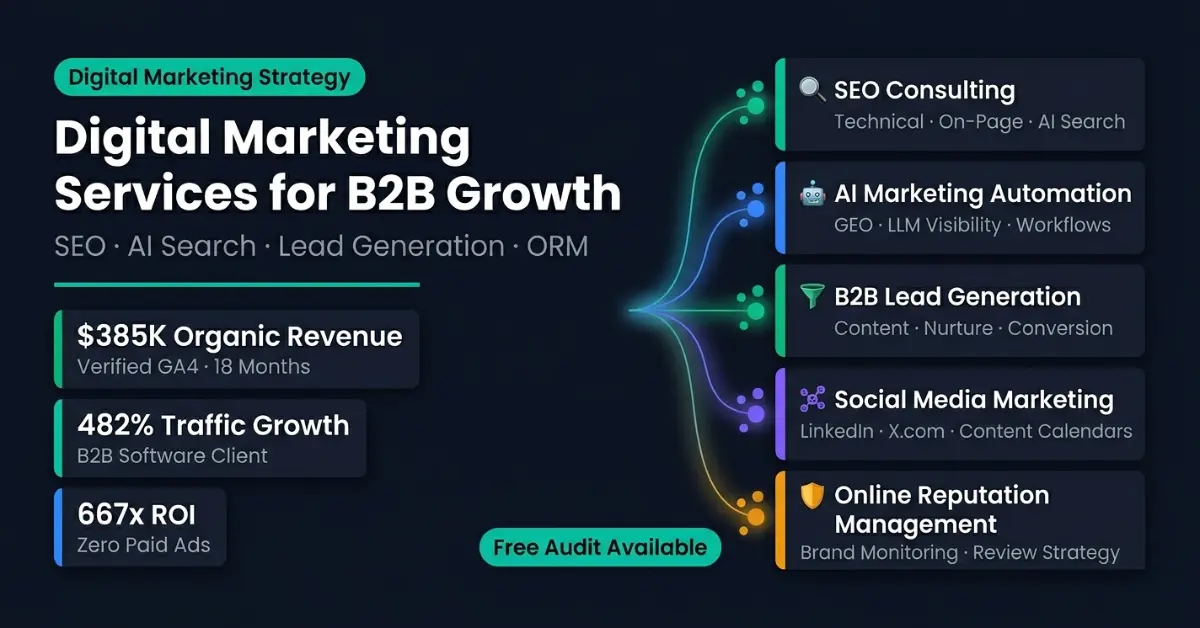
- The verified campaign result that defines the standard: $385,091 in organic revenue for a US B2B software company over 18 months at 482% traffic growth and 667x ROI on total investment. Full GSC and GA4 data in the Indigo Software case study.
- No long-term contracts. Engagements operate on monthly retainers with 30-day notice. The business model depends on results keeping clients, not contract clauses.
- AI search visibility (GEO) is integrated into every SEO engagement. In 2026, ranking in Google and appearing in ChatGPT, Perplexity, and Google AI Mode are separate but related visibility systems. Both require specific optimization.
- Every engagement starts with a free audit and strategy call before any commitment. The audit covers current SEO health, AI visibility status, and the 3 highest-priority improvements for your specific situation.
What This Guide Covers
- Freelance SEO Consultant Positioning and What That Means for You
- Target Markets and Who This Is For
- Services Overview
- How Digital Marketing Campaigns Are Built
- Technical SEO and On-Page Content
- AI Search and Generative SEO
- Content Marketing for B2B Lead Generation
- Social Media and Organic Growth
- Local SEO for Local Businesses and Multi-Location Brands
- Development Services
- Online Reputation Management
- Measurement, Reporting, and Continuous Optimization
- Proof: Case Studies, Metrics, and Testimonials
- Pricing, Engagement Models, and Trial Options
- Onboarding Steps for New Clients
- Frequently Asked Questions
- Get Started
Freelance SEO Consultant: What That Positioning Actually Means
A freelance digital marketing consultant delivers something a full-service agency structurally cannot: direct access to the person doing the work on every client communication, every audit, and every strategic decision. At agencies, the person who sells the engagement is rarely the person who runs it. Work gets handed to account managers, then to junior strategists, then to execution teams across multiple time zones. The original strategic thinking that won the pitch often does not survive contact with the delivery layer.
With 13+ years of hands-on experience across B2B SaaS, software, e-commerce, and professional services, every client engagement runs directly without delegation layers. This means faster decisions, cleaner communication, and accountability that runs in one direction: the results are mine to own, not a junior team member's to explain away in a quarterly review.
The trade-off is scale: a freelance consultant takes on fewer clients than an agency and goes deeper on each. Current capacity is limited to 4 to 6 active retainer clients at a time, which is the number where the quality of strategic attention holds across all engagements simultaneously.
The free 31-check Claude SEO audit tool is available to any business before any conversation happens. It runs in 20 seconds and tells you your current score, your top 3 blocking issues, and whether the gap is technical, content, or AI visibility. It is an honest first read on where you stand before committing to a call.
Target Markets: US, UK, France, and Switzerland
The consultancy serves B2B companies primarily across four markets: the United States, the United Kingdom, France, and Switzerland. These markets share characteristics that make them well-suited to the service model: competitive organic search environments where ranking advantage compounds over time, business cultures that value transparent reporting over vanity metrics, and buyer journeys where decision-makers conduct significant research before purchasing or hiring.
The specific business types that benefit most from these services are B2B SaaS companies targeting mid-market and enterprise buyers, professional services firms (consulting, legal, financial services, HR), technology companies with complex products requiring explanation-led content, and e-commerce brands in competitive categories where SEO is the highest-ROI acquisition channel at scale.
Geographic experience matters in ways that generic digital marketing strategy rarely accounts for. US B2B buyers research vendors differently than UK or French buyers. Review platforms, thought leadership channels, and competitor landscapes vary by market. Campaigns for US clients account for how ChatGPT and Perplexity are reshaping B2B vendor discovery. Campaigns for French clients account for different trust signal hierarchies and LinkedIn engagement patterns.
Services Overview
Five core service areas are offered, each with a dedicated service page covering specific deliverables, pricing context, and case study evidence. The overview below maps each service to the business outcome it is designed to produce.
SEO Consulting: Organic traffic growth, keyword ranking improvement, and lead quality uplift through technical SEO, content strategy, link building, and AI search visibility integration. The primary service and the foundation most clients start with.
AI Marketing Automation: Workflow automation for content production, reporting, competitor monitoring, and customer communication using Claude, ChatGPT, and custom AI integrations. Scales marketing output without scaling headcount.
B2B Lead Generation: Full-funnel lead generation combining SEO-driven organic traffic, gated content assets, email nurture sequences, and conversion optimization. Designed to produce a consistent, qualified pipeline rather than traffic volume alone.
Social Media Marketing: LinkedIn-focused organic strategy for B2B brands, including content calendars, thought leadership development, engagement management, and lead-driving campaign setup. Includes X.com and Instagram where relevant to the client's audience.
Online Reputation Management: Brand monitoring, negative search result suppression, review management, and proactive authority building across Google, review platforms, and social media.
Additional services including technical web development for conversion optimization and local SEO for location-based businesses are available within SEO and lead generation engagements. These are not standalone offerings but integrated workstreams within broader campaigns.
How Digital Marketing Campaigns Are Built
Every engagement follows the same sequenced process regardless of service type. The sequence exists because the most common reason marketing campaigns underperform is implementing tactics before diagnosing the actual constraint. Spending on content before technical SEO is fixed, or running ads before a conversion path is optimized, produces diminishing returns regardless of budget.
Phase 1: Discovery and Baseline Audit
The engagement begins with a comprehensive baseline audit covering your current technical SEO health, content quality and gap analysis, GSC performance data interpretation, AI search visibility status (ChatGPT, Perplexity, Google AI Mode citation presence), competitive positioning, and conversion path analysis. The audit uses the same 5-workflow process documented in the Claude SEO audit playbook, with additional client-specific layers for competitive intelligence and audience research.
Phase 2: Priority Identification
The audit output produces a prioritized fix list organized by impact-to-effort ratio. Not all SEO and marketing problems are equally urgent. A canonical error affecting 200 pages ranks higher than a meta description improvement on one post. A missing robots.txt AI crawler rule ranks higher than a social media posting frequency increase. Every recommendation has a stated reason for its priority level and an estimated impact range based on comparable client work.
Phase 3: Phased Campaign Roadmap
A phased roadmap maps each priority to a timeline with specific deliverables, assigned responsibilities (what the consultant does versus what the client's team does), and defined success metrics per phase. The roadmap is not a fixed document. It updates quarterly based on what the data shows is working and what the market is doing. Quarterly strategy reviews are standard in every retainer engagement.
Phase 4: Defined Success Metrics
Before any work begins, the specific KPIs are agreed: organic traffic growth targets, keyword ranking milestones, lead volume goals, conversion rate benchmarks, and in 2026, AI citation frequency targets for key queries. Every KPI has a baseline, a target, and a measurement method. This agreement prevents the most common client-consultant friction: different expectations about what "success" means at the 90-day mark.
Technical SEO, On-Page Content, and Search Engine Visibility
Technical SEO is the foundation layer that every other marketing tactic builds on. Content strategy cannot outperform a site with crawl errors. Link building cannot rescue a site where important pages carry noindex tags by accident. AI visibility work cannot reach ChatGPT if Bing Webmaster Tools is unverified.
The technical SEO workflow runs a full site crawl using Screaming Frog, diagnoses the findings using Claude for prioritization and specific fix recommendations, and resolves issues in the Critical tier before moving to Important or Nice-to-have improvements. The complete 12-point technical audit checklist is publicly available in the Claude technical SEO audit checklist for anyone who wants to run the process independently before engaging.
On-page optimization covers meta tag rewriting for CTR improvement (particularly for pages with high impressions but below-expected CTR in GSC), heading hierarchy restructuring for featured snippet eligibility, schema markup implementation and validation for rich results, keyword research targeting both traditional search and AI-generated answer query patterns, and Core Web Vitals monitoring via GSC field data.
The keyword research process in 2026 has two parallel tracks. Traditional keyword research targets Google ranking. AI search keyword research targets the specific question patterns that ChatGPT, Perplexity, and Google AI Mode users ask when researching vendors and solutions in your category. These overlap significantly but not completely, and both need to be explicitly planned for rather than assumed to be the same work.
AI Search Engines and Generative SEO Services
The fastest-growing component of SEO services in 2026 is GEO: Generative Engine Optimization. Semrush confirmed that 93% of Google AI Mode queries end without a click to an external website. This does not mean organic SEO is less important. It means that appearing in the AI-generated answer itself, rather than only in the ranked results below it, is now a distinct visibility goal that requires distinct optimization.
GEO services cover three interconnected workstreams.
Content optimization for LLM queries and AI Overviews. Pages structured for AI citation use answer-first H2 sections where the first sentence of every major section directly answers the implied question, named statistics with explicit source attribution, self-contained paragraphs that read as complete answers without surrounding context, and FAQPage schema that explicitly maps questions to answers for AI retrieval. The full framework is in the GEO and AEO optimization guide.
Technical AI visibility configuration. This covers robots.txt configuration to explicitly allow ChatGPT-User (the retrieval crawler), ClaudeBot, and PerplexityBot. It covers Bing Webmaster Tools verification, which is the prerequisite for ChatGPT's real-time retrieval finding your content at all. It covers llms.txt implementation, the Markdown file at your site root that gives AI systems a curated guide to your most important content. The complete llms.txt guide covers the full format and framework support.
Citation and mention strategy for AI trust signals. AI systems learn to cite sources with strong entity authority: consistent presence across LinkedIn, Reddit, G2, Trustpilot, and industry publications. The LLM citation and backlink strategy guide documents the 5-method approach used in the Indigo Software campaign that produced 369 AI-cited pages and 534 brand mentions in AI responses.
Content Marketing for B2B Lead Generation
Content marketing for B2B lead generation is not a blogging strategy. It is a systematic plan that maps content types to buyer stages, builds topical authority that compounds over time, and creates assets that generate leads through search, AI discovery, and social sharing simultaneously.
The content strategy process begins with a pillar-topic content plan built from keyword research, competitor gap analysis, and buyer journey mapping. Pillar pages target the high-volume, high-commercial-intent queries in your category. Supporting cluster content targets the long-tail informational queries that bring prospects into your ecosystem before they are ready to buy. Both types are planned together because their internal linking structure determines how authority flows across the site.
Long-form content pages written for conversion optimization serve three functions simultaneously: they rank for target keywords, they earn AI citations for relevant queries, and they convert visitors who arrive with buying intent. The content that performs best in B2B combines deep practitioner expertise with specific data points, case study evidence, and a clear value proposition for the reader's stage in the buying journey.
Gated assets for lead capture include research reports, audit templates, frameworks, and tools that exchange access for a business email. These assets sit at the bottom of the content funnel and convert high-intent readers who have consumed earlier-stage content. The free Claude SEO audit tool on this site is an example of the lead capture mechanism in practice: it provides immediate value, captures a qualified email, and creates the context for a follow-up consulting conversation.
Content repurposing across social channels extracts maximum reach from each long-form piece. A 3,500-word guide produces a LinkedIn document carousel, a Twitter/X thread, a Quora answer series, a Reddit community post, and an email newsletter section. Each format reaches a different segment of the target audience where they already spend time.
Social Media Marketing and Organic Growth
Social media marketing for B2B focuses primarily on LinkedIn, which remains the highest-ROI platform for B2B professional services according to consistent client data. Profound research from February 2026 confirmed LinkedIn moved from domain rank 11 to rank 5 in ChatGPT citations in three months, making an active LinkedIn presence valuable for both direct audience reach and AI search visibility simultaneously.
The social media workflow begins with a profile and content audit covering your current account health, content performance data, follower quality, and competitor benchmarking. The audit identifies what content format and cadence your specific audience responds to, rather than applying a generic strategy developed for a different industry.
Platform-specific content calendars are built around three content types: thought leadership (your original practitioner perspective on industry developments), educational content (practical how-to guidance that demonstrates expertise), and proof content (case study results, data from your own campaigns, client outcomes). The ratio across these types varies by platform but the underlying content assets can often be repurposed across all three categories.
Lead-driving social campaigns include LinkedIn lead generation forms, strategic connection request sequences, and content that creates direct booking opportunities. The goal is not follower count but qualified conversation starts that convert to discovery calls.
Local SEO for Local Businesses and Multi-Location Brands
Local SEO services target businesses whose customers search for them by location: professional services firms, retail brands, restaurants, healthcare providers, and any multi-location operation where visibility in local search results directly determines foot traffic and phone inquiry volume.
The local SEO workflow covers Google Business Profile optimization and verification for all locations, local citation building and consistency across directories (Name, Address, Phone must be identical across all platforms), location pages built with service-specific keywords and local schema markup, and review acquisition systems that generate a consistent flow of recent reviews rather than a one-time burst that fades.
In 2026, local SEO has an AI dimension that most local businesses are not addressing: ChatGPT's location sharing feature launched in April 2026, enabling location-aware recommendations from ChatGPT for local service queries. Businesses with strong Bing local listings, consistent NAP data, and recent review activity are appearing in ChatGPT local recommendations. This is a new visibility channel with essentially no competition from businesses that have not discovered it yet.
Development Services: Conversion-Focused Web Development
Development services are available as a component of broader SEO and lead generation engagements rather than as standalone projects. The focus is conversion optimization and technical performance rather than full site builds.
The development workflow starts with a site architecture audit that maps current conversion paths against user behavior data. Pages where users arrive with buying intent but leave without converting are identified, diagnosed, and restructured. Speed and accessibility fixes are implemented to improve Core Web Vitals scores that affect both Google rankings and user experience. CRO experiments including A/B tests on page layouts, CTAs, and form structures are designed, deployed, and measured. Analytics and tracking implementations ensure every campaign has the data infrastructure to measure accurately.
Online Reputation Management and Trust Building
Online reputation management addresses the gap between how a business wants to be perceived and how it actually appears across Google, review platforms, social media, and AI-generated summaries. For B2B companies, where enterprise buyers regularly search company names and founder names before any conversation, what appears on the first page of those results is a sales asset or a sales problem.
ORM services cover brand mention monitoring across all major channels, a structured response process for negative reviews that protects brand voice while addressing legitimate concerns, proactive testimonial and case study page development that builds the positive signal volume needed to naturally push negative content down in search results, and entity authority building across review platforms (G2, Clutch, Trustpilot) that also serves AI citation frequency goals. Trustpilot's citation frequency in ChatGPT surged 246% between June and August 2025, making it the fifth most cited domain in ChatGPT globally by January 2026.
Measurement, Reporting, and Continuous Optimization
Transparent, consistent reporting is not optional in how this consultancy operates. Every retainer engagement includes a monthly performance report delivered on a fixed date, covering organic traffic trends, keyword position movement, lead volume and source attribution, AI citation frequency for target queries, and the specific actions taken in the previous month alongside their measured impact.
Monthly strategy meetings with stakeholders review the data, identify what is working and what is not, and confirm the priorities for the next month's work. These meetings are working sessions, not status updates. Decisions get made, priorities get adjusted, and the roadmap gets refined based on what 30 days of live data shows.
A/B testing is built into content and conversion optimization work as a standard practice rather than an occasional experiment. Test results are documented, shared in reporting, and used to inform future decisions. The goal is a client organization that becomes more data-literate about its own marketing over the course of the engagement, not one that depends on the consultant to interpret every number.
Proof: Case Studies, Metrics, and Client Results
Indigo Software: $385,091 in Organic Revenue Over 18 Months
A US-based B2B software company with zero organic search presence at the start of the engagement. The 18-month SEO and AI visibility campaign produced 482% organic traffic growth, 5,219% Google impressions growth, 369 AI-cited pages across ChatGPT, Perplexity, and Google AI Mode, 534 brand mentions in AI responses, and $385,091 in verified organic revenue with a 667x ROI on the total campaign investment. The full month-by-month breakdown with verified GA4 and GSC data is in the Indigo Software case study.
The most important finding from this campaign was not the traffic growth. It was the conversion quality: AI-sourced leads converted at 40% higher rates in discovery calls than paid channel leads. Prospects who arrived after seeing the brand cited in Perplexity or ChatGPT responses came pre-educated and pre-qualified. The AI citation did the first stage of the sales process before any human conversation happened.
This Site's Own Campaign
kulbhushanpareek.com launched in February 2026. By April 29, 2026 (67 days later), the site had reached 180 clicks in 28 days from a standing start, earning impressions for over 1,200 distinct queries and ranking at position 1 for "technical seo checker" among several other competitive Claude-related keyword clusters. The trajectory: 20 clicks at day 30, 50 at day 38, 80 at day 46, 150 at day 62, 180 at day 67. The content strategy, GEO optimization, and daily insights publishing system that produced these results is the same approach deployed for clients.
Pricing, Engagement Models, and Trial Options
Detailed pricing with transparent scope descriptions is on the pricing page. The summary below covers the engagement model options.
Monthly consulting retainer. The primary engagement model. A defined scope of monthly deliverables, a set number of strategy hours, and a 30-day notice period in lieu of long-term contract commitments. The business model is designed so results keep clients rather than contract clauses keeping clients. Retainer rates start based on scope, company size, and campaign complexity. See the pricing page for current ranges.
Project-based development services. For specific technical projects within an existing engagement: site architecture work, tracking implementation, conversion optimization sprints, or technical SEO remediation. Scoped and priced per project with defined deliverables and timelines.
Free initial audit and trial advisory call. Every prospective client starts here. The free 31-check automated audit provides an immediate read on technical and GEO health. The 30-minute strategy call builds on that audit with a human analysis of your specific competitive position, content gap, and the 3 highest-priority actions for your situation. No commitment, no payment, no sales pitch. If the call confirms a fit, the onboarding process begins. If not, you walk away with a useful analysis at zero cost.
Onboarding Steps for New Clients
The onboarding process runs on a defined timeline so new clients have clarity on what happens and when from the moment they confirm an engagement.
Within 5 business days of confirmation: Discovery call scheduled. Pre-call brief sent covering what access and information is needed (GSC, GA4, CMS access, existing keyword data, competitor list, current content assets). The client completes the brief at their own pace before the discovery call.
Discovery call: 60 to 90 minutes covering business goals, current challenges, previous marketing history, audience and competitive landscape, and what success looks like at 90 days, 6 months, and 12 months. This is a working session, not a sales meeting. By the end, the priority areas are identified and agreed.
Week 1 to 2: Kickoff audit using the baseline data from the discovery brief. Technical SEO crawl, GSC data analysis, content gap assessment, AI visibility status check, competitive positioning review. The audit output is the working document for the first quarter's roadmap.
Week 2 to 3: First recommendations delivered. A prioritized action list with rationale, timeline, and expected impact for each item. This is the start of the active campaign, not the planning phase for it.
Get Started: Book a Free Audit and Strategy Call
The fastest way to understand what digital marketing services would produce for your specific business is to start with your actual data rather than a generic conversation about capabilities.
Two options, both free, both useful before any commitment:
Option 1: Run the automated audit. The free 31-check Claude SEO and GEO audit tool evaluates your site across 24 classic SEO signals and 7 AI visibility signals in 20 seconds. You get a score, a letter grade, your top 3 blocking issues, and for sites scoring below 80, a Claude Haiku AI analysis with a personalised fix-in-this-order plan. No email required to see your score. The email you provide receives the full report.
Option 2: Book the strategy call. The free 30-minute strategy call is a live working session reviewing your current site, your GSC data, and your competitive position. By the end, you have the 3 highest-priority actions for your specific situation and an honest assessment of what a campaign engagement would realistically produce. No sales pitch. No obligation. If there is no fit, the call is still useful.
For questions before booking, the contact page is the fastest route to a direct response.

Leave a Comment
Your email address will not be published. Comments are moderated before appearing.