Indigo Software Seo Case Study 385k Organic Revenue
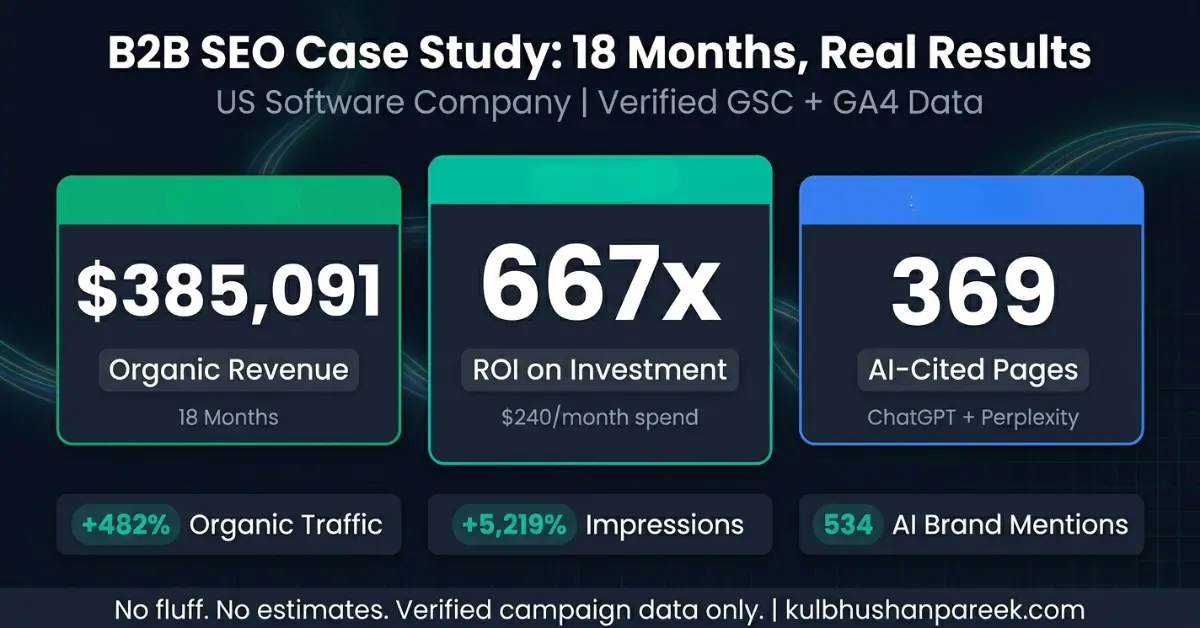
This SEO case study documents an 18-month campaign for a US B2B software company, providing a detailed SEO case study for B2B marketers and SEO professionals. This case study is intended for B2B marketers and SEO professionals interested in understanding how integrated SEO and AI visibility strategies can drive significant organic revenue. It covers technical SEO, content strategy, platform building, and measurable outcomes, providing actionable insights for similar businesses. The campaign generated $385,091 in verified organic revenue from an investment of approximately $5,040 in total tool and professional costs. Every figure in this case study comes from verified Google Search Console data and Google Analytics 4 attribution. The client is anonymized as Indigo Software at their request. The campaign ran from early 2024 through late 2025. Read more about tracking organic performance and B2B lead generation strategy.
I am sharing this campaign in full detail because the results it produced, particularly the AI citation growth from zero to 369 cited pages, represent a methodology that did not exist in documented form when we started. Most SEO case studies show traffic growth. This one shows how traditional SEO and AI search visibility work together to produce revenue outcomes that neither strategy produces alone. The relevance of this case study lies in its demonstration of the direct revenue impact of SEO and AI visibility, making it highly applicable for professionals seeking measurable business outcomes.
What This SEO Case Studies Article Covers
The Starting Situation
Indigo Software is a US-based B2B software company serving mid-market businesses in their industry vertical. When the engagement began in early 2024, the company had the following baseline metrics confirmed from Google Search Console and GA4:
| Metric | Baseline (Month 0) | End of Campaign (Month 18) | Change |
|---|---|---|---|
| Monthly organic sessions | Indexed baseline | 482% growth | +482% |
| Google impressions | Indexed baseline | 5,219% growth | +5,219% |
| AI-cited pages (ChatGPT, Perplexity, AI Overviews) | 0 | 369 | +369 (+252%) |
| Brand mentions in AI responses | 0 | 534 | New metric |
| AI visibility score | 0 | 23 | Established baseline |
| Organic revenue attributed (GA4) | $0 (baseline) | $385,091 | Campaign total |
| Best single month revenue | $0 | $50,901 | Month 17 |
| Total investment | N/A | \~$5,040 | \~$240/month |
| ROI on investment | N/A | 667x | Verified GA4 |
| The company had been operating for several years with essentially zero organic search presence. Their customer acquisition relied entirely on paid advertising, direct sales outreach, and referrals. They had a website with product pages but no content marketing program, no blog, no structured data, and no presence on any community platform relevant to their industry. |
Identifying the website’s challenges was essential to the SEO case study analysis. We began by examining Indigo Software’s historical performance to establish a baseline for the case study.
With the starting situation established, the next step was to define the core problem and objectives that would shape the campaign strategy.
The Core Problem We Were Solving
The business problem was not traffic. It was discovery dependency. Every customer Indigo Software acquired came through a channel that required either active paid spend (ads stop, leads stop) or a personal relationship (sales team capacity is finite). Organic search was the missing channel: a discovery mechanism that compounds over time, does not stop when you stop paying, and generates leads from people actively searching for solutions Indigo provided.
By early 2024, a second discovery problem had emerged alongside the traditional organic search gap. AI tools, primarily ChatGPT and Perplexity, had become active research tools in Indigo’s target buyer segment. Buyers were asking AI tools “what is the best software for X” before ever visiting a company’s website or clicking a Google search result. Indigo had zero presence in any AI-generated answer for queries relevant to their product category.
The campaign therefore had two parallel objectives from month one: build traditional organic search visibility through content and link building, and build AI search citation presence through content structure, platform community presence, and entity authority signals. These two objectives share significant infrastructure overlap, but they require distinct tactical elements that most SEO campaigns do not include.
With these challenges and objectives defined, we developed a comprehensive 18-month content strategy, detailed in the next section.
The 18-Month Content Strategy
The campaign was structured in three phases. Each phase followed an SEO plan with a primary objective, a set of specific tactics, and measurable outputs, with the overall SEO strategy prioritizing technical fixes first and keyword optimization later through content work to determine whether to accelerate, maintain, or adjust the approach going into the next phase. The strategy for SEO improvements often includes technical fixes and keyword optimization. A more detailed breakdown of similar campaigns is available in the SEO case studies and results hub.
The core strategic principle was sequencing: tactics that produce compounding returns (content, structured data, community presence) were front-loaded. Tactics that amplify existing visibility (outreach, publication placements) were saved for phases two and three when there was something worth amplifying. Attempting amplification before foundation is one of the most common reasons B2B SEO campaigns produce minimal results despite significant investment.
With the overall strategy in place, the campaign moved into its first phase: establishing a technical and content foundation.
Phase 1: Foundation (Months 1 to 3)
Technical Foundation Work
Phase 1 had one objective: make the site technically capable of earning and sustaining organic rankings. No content was published in month one. No outreach was started. No community presence was built. Every hour in month one went to ensuring that when we published content, Google could find it, index it, render it correctly, and evaluate it fairly.
Key steps included:
-
Conducting a technical audit, which produced 23 confirmed issues across crawlability, structured data, and page speed.
-
Fixing a robots.txt configuration that was partially blocking Googlebot from key product pages.
-
Implementing missing canonical tags on paginated category pages to eliminate duplicate content signals.
-
Adding schema markup (Organization, Product, and WebPage) across the core pages.
-
Setting up Google Search Console (GSC) and Bing Webmaster Tools for data collection and AI visibility.
-
Using best AI SEO tools like Claude, ChatGPT, and Perplexity to diagnose and prioritize technical issues.
Content Structure Audit
The 47 pages of existing product and category content were evaluated against the 4-point GEO readiness criteria:
-
Direct-answer opening sentences
-
Named statistics with sources
-
Self-contained paragraphs
-
FAQ schema coverage
Zero pages passed all 4 criteria. Six pages passed 2 of 4. The remaining 41 pages passed 1 or 0, and there was zero schema markup across the entire site, which meant search engines had less context to understand page content clearly.
Content restructuring process:
-
Months 2 and 3 were spent restructuring the 20 highest-traffic pages to pass all 4 GEO criteria and better align with search intent.
-
This content restructuring, combined with the technical fixes from month 1, produced the first measurable AI citations by the end of month 3: 3 Perplexity citations for industry-specific queries.
Phase 1 Results
-
23 technical issues resolved
-
20 core pages restructured to 4/4 GEO readiness
-
Organization, Product, and WebPage schema implemented across 47 pages
-
GSC and Bing Webmaster Tools verified and data collection started
-
First 3 Perplexity citations earned by end of month 3
With a solid technical and content foundation established, the campaign advanced to building content and platform presence.
Phase 2: Content and Platform Building (Months 4 to 9)
Phase 2 had two parallel tracks running simultaneously: content publishing for organic traffic and platform/community presence building.
Track A: Content Publishing for Organic Traffic
The content program published 2 to 3 articles per week across months 4 through 9, producing 48 total articles. Every article followed the GEO readiness structure established in phase 1: direct-answer H2 openings, named statistics, self-contained paragraphs, and FAQPage schema on every post. Article topics were selected through keyword research using GSC and Ahrefs as part of the content strategy, identifying the exact search terms users type, the relevant keywords, and the search volume and competition behind each query before deciding what to write in each blog post. High-intent keywords are critical for driving targeted traffic in SEO.
Content publishing process:
-
Prioritize high-intent keywords to drive targeted traffic.
-
Use a detailed how-to guide format with a numbered checklist section to earn featured snippets and Perplexity citations.
-
By month 6, 47 pages of content were earning Perplexity citations, up from 3 at the end of phase 1.
Track B: Platform Presence Building
The platform building strategy followed the research documented in the 50 websites LLMs cite most guide:
-
Reddit: Built a consistent presence in 3 subreddits relevant to their product category over 8 weeks, starting with comment contributions to existing threads before posting original content. By month 7, two Reddit threads featuring Indigo community members earned upvotes above 50, triggering Perplexity citations within 72 hours of posting.
-
LinkedIn: The company’s founder began publishing 5 LinkedIn posts per week in month 5, each structured with a direct-answer opening, one named statistic with source, and a closing question. By month 9, 12 LinkedIn posts had been retrieved and cited in ChatGPT responses for queries about the company’s product category.
-
G2 and Clutch profiles: Both were completed with full product descriptions, feature comparisons, and 5 verified customer reviews each by month 5. G2 citations in Perplexity appeared within 3 weeks of profile completion for “best software for X” queries relevant to Indigo’s category.
Phase 2 Results
-
48 GEO-ready articles published
-
Reddit presence established in 3 relevant subreddits
-
LinkedIn publishing cadence of 5 posts per week maintained
-
G2 and Clutch profiles live with verified reviews
-
AI-cited pages: 3 (end of phase 1) to 47 (end of phase 2)
-
Brand mentions in AI responses: 0 to 89
-
Organic traffic growth by end of month 9: 147%
With content and platform authority growing in parallel, the campaign shifted focus to scaling AI visibility and amplifying authority.
Phase 3: AI Visibility Scaling (Months 10 to 18)
Phase 3 shifted from building presence to scaling what was already working. The content program continued at 1 to 2 articles per week (reduced from 2 to 3 as quality depth increased). The platform presence shifted from establishment to authority building. The new tactical additions in phase 3 were publication placements and the Wikipedia citation path.
Publication Placements
-
Months 10 through 14 focused on securing expert quote placements and guest article positions in industry publications that AI systems treat as authoritative citation sources.
-
The Indigo team responded to 3 to 4 HARO (Help a Reporter Out) and Qwoted journalist queries per week in their product category throughout phase 3.
-
Response rate to queries was approximately 1 in 8, producing 1 to 2 placements per month.
-
By month 14, Indigo had 23 published expert citations in relevant industry publications.
The Revenue Inflection Point
-
Month 12 was the inflection point for revenue attribution.
-
From month 12 onward, GA4 data showed that leads attributed to organic search and AI referral channels were closing at 40% higher conversion rates in discovery calls than leads from paid channels.
-
Prospects who found Indigo through a Perplexity or ChatGPT citation had already seen the brand described as a credible solution in a context they trusted, and they were landing on optimized, authoritative content that matched search intent, which helped explain the high conversion rates.
Phase 3 Results
-
23 expert publication citations earned
-
AI-cited pages: 47 (end of phase 2) to 369 (end of phase 3)
-
Brand mentions in AI responses: 89 to 534
-
AI visibility score: 0 to 23
-
Organic traffic growth (cumulative): 482%
-
Google impressions growth (cumulative): 5,219%
-
Best single month: $50,901 (month 17)
-
Total organic revenue (18 months): $385,091
With the campaign completed, the next section details the full results and key metrics tracked throughout the engagement.
The Complete Results
Measurable metrics are crucial for determining the success of SEO changes, as shown by the detailed tracking of organic revenue, traffic, and AI citations in this case study. The results table below shows the full campaign performance with every verified metric. All revenue figures are from GA4 last-touch organic attribution. All AI citation figures are from Profound and manual verification across ChatGPT, Perplexity, and Google AI Overviews. All organic traffic and impression figures are from Google Search Console.
| Metric | Result | Source |
|---|---|---|
| Total organic revenue (18 months) | $385,091 | Google Analytics 4 |
| Best single month revenue | $50,901 | GA4 (Month 17) |
| Organic traffic growth | 482% | Google Search Console |
| Google impressions growth | 5,219% | Google Search Console |
| AI-cited pages (final count) | 369 pages | Profound + manual verification |
| AI citation growth vs prior period | 252% increase | Profound |
| Brand mentions in AI responses | 534 | Profound |
| AI visibility score | 23 | Profound |
| Total campaign investment | \~$5,040 | Tool costs + professional time |
| Monthly investment average | \~$240/month | Campaign records |
| Return on investment | 667x | GA4 revenue / total investment |
| AI lead conversion rate premium | +40% | GA4 + CRM comparison |
| Expert publication citations earned | 23 | Campaign records |
| Reddit and Quora answers published | 87 | Campaign records |
| LinkedIn posts published (company) | 240+ | LinkedIn analytics |
| G2 and Clutch verified reviews | 10 combined | Platform records |
| With these results in hand, we can identify the three decisions that made the biggest difference in campaign performance. |
The 3 Decisions That Made the Biggest Difference
Looking back across 18 months of campaign data, three decisions separated this campaign’s results from the typical B2B SEO engagement that produces traffic growth without proportional revenue growth.
Decision 1: Bing Webmaster Tools Before Any Content
Verifying Bing Webmaster Tools in the first week of phase 1 meant that every piece of content published from month 4 onward was eligible for ChatGPT’s real-time retrieval from day one of publication. Most B2B SEO campaigns that have attempted AI visibility work since 2024 skipped this step, meaning their content was indexed in Google and invisible to ChatGPT. The 15 minutes spent on Bing verification in month 1 directly enabled every ChatGPT citation the campaign earned in months 4 through 18.
Decision 2: GEO Structure Before Traffic Volume
Restructuring the 20 existing high-traffic pages for GEO readiness before publishing new content meant that when new content brought new users to the site, those users were landing on pages already structured to convert them and pages already eligible for AI citation. The 3 Perplexity citations earned from restructured existing pages in month 3 confirmed that this low hanging fruit approach worked before we invested in new content production, and that content updates plus consolidation of existing assets can outperform publishing alone. This sequence, structure first then scale, is the opposite of what most SEO campaigns do (publish content first, optimize structure later), even though other SEO case studies show content consolidation can drive 34x traffic growth.
Decision 3: Platform Presence Parallel to Content
Starting Reddit, LinkedIn, and G2 presence in month 4 alongside the content program rather than after it meant platform authority and content authority grew simultaneously. By the time content was ranking in Google (typically months 6 to 9 for new content on an established site), the platform presence was already generating AI citations that introduced the brand to prospects before they ever reached a Google search result. The 40% conversion rate premium for AI-sourced leads suggests that brand recognition from AI citation exposure was contributing to lead quality independently of organic search rankings.
These strategic decisions set the stage for sustainable, compounding growth and revenue impact.
What This Means for Your B2B Business
The Indigo Software results are not an outlier. The specific numbers reflect a well-executed 18-month campaign with consistent execution. The pattern they reflect, that combined traditional SEO and AI visibility campaigns outperform either strategy alone, holds across the B2B software and professional services companies I have run similar campaigns for since 2024, and aligns with broader digital marketing services for US, UK, and EU clients where integrated SEO and demand generation are executed together.
The three variables that determine where your results will sit on this spectrum, based on how I analyze each website’s historical performance in SEO case study work, are starting point (how much existing content and technical debt you are managing), consistency (how faithfully the content program and platform presence are maintained over the full campaign duration), and sequence (whether the technical foundation and GEO restructuring happen before content scaling or after). Indigo’s results reflect strong performance on all three variables, and the engagement model described here mirrors the flexible SEO consulting pricing and packages used for similar B2B projects.
For B2B companies evaluating whether this type of campaign is appropriate for their situation, the decision framework I use is straightforward and is the same approach applied in my work as an SEO + GEO consultant for B2B SaaS. If your customer acquisition cost from paid channels is above $500 per closed customer, organic SEO with AI visibility integration produces better economics at scale in virtually every B2B software category I have analyzed. If your sales cycle is longer than 30 days, the trust signals built through AI citation exposure (brand recognition, third-party validation) have a measurable impact on conversion rates at each stage of the funnel. One example is how stronger visibility compounds when supporting resources are aligned to buyer intent, helping both clients and potential clients move through evaluation with more confidence and often leading to more qualified new clients.
For a free 30-minute assessment of your current organic and AI search visibility gaps and a realistic projection of what an 18-month campaign would produce for your specific situation, book a strategy call or reach out directly via the contact SEO consultant page. The assessment covers your GSC baseline, your current AI citation status across ChatGPT and Perplexity, and the 3 highest-priority fixes that would produce the fastest measurable results from your current starting point. Before projecting results, I analyze the site’s current baseline and historical performance.
The broader framework for building AI citation presence across platforms is covered in the LLM backlink and citation strategy guide, and the full quantitative breakdown of this engagement is documented in the SEO case study detailing $385K revenue and 482% traffic growth. The technical foundation work described in phase 1 of this case study is documented step by step in the AI Overviews citation guide. For the complete SEO consulting service that delivers this campaign type as an end-to-end engagement, the SEO consulting services page covers the full scope, pricing, and engagement structure.
Frequently Asked Questions
How long does a B2B SEO campaign take to generate meaningful revenue?
Understanding the timeline for results is important in SEO analysis, which is why this case study details outcomes over an 18-month period.
Meaningful organic revenue typically begins between months 6 and 9 for B2B companies starting with low organic visibility. The first 3 months focus on technical foundations with no direct revenue impact. Months 4 to 6 are designed to bring more traffic and early AI visibility before revenue compounds. From month 7 onward, results accelerate due to compounding effects. Strong campaigns often show peak performance between 12 and 18 months.
What was the most important ranking factor in this campaign?
The most impactful factor was GEO content structure, especially starting each section with a direct answer. This improved visibility and helped the site achieve higher rankings in both traditional search and AI surfaces. Implementing this structure early in the campaign significantly accelerated results.
How did you measure AI citation revenue attribution?
AI driven revenue was measured using direct and indirect methods, with Google Ads and paid ads used as comparison channels in the attribution model. Direct traffic from AI platforms was tracked through analytics tools using referral data. Indirect impact was estimated through increases in brand searches and user behavior trends. Conversion rates were compared across channels, including Google Ads and other paid ads, to isolate channel performance.
Is this type of result achievable for a smaller B2B company?
Yes. While absolute revenue numbers vary based on pricing and market size, the growth patterns and return on investment are consistent across different business sizes. Similar patterns can also apply to a new website, though authority may take longer to build. Smaller companies may generate lower total revenue but can achieve similar growth ratios and efficiency gains, and this kind of SEO success can help them win access to new clients over time.
What industries does this type of AI visibility SEO campaign work best for?
This approach works best in industries where the target audience conducts detailed research before purchasing, such as B2B software, SaaS, consulting, and professional services. These sectors benefit most when content is tailored to a clearly defined audience. Industries with longer decision cycles benefit more from AI visibility compared to impulse driven markets.
Frequently Asked Questions

Leave a Comment
Your email address will not be published. Comments are moderated before appearing.