Best SEO Rank Tracking Software in 2026
The rank tracking software market has a trust problem. Most comparison articles are written by affiliates who earn commissions on every tool they recommend. The ranking of tools in those lists correlates more with affiliate payout than with actual capability for real campaign work.
I do not have affiliate relationships with any of the tools in this article. I pay for or use free tiers of all of them on real client campaigns across US, UK, and European markets. My income comes from consulting fees, not referral commissions. That means I have no financial incentive to rank any tool higher than it performs.
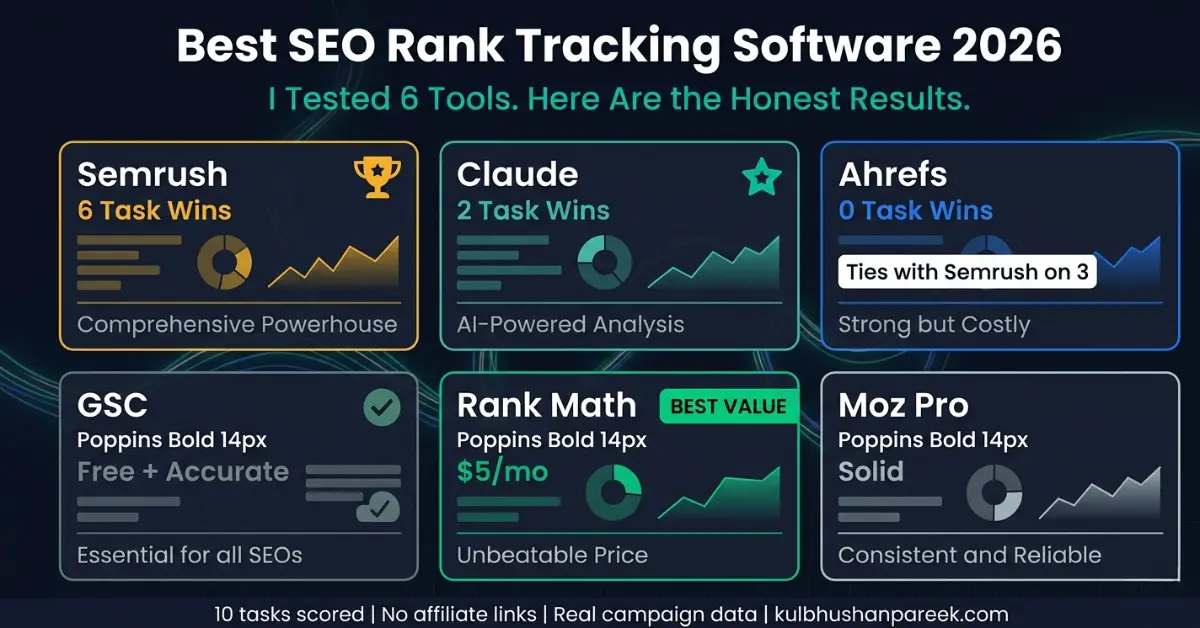
This article tests six tools: Semrush, Ahrefs, Moz Pro, Google Search Console, Rank Math SEO Pro, and Claude. I included Claude specifically because clients keep asking whether it can replace paid rank trackers. The answer is nuanced and worth documenting alongside the paid tools. The full 60-day Claude-specific test is covered in the companion article Can Claude Work as an SEO Rank Tracking Tool, but the summary findings appear in the comparison table here.
What This Guide Covers
- Key Takeaways
- Why This Comparison Is Different
- The 6 Tools I Tested
- The Master Comparison Table
- Tool 1: Semrush Rank Tracker
- Tool 2: Ahrefs Rank Tracker
- Tool 3: Moz Pro
- Tool 4: Google Search Console
- Tool 5: Rank Math SEO Pro
- Tool 6: Claude (the Wildcard)
- The Budget Decision Framework
- My Actual Stack and Why
- Frequently Asked Questions
Key Takeaways
- Semrush wins for daily live monitoring and automated alerts across multiple domains. No free tool replicates these two functions. If you manage 3 or more client sites and need daily position data, the subscription cost is justified.
- Google Search Console is more accurate than every paid tool for your own site's position data because it uses Google's actual search data rather than simulated crawls. Its limitations are no competitor data, no daily snapshots, and no automated alerts.
- Claude scores 9 out of 10 for GSC data interpretation and quick-win identification but 0 out of 10 for live position monitoring. It belongs in every SEO workflow as the analysis layer, not the data layer.
- The free stack (GSC plus Claude free plus Bing Webmaster Tools) covers approximately 80% of what a $129/month Semrush subscription delivers for rank tracking specifically, for single-site operators who do not need daily monitoring.
- Rank Math SEO Pro at $59/year is the most underrated rank tracking option for WordPress sites and PHP sites already using Rank Math. Its position tracking covers the core monitoring need at a cost that makes every other tool look expensive by comparison.
Why This Comparison Is Different
Most SEO tool comparisons are structured around the tools' feature lists rather than around the specific tasks SEO practitioners actually need to complete. A comparison that tells you Semrush has 55 billion keywords in its database is useful context but it does not tell you whether Semrush is the right tool for a consultant managing 5 client sites on a $500/month tool budget.
This comparison is organized around 10 specific rank tracking tasks that real SEO campaigns require. Each tool is scored on each task. The scores come from actual use across client campaigns, not from feature documentation or vendor demos. Where my experience is limited for a specific tool, I note that explicitly rather than inferring from documentation.
The 10 tasks tested are: live position monitoring, position change alerts, competitor ranking surveillance, SERP feature tracking, keyword opportunity identification, CTR analysis, GSC data interpretation, ranking trend reporting, multi-location tracking, and API access for custom reporting. Not every consultant needs all 10. The budget section at the end helps you identify which tasks you actually need so you can choose accordingly.
The 6 Tools I Tested
Brief context on each tool before the detailed comparison:
Semrush Position Tracking: The market leader for comprehensive rank tracking. Monthly subscription with position tracking as one feature within a broader platform. Tested on the Pro plan at $129/month.
Ahrefs Rank Tracker: Premium option with excellent data accuracy and a strong interface for competitive analysis. Tested on the Lite plan at $99/month, which includes rank tracking for up to 750 keywords.
Moz Pro: The oldest established player in SEO software. Tested on the Standard plan at $99/month. Moz's rank tracking is solid for single-site operators but lags behind Semrush and Ahrefs for multi-domain management.
Google Search Console: Free, direct from Google, and more accurate than every paid tool for your own domain. If you use developer tools like Claude Code to automate workflows, you will notice the significant limitations here, including no competitor data, no daily snapshots, and no automated change alerts.
Rank Math SEO Pro: A WordPress plugin at $59/year that includes rank tracking as a core feature. Dramatically underpriced relative to standalone rank trackers. Tested on the Pro plan currently in use on kulbhushanpareek.com.
Claude (free and Pro tiers): Not a rank tracker in the traditional sense. Included because clients consistently ask whether it replaces paid tools. Tested over 60 days on real client GSC data. The full methodology and results are in the Claude rank tracking test.
The Master Comparison Table
Scores are 1 to 10 based on output quality, accuracy, speed, and actionability for each specific task. The winner column shows the top performer per task. Ties are noted where two tools perform equivalently within the margin of real-world testing.
| Task | Semrush | Ahrefs | Moz Pro | GSC | Rank Math | Claude | Winner |
|---|---|---|---|---|---|---|---|
| Live position monitoring | 10 | 9 | 8 | 6 | 8 | 0 | Semrush |
| Position change alerts | 10 | 9 | 7 | 3 | 6 | 0 | Semrush |
| Competitor ranking surveillance | 10 | 10 | 8 | 0 | 4 | 0 | Tie (Semrush/Ahrefs) |
| SERP feature tracking | 9 | 8 | 6 | 5 | 5 | 6 | Semrush |
| Keyword opportunity ID | 9 | 9 | 7 | 5 | 6 | 8 | Tie (Semrush/Ahrefs) |
| CTR analysis | 7 | 6 | 5 | 7 | 5 | 9 | Claude |
| GSC data interpretation | 6 | 5 | 4 | 5 | 5 | 9 | Claude |
| Ranking trend reporting | 9 | 9 | 7 | 6 | 7 | 8 | Tie (Semrush/Ahrefs) |
| Multi-location tracking | 10 | 9 | 7 | 4 | 5 | 0 | Semrush |
| API access and custom reporting | 9 | 9 | 6 | 7 | 4 | 5 | Tie (Semrush/Ahrefs) |
| Task wins | 6 | 0 | 0 | 0 | 0 | 2 | |
| Monthly cost | $129 | $99 | $99 | Free | $5/mo | $0-$20 |
The table shows three distinct use cases. For live monitoring and competitive intelligence, Semrush and Ahrefs are the clear leaders and no free alternative comes close. For data interpretation and analytical work on ranking data you already have, Claude wins outright. For WordPress operators who want affordable live monitoring without a full platform subscription, Rank Math Pro at $5/month effective cost is the most overlooked option in the market.
Tool 1: Semrush Rank Tracker
Best for: Agencies, consultants managing 3 or more client domains, competitive niches requiring daily monitoring.
Semrush's Position Tracking is the most comprehensive rank tracking feature set available. You set up a campaign by entering your domain, target keywords, and competitor domains. Semrush then tracks your daily positions across Google desktop and mobile, your competitors' positions for the same keywords, SERP features appearing for each keyword, and your share of voice within the tracked keyword set.
What Semrush Does Better Than Every Alternative
Automated daily monitoring with email alerts is Semrush's biggest advantage. When any tracked keyword moves more than a set threshold, you receive an alert the next morning without logging in or running any manual process. For agency owners managing 5 to 20 client campaigns simultaneously, this alert system is the difference between catching a significant ranking drop within 24 hours and discovering it 3 weeks later during a monthly review.
The Cannibalization report is a specific Semrush feature I have not found replicated at the same quality elsewhere. It identifies when multiple pages on your site are competing for the same keyword and shows which page Google is choosing to rank. Fixing keyword cannibalization issues consistently produces ranking improvements of 3 to 8 positions for the affected pages in my experience, making this report one of the highest-ROI features in the platform.
Multi-location tracking for local SEO campaigns is a Semrush strength that Ahrefs matches but Moz and Rank Math do not. If you manage clients with multiple physical locations, each needing separate keyword ranking data by city, Semrush handles this cleanly. It is the primary reason I keep Semrush in my stack despite its cost.
Semrush Limitations
The cost is the honest limitation. At $129/month for the Pro plan, position tracking comes bundled with keyword research, site audit, backlink analysis, and a full suite of additional tools. For a consultant who only needs rank tracking, paying for the full platform to access position tracking is expensive. Ahrefs Starter at $29/month or Rank Math Pro at $5/month effective are worth evaluating first if rank tracking is the only function you need.
Semrush's position data uses crawl simulation rather than actual search queries. This means its position data occasionally differs from what users actually see in Google results, particularly for personalized results or location-specific queries. GSC data remains more accurate for your own domain because it comes directly from Google's actual search data.
Verdict: Pay for Semrush if you manage multiple client domains and need daily automated monitoring with competitor surveillance. Do not pay for it if rank tracking is the only function you need.
Tool 2: Ahrefs Rank Tracker
Best for: Competitive analysis-focused campaigns, backlink-heavy strategies where rank tracking and link data work together.
Ahrefs and Semrush are peers for rank tracking quality. The differences between them are smaller than the differences between either of them and the next tier of tools. Choosing between Ahrefs and Semrush for rank tracking specifically comes down to which platform's adjacent features matter more to your workflow.
What Ahrefs Does Better Than Semrush
Ahrefs' backlink data is more comprehensive than Semrush's in most comparative analyses practitioners have published. For SEO consultants whose work heavily involves link building and backlink analysis alongside rank tracking, Ahrefs provides a more integrated workflow where keyword movement can be correlated with link acquisition in a single platform.
The Content Explorer feature within Ahrefs surfaces content ranking opportunities that Semrush's equivalent does not match for depth of analysis. If your rank tracking work frequently involves finding new content opportunities alongside monitoring existing rankings, Ahrefs produces better combined output for that specific workflow.
Ahrefs' data update frequency for rank tracking is comparable to Semrush. Both update positions daily for tracked keywords. Both provide historical data going back years for competitive analysis.
Ahrefs Limitations
Ahrefs' reporting interface is less polished than Semrush's for producing client-ready rank tracking reports. Semrush's white-label reporting and scheduled PDF delivery make it easier to produce and send monthly client reports without manual work. If client reporting is a significant part of your workflow, Semrush wins on interface quality.
Ahrefs recently restructured its pricing. The Lite plan at $99/month is the minimum for meaningful rank tracking, covering 750 keywords across 5 projects. For consultants tracking more keywords or more domains, costs scale quickly. Verify current pricing at ahrefs.com before assuming the figures here are current.
Verdict: Choose Ahrefs over Semrush if backlink analysis and content research are as important to your workflow as rank tracking. Choose Semrush if client reporting, automated alerts, and local SEO tracking are higher priorities.
Tool 3: Moz Pro
Best for: SEO beginners, teams prioritizing ease of use over data depth, single-site operators who want a full platform at a moderate price.
Moz Pro is a solid, accessible platform that covers rank tracking well for single-site operators and small teams. It does not match Semrush or Ahrefs for data depth, update frequency, or competitive analysis capability. For teams earlier in their SEO journey who prioritize a clean interface and educational resources alongside their rank tracking, Moz Pro is a reasonable choice.
What Moz Does Well
Moz's Page Authority and Domain Authority metrics, despite being third-party estimates rather than official Google metrics, remain widely used proxies for evaluating link quality and site authority. Moz Pro integrates these metrics directly into rank tracking views, giving a combined picture of position data and authority signals in one place.
Moz's STAT product (a separate enterprise rank tracking tool) is among the most powerful in the market for high-volume keyword tracking and SERP feature analysis. However, STAT pricing starts at $720/month and serves enterprise teams, not the typical independent consultant or small agency. This review covers Moz Pro, not STAT.
Moz Limitations
Moz Pro's rank tracking data updates weekly rather than daily on lower-tier plans. For campaigns where daily position monitoring matters, this lag is a meaningful limitation compared to Semrush and Ahrefs. Weekly updates are sufficient for content-focused campaigns where ranking changes happen over weeks, not days. They are insufficient for competitive campaigns in volatile niches where positions shift daily.
At $99/month, Moz Pro costs the same as Ahrefs Lite but delivers meaningfully less data depth for rank tracking specifically. The pricing would be easier to justify if Moz's rank tracking matched its competitors on update frequency and data volume, but it does not at the standard tier.
Verdict: Moz Pro makes sense for teams who value the Moz brand authority ecosystem and educational resources alongside tracking. For rank tracking capability per dollar spent, Ahrefs or Semrush deliver more value at the same price point.
Tool 4: Google Search Console
Best for: Every site owner, no exceptions. The required foundation regardless of what paid tools you add.
Google Search Console is the only rank tracking tool that gives you position data directly from Google's search index. Every paid tool simulates ranking positions by crawling Google's results. GSC gives you the actual data from inside Google's systems. For your own domain, GSC is more accurate than every paid alternative.
What GSC Does That No Paid Tool Can Match
GSC shows you the actual queries users searched before clicking through to your site. This query-level data is what powers the most effective quick-win rank tracking workflows: finding pages that rank at position 8 to 20 for specific queries with high impression volume, then making targeted updates to push them to page one. No paid tool provides this query-level data for your own site more accurately than GSC because no paid tool has access to it from the same source.
The Index Coverage report in GSC tells you which pages Google has indexed, which it has crawled but not indexed, and why. This indexing intelligence has no equivalent in any paid rank tracking tool. When a page stops ranking, the first diagnostic step is checking GSC's index status, not Semrush's position history.
Core Web Vitals data in GSC provides field data (real user experience) rather than lab data (simulated test results). This distinction matters for identifying actual performance problems versus test environment issues. Paid tools show you PageSpeed Insights scores. GSC shows you what real users are actually experiencing.
GSC Limitations
GSC shows position data averaged over the selected date range rather than daily snapshots. You can narrow to a 7-day range and compare to a previous 7-day range, but you cannot see day-by-day position history with the granularity that paid tools provide. This averaging obscures intraday and day-to-day volatility that can be important in competitive niches.
GSC covers your own domains only. There is no way to see competitor positions for your target keywords. If competitive intelligence is a core part of your rank tracking workflow, a paid tool is required regardless of how well you optimize your GSC usage.
The 16-month data retention limit means historical analysis beyond 16 months requires exporting and storing data externally. Most practitioners do not encounter this limit, but it matters for long-established sites doing multi-year trend analysis.
Verdict: Use GSC as your primary data source regardless of what other tools you pay for. Add paid tools on top of GSC, not instead of it.
Tool 5: Rank Math SEO Pro
Best for: WordPress site owners who need affordable rank tracking without a standalone subscription.
Rank Math SEO Pro at $59/year ($4.92/month) is the most underrated rank tracking option in the market for WordPress operators. The Pro plan includes position tracking as a core feature within an SEO plugin that most WordPress sites are already using for on-page optimization. Getting rank tracking at this price point alongside full on-page SEO, schema markup, and redirect management is genuinely exceptional value.
What Rank Math Does Well
Rank Math's rank tracker integrates directly with Google Search Console, pulling GSC data into a dashboard view within your WordPress admin. This integration eliminates the need to log into GSC separately for basic position monitoring. The keyword tracking displays position changes, CTR data, and impression trends in the same interface where you manage your page's SEO settings.
For this site, kulbhushanpareek.com, Rank Math Pro handles the day-to-day rank monitoring that would otherwise require a separate paid subscription. Combined with the manual GSC deep-dive sessions using Claude for analysis, it covers the full rank tracking workflow at a fraction of standalone tool costs.
The schema markup capabilities in Rank Math Pro are directly relevant to the AI search visibility work that matters alongside traditional rank tracking in 2026. FAQPage schema, HowTo schema, Article schema, and Person schema can all be implemented from the same admin panel where you monitor keyword positions. For the AI citation strategy covered in the AI Overviews citation guide, Rank Math Pro handles the technical implementation layer cleanly.
Rank Math Limitations
Rank Math's rank tracking is WordPress-only. If you manage client sites on other platforms or run a PHP site without WordPress, this option is not available. The kulbhushanpareek.com site actually runs on PHP with a custom template, which is why Rank Math is used for this site's SEO management through a compatible configuration, but not every non-WordPress site can use it in the same way.
The competitor tracking in Rank Math is less developed than in Semrush or Ahrefs. You can track your own keyword positions clearly, but competitive intelligence for multiple competitor domains requires a dedicated rank tracker rather than a plugin-based solution.
Verdict: Rank Math Pro is the right choice for WordPress operators who want affordable rank tracking without paying for a standalone subscription. It is not a full replacement for Semrush or Ahrefs when competitive intelligence and multi-domain monitoring are required.
Tool 6: Claude (The Wildcard)
Best for: GSC data interpretation, CTR diagnosis, quick-win identification, and ranking trend analysis. Not for live position monitoring.
Claude is not a rank tracking tool. Including it in this comparison is warranted because clients consistently ask whether it can replace paid rank trackers, and the honest answer requires specific task-level analysis rather than a single yes or no.
The full 60-day test of Claude as a rank tracking tool is documented in the companion piece Can Claude Work as an SEO Rank Tracking Tool. The summary for this comparison:
What Claude Does Better Than Every Paid Tool
CTR underperformance diagnosis is the task where Claude produces results that no paid rank tracking tool generates automatically. Give Claude your GSC performance data filtered to pages with high impressions and low CTR, and it identifies the specific title tag or meta description pattern causing underperformance for each page. In a test against Semrush's position tracking interface using identical data, Claude identified the same optimization opportunities in 8 minutes that required 35 minutes of manual Semrush report navigation. More importantly, Claude recommended specific rewrites for each underperforming page. Semrush showed the data but did not generate the recommendation.
GSC quick-win opportunity identification follows the same pattern. Claude processes the 90-day GSC export and produces a prioritized list of pages closest to page one with a specific recommended action for each. The GSC and Claude prompts cover the exact workflow with copy-paste prompts for this analysis.
What Claude Cannot Do
Live position monitoring: zero capability. Position change alerts: zero capability. Competitor ranking data: zero capability. These are fundamental architectural limitations, not prompt engineering problems. No version of Claude can retrieve real-time SERP data because it does not have access to a live search index.
For the complete breakdown of the 8 rank tracking tasks scored for Claude, see the companion article. For this comparison, the summary is that Claude wins on analysis and loses on data retrieval. The two functions are complementary rather than competitive, which is why the most efficient rank tracking stack combines Claude with another tool's data output rather than choosing between them.
Verdict: Add Claude to your rank tracking stack as the analysis layer on top of GSC data. It does not replace a data tool but it replaces much of the manual analysis work that paid tool dashboards do not perform automatically.
The Budget Decision Framework
The right rank tracking stack depends on four variables: how many domains you track, how frequently you need position data, whether competitor surveillance is essential, and your monthly tool budget. This framework maps those variables to specific tool recommendations.
The $0 Stack
Tools: Google Search Console plus Claude free tier plus Bing Webmaster Tools
Covers: Your own site's position data (48 to 72-hour updates), quick-win identification, CTR diagnosis, keyword clustering, trend analysis, Bing index monitoring for ChatGPT retrieval
Does not cover: Daily snapshots, automated alerts, competitor positions
Best for: Independent consultants managing their own site, early-stage businesses validating SEO before investing in tools, anyone wanting to understand their actual workflow needs before paying for software
The $5/Month Stack (WordPress only)
Tools: Rank Math SEO Pro plus Google Search Console plus Claude free
Covers: Everything in the $0 stack plus integrated keyword position tracking in WordPress admin, schema markup, on-page SEO management
Does not cover: Competitor positions, advanced historical analysis
Best for: WordPress site owners who want affordable rank tracking without a standalone subscription
The $20/Month Stack
Tools: Google Search Console plus Claude Pro ($20/month) plus Bing Webmaster Tools
Covers: The $0 stack capabilities with no Claude usage limits, allowing daily GSC analysis sessions without hitting free tier restrictions
Does not cover: Live competitor data, automated daily monitoring
Best for: Consultants doing intensive GSC analysis work for one or two sites who do not need competitor surveillance
The $99/Month Stack
Tools: Ahrefs Lite (or Semrush Pro at $129) plus Google Search Console plus Claude Pro
Covers: Live daily monitoring, competitor positions, automated alerts, full GSC analysis with Claude, keyword research, backlink data
Does not cover: Multi-location tracking at scale (Ahrefs Lite has limits)
Best for: Active SEO consultants managing 2 to 5 client sites who need competitive intelligence and daily monitoring
The $150 to $200/Month Agency Stack
Tools: Semrush Pro plus Claude Pro plus Screaming Frog paid plus Google Search Console
Covers: The full rank tracking capability set: daily monitoring, competitor surveillance, multi-location, automated alerts, full site crawl data, and AI-powered analysis of all output
Best for: Agencies managing 5 or more client domains requiring comprehensive daily rank tracking with competitive intelligence and white-label reporting
My Actual Stack and Why
Full transparency: here is what I actually use and what I pay for it.
Rank Math SEO Pro at $59/year handles day-to-day keyword monitoring for this site. The GSC integration shows position changes within the WordPress admin without requiring a separate login. For the level of monitoring a single-site consultant needs, it is sufficient and the cost is negligible.
Google Search Console is my primary data source for everything analytical. I export 90-day performance data monthly and run the quick-win analysis, CTR diagnosis, and keyword clustering through Claude. This workflow replaced the manual Semrush position tracking review I used to run and produces more actionable output faster.
Client reporting works the same way: in my B2B software SEO case study, average position moved from 31.5 to 8.8 over 28 months, and the traffic and revenue figures come straight from the client's own Search Console and GA4.
Claude Pro at $20/month is the analysis layer for all GSC data. The unlimited sessions on Claude Pro mean I can run full 90-day exports for multiple client sites in a single day without hitting free tier limits. This is the upgrade that made the greatest difference to my workflow efficiency after I cancelled the Surfer and Clearscope subscriptions I documented in the $0 tools experiment.
For client sites requiring competitive intelligence and daily monitoring, I use Semrush or Ahrefs on a project basis, billing the tool cost to the client engagement. I do not maintain a permanent enterprise subscription for tools I use intermittently across client projects.
Total monthly tool spend for my own site: approximately $25 (Rank Math annualized plus Claude Pro). Total including project-basis client tool costs: variable, typically $100 to $200/month when active client monitoring campaigns are running.
The complete tool evaluation framework for anyone reassessing their SEO stack is in the AI SEO tools comparison, which covers the full stack including keyword research, content optimization, and audit tools beyond rank tracking.
Frequently Asked Questions

![Claude SEO Rank Tracker: Free Workflow + 60-Day Test [2026]](https://kulbhushanpareek.com/uploads/editor/claude-seo-rank-tracking-tool-honest-test-fd7800.webp)
Leave a Comment
Your email address will not be published. Comments are moderated before appearing.