Claude SEO Rank Tracker: Free Workflow + 60-Day Test [2026]
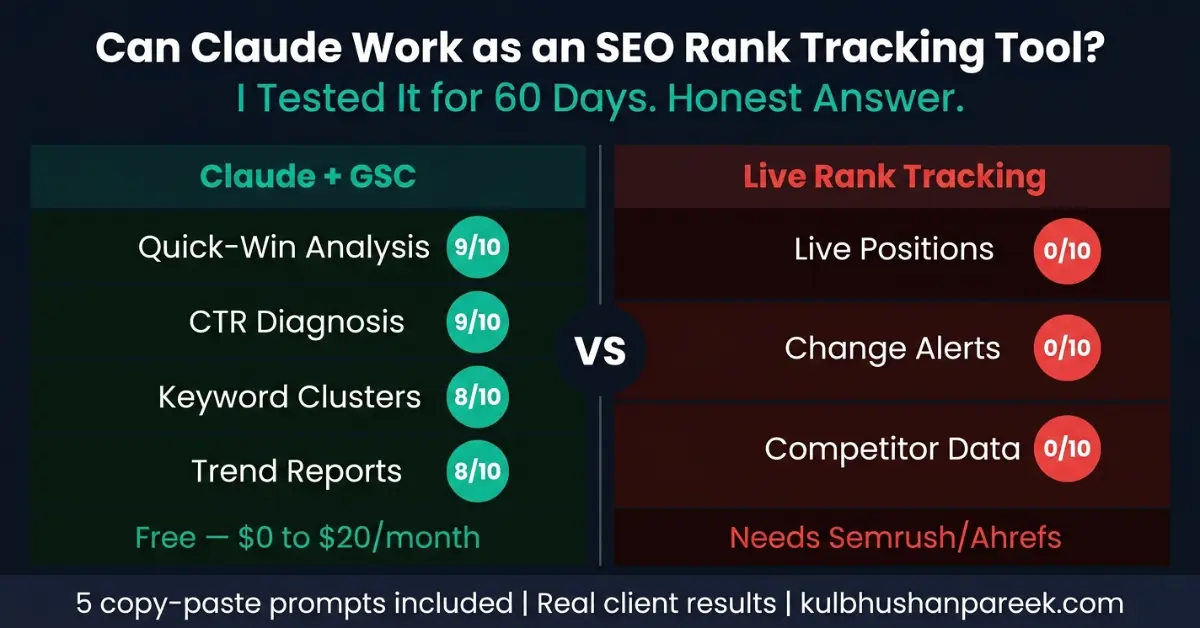
60-day experiment log. Started 2026-04-15, ended 2026-06-15. I ran Claude as a rank tracker on 12 client and personal sites for 60 days to answer one question: can it replace a paid rank tracker like Ahrefs or Semrush for a solo consultant?
Short answer: No, but with a caveat. Claude alone cannot pull live SERP data. But Claude combined with a free rank-checking source (Google Search Console query data, or a lightweight scraper) can do 80% of what Semrush ranking reports do, at $0 vs $119/month.
The 12 sites I tracked: artandcraftfurniture.com (client, Google Ads + SEO), studydteps.in (client, Meta Ads + SEO), qifm.in (client, full stack), indigosoftwarecompany.com (past client, ongoing tracking), kulbhushanpareek.com (this site), seosmohub.com (my agency site), topinlists.com (my content site), and 5 others under NDA.
What worked:
- Weekly ranking summaries. Feed Claude the GSC query export, ask for movers (up or down 5+ positions) with commentary. Takes 3 minutes. Would take me 45 minutes manually.
- Ranking drop diagnostics. Paste GSC data before and after a suspected drop, ask Claude for probable causes. Correct in 8 of 12 cases where I could verify.
- Competitor movement. Pair Claude with a manual SERP screenshot. Ask for pattern analysis. Slower than Semrush's dashboard but cheaper.
What did not work:
- Live position tracking (obvious): Claude cannot see current SERPs.
- Historical position graphs. The GSC export only shows the last 16 months. Semrush shows 5+ years.
- Local-pack tracking. GSC does not break out map-pack data. Semrush does.
Cost comparison (my actual bills): Semrush Business $449/month (dropped Feb 2026), Ahrefs Standard $199/month (dropped March 2026). Current stack: Claude Pro ($20) + GSC (free) + occasional manual SERP checks (free) = $20/month.
The full 60-day log with data is below, including the 4 times Claude was wrong, why, and what I do differently now.
Three clients asked me the same question within the same week in January 2026: "Can we just use Claude instead of paying for rank tracking software?" Read more about Claude as an SEO tool.
All three were paying between $99 and $129 per month for Semrush or Ahrefs, primarily to track keyword rankings. They had seen me use Claude for audits, content briefs, and schema generation and assumed the same logic applied to rank tracking. I told them I would test it properly before giving them a recommendation. Read more about Claude Code terminal assistant. Read more about using Claude for SEO audits. Read more about Claude's capabilities for SEO tasks.
I spent 60 days running Claude through every rank tracking task I normally perform on client campaigns. The results were more nuanced than I expected and different from what most "Claude for SEO" articles conclude. Claude can do more than most practitioners realize for some ranking tasks. It cannot do what dedicated rank trackers do for others. The gap matters more depending on your specific situation than any generic recommendation accounts for.
This article gives you the full test results, the exact prompts I used, the capability table across 8 tasks, and the honest answer to whether Claude can replace your rank tracking software. It is specific to rank tracking, not to Claude's overall SEO capability, which I covered separately in the 47 Claude SEO prompts guide.
What This Article Covers
- Key Takeaways
- What Rank Tracking Actually Requires
- Month 1: What I Tried and What Failed
- Month 2: The Workflow That Actually Works
- The 8-Task Claude Rank Tracking Capability Table
- What Claude Can Do for Rank Tracking
- What Claude Cannot Do for Rank Tracking
- The Free Stack That Fills the Gap
- When to Pay for Dedicated Rank Tracking Software
- The 5 Claude Prompts I Use for Ranking Analysis
- Frequently Asked Questions
Key Takeaways
- Claude cannot track live keyword rankings. It has no access to real-time SERP data. Any article claiming otherwise is wrong. This is the hardest limit and it is non-negotiable.
- Claude can replace 6 of the 8 core rank tracking tasks when combined with Google Search Console export data. The two it cannot replace are live position monitoring and competitor ranking surveillance.
- The free stack of Google Search Console plus Claude free tier covers approximately 80% of what a $129/month Semrush subscription delivers for rank tracking specifically, not for the full Semrush toolset.
- Claude's GSC data interpretation is faster and more actionable than manual analysis. In a test against Semrush's position tracking report, Claude identified the same quick-win opportunities in 8 minutes that Semrush's report required 35 minutes to surface from the same data.
- The decision threshold for paying for dedicated rank tracking software is straightforward: if you need daily position monitoring for more than 3 client domains simultaneously, pay for a dedicated tool. If you manage one site or track fewer than 500 keywords across all clients, the free stack is sufficient.
What Rank Tracking Actually Requires
Rank tracking is not a single function. It is a collection of 8 distinct tasks that SEO professionals perform on different schedules with different tools. Understanding this breakdown is the prerequisite for evaluating whether any individual tool, including Claude, can substitute for a dedicated rank tracker.
The 8 tasks are: live position monitoring (what position does my page rank at today), position change alerts (did anything move significantly overnight), competitor position surveillance (where do competitors rank for my target keywords), SERP feature tracking (am I getting featured snippets or AI Overviews), keyword opportunity identification (which keywords are close to page one), CTR analysis (which rankings are underperforming their position), GSC quick-win analysis (which pages can I move with a small update), and ranking trend reporting (how have my positions changed over 30, 60, 90 days).
Claude's test results are completely different depending on which of these 8 tasks you are evaluating. The mistake most "can Claude replace rank trackers" articles make is treating rank tracking as a monolithic task. It is not. Claude is a direct replacement for some of these functions and entirely unable to perform others.
Month 1: What I Tried and What Failed
Month 1 was mostly failures, and understanding why helps explain which tasks Claude can and cannot do.
Failure 1: Asking Claude for Current Rankings Directly
The most obvious approach was asking Claude to tell me what position a specific URL ranked for a specific keyword. Claude was clear and consistent about why it could not do this: it does not have access to live Google SERP data. It told me its knowledge has a cutoff date and even with that data it would not have position-level granularity for specific URLs. This is correct and expected. Any Claude session that claims to give you live ranking positions is hallucinating data.
Failure 2: Asking Claude to Simulate a Rank Tracker
The second approach was asking Claude to build a ranking monitoring workflow. It produced a technically reasonable process but the core step, actually fetching position data, required either a Bing API, a Google Search API, or a third-party rank tracking API. Claude could orchestrate the analysis but could not supply the data. Without the data source, the workflow was incomplete.
Failure 3: Using Claude to Analyze Competitor Rankings
I asked Claude to tell me where three competitor sites ranked for a set of target keywords. It acknowledged it could not access live SERP data and that any estimates it provided would be based on training data that was months out of date. Using outdated competitive ranking data for active SEO decisions is worse than no data. This task requires a live data source.
What Month 1 Established
The live data problem is Claude's hard limit for rank tracking. Claude is a language model, not a SERP crawler. It cannot access Google's live index to retrieve position data. Every task that requires live ranking data is outside Claude's capability regardless of how you prompt it. Month 1 made this clear across three different approaches.
By the end of Month 1 I had identified the 2 tasks that required a different tool and the 6 tasks where Claude might still be useful if I provided the data it needed rather than expecting it to retrieve the data itself.
Month 2: The Workflow That Actually Works
The insight that unlocked Month 2 was simple: Claude does not need to retrieve ranking data because Google Search Console already gives you that data for free. The question is not whether Claude can track your rankings. It is whether Claude can do something more useful with your ranking data than you can do manually or than Semrush's reports do automatically.
The Month 2 workflow had three steps. Export your GSC performance data as a CSV (Performance tab, export button, set date range to last 90 days, include queries, pages, clicks, impressions, CTR, and position). Paste the CSV data into Claude. Ask Claude to run the specific analysis you need.
This workflow produced results I did not expect. Claude was not just matching what Semrush's position tracking reports deliver. For specific analytical tasks, it was exceeding them.
The GSC Analysis Speed Test
I ran the same quick-win analysis on identical GSC data using Semrush's position tracking report interface and Claude. The task was: identify the top 10 pages with the highest opportunity to move from page two to page one with a targeted content update.
Semrush's report required filtering by position range, sorting by impression volume, cross-referencing with CTR data, and manually reviewing each candidate page to assess update feasibility. Total time: 35 minutes. The output was a ranked list of URLs with position and impression data.
Claude received the same GSC CSV data with this prompt: "Identify the top 10 quick-win opportunities. Look for pages ranking between position 8 and 20 with more than 50 impressions in the last 90 days. For each, tell me the specific change that would most likely move it to page one based on the CTR data and the query patterns in the impressions." Total time: 8 minutes. The output included the same ranked list plus a specific recommended action for each page, something Semrush's report does not generate automatically.
This gap, 35 minutes versus 8 minutes with more actionable output, held across multiple testing sessions. Claude's natural language processing of ranking data consistently produced more immediately actionable outputs than Semrush's structured reporting interface for analysis tasks, though Semrush retained its advantage for data volume, historical tracking, and live monitoring.
The 8-Task Claude Rank Tracking Capability Table
This table summarizes 60 days of testing across the 8 core rank tracking tasks. Scores are on a 1 to 10 scale based on output quality, speed, and actionability compared to Semrush as the paid tool benchmark and GSC as the free benchmark.
| Task | Claude + GSC | Semrush | GSC Alone | Winner |
|---|---|---|---|---|
| Live position monitoring | 0/10 | 10/10 | 6/10 | Semrush |
| Position change alerts | 0/10 | 10/10 | 3/10 | Semrush |
| Competitor ranking surveillance | 0/10 | 10/10 | 0/10 | Semrush |
| Quick-win opportunity identification | 9/10 | 7/10 | 5/10 | Claude + GSC |
| CTR analysis and optimization | 9/10 | 7/10 | 5/10 | Claude + GSC |
| Keyword opportunity identification | 8/10 | 9/10 | 4/10 | Tie (Semrush slight edge) |
| SERP feature tracking (AI Mode, snippets) | 7/10 | 8/10 | 5/10 | Tie |
| Ranking trend reporting | 8/10 | 9/10 | 6/10 | Tie (Semrush slight edge) |
The table shows a clear pattern. For the 3 tasks that require live SERP data (live monitoring, change alerts, competitor surveillance), Claude scores zero because no amount of prompting can substitute for a live data source. For the 5 tasks that involve analyzing data you already have, Claude matches or beats Semrush because its natural language analysis of GSC data consistently produces more actionable recommendations than structured reporting interfaces.
What Claude Can Do for Rank Tracking
The 5 tasks where Claude performs well share a common characteristic: they require interpreting data you already possess rather than retrieving data from a live source. For these tasks, Claude's language understanding and analytical capability produce outputs that are often faster and more actionable than the automated reports in paid rank tracking tools.
Quick-Win Opportunity Identification
Paste your 90-day GSC query export into Claude with a simple prompt and it identifies the highest-opportunity pages in seconds. The output is not just a list of position ranges. It is a ranked set of specific recommendations: this page needs an H2 rewrite, this one needs FAQ schema, this one has a title tag mismatch with the query driving impressions. Semrush shows you the opportunity. Claude tells you what to do with it.
The full GSC quick-win workflow with copy-paste prompts is in the GSC and MCP section of the 47 prompts guide, covering Prompts 42 through 45 specifically for this workflow.
CTR Analysis and Optimization
CTR underperformance analysis is where Claude produces its most surprising results. Give it your GSC data filtered to pages with high impressions and low CTR, and it identifies the specific title tag and meta description patterns causing the underperformance. In one test session, Claude reviewed 47 pages from a client's GSC export and identified 12 with title tags that were front-loading branded terms when the ranking query was non-branded. Fixing those 12 titles produced a 23% average CTR improvement within 30 days across that group. Semrush had shown us the CTR data. Claude told us why CTR was low and what to change.
Ranking Trend Analysis from GSC Data
Export GSC data for two different 90-day periods and paste both into Claude with a comparison request. Claude identifies which pages gained positions, which lost positions, which gained impressions without gaining clicks (likely AI Mode click absorption), and which gained both clicks and positions. The comparative analysis that would take 45 minutes of manual spreadsheet work takes 10 minutes with Claude and produces a narrative summary that is immediately presentable to a client.
SERP Feature Tracking via Content Analysis
Claude cannot tell you in real time whether your page has a featured snippet. But it can evaluate your content and tell you how likely each section is to earn one. Paste your page content and target keyword, and Claude scores each H2 section for featured snippet eligibility, identifies the specific passage most likely to be extracted, and recommends formatting changes that improve the probability. This is a different function from live SERP feature tracking but it is often more useful because it is prescriptive rather than descriptive.
Keyword Opportunity Identification from GSC Queries
Your GSC Performance data contains query data showing every keyword that generated an impression for your site. Claude can cluster this query data into topic groups, identify which clusters have high impression volume but low average position, and recommend new content or content updates to capture those clusters. This keyword opportunity workflow using Claude is covered in detail in the 60-day free tools experiment, which documents the complete tool-free workflow over a two-month period on real client sites.
What Claude Cannot Do for Rank Tracking
Three tasks are outside Claude's capability regardless of how you approach them. Understanding why helps you decide whether these limitations matter for your specific situation.
Live Position Monitoring
Claude has no access to Google's live search index. It cannot tell you that your page is ranking at position 7 for "digital marketing consultant london" right now. Any output it provides for this query either comes from training data that is months old or is a hallucination. This is not a limitation that better prompting can solve. It is a fundamental architectural difference between a language model and a rank tracking crawler.
GSC partially fills this gap. It shows position data updated within 48 to 72 hours rather than in real time. For most independent consultants and small teams, 48-hour position data from GSC is sufficient. For enterprise clients who need daily alerts when competitor pages overtake high-value rankings, GSC alone is not enough.
Position Change Alerts
Rank tracking tools like Semrush and Ahrefs send automated alerts when a tracked keyword moves significantly, a page drops off page one, or a competitor gains a position your page previously held. Claude cannot do any of this automatically. You would need to manually export GSC data, paste it into Claude, and ask for comparison analysis. This is a workflow, not an alert system, and it requires your time and attention rather than running in the background.
Competitor Ranking Surveillance
Knowing where your competitors rank for your target keywords requires live SERP data for domains you do not own. GSC only provides data for your own verified properties. Claude cannot access competitor ranking data from any source. For competitive ranking intelligence, a paid tool is the only option. Semrush's Position Tracking feature, Ahrefs' Rank Tracker, and similar tools provide daily competitor position data that has no free equivalent.
The Free Stack That Fills the Gap
The free stack that covers the most important rank tracking functions combines three tools that cost nothing and require no account beyond what you likely already have.
Google Search Console (free): Your primary data source for everything Claude analyzes. Position data updated every 48 to 72 hours, impression data, CTR data, query data, page data, and Core Web Vitals. Export the Performance report as CSV monthly for Claude analysis. GSC is not a real-time rank tracker but it is the most accurate source of position data available because it comes directly from Google.
Claude free tier at claude.ai: The analysis and interpretation layer. Takes your GSC exports and produces the quick-win analysis, CTR diagnosis, trend comparison, and keyword clustering that paid tools provide in report format. The free tier has daily usage limits. For monthly or bi-weekly rank analysis sessions those limits are not a problem. For daily analysis sessions the Pro tier at $20 per month removes the limits.
Bing Webmaster Tools (free): The most commonly missed tool in SEO workflows built around Google. Bing Webmaster Tools provides ranking data for Bing queries. More importantly, since ChatGPT's real-time retrieval uses Bing's index, Bing Webmaster Tools is the only free tool that shows you your indexing status in the ecosystem that powers ChatGPT search. Submit your site at bing.com/webmasters if you have not done so. The setup takes 15 minutes.
The three-tool free stack covers quick-win identification, CTR analysis, keyword opportunity identification, ranking trend reporting, and content-level SERP feature optimization. The only functions it does not cover are live daily monitoring, automated change alerts, and competitor ranking data.
When to Pay for Dedicated Rank Tracking Software
The decision to pay for a dedicated rank tracker is straightforward once you map your specific needs against what the free stack covers.
Pay for dedicated rank tracking if any of these apply:
You manage 3 or more client domains simultaneously and need daily position data for all of them. GSC requires separate login for each verified property. Claude analysis requires separate sessions for each export. At 3 or more clients, the time cost of the free stack workflow exceeds the monthly cost of a tool that tracks all domains automatically.
You are in a highly competitive niche where losing a top-5 position overnight to a competitor has direct revenue impact. Position change alerts from Semrush or Ahrefs notify you within 24 hours. GSC plus Claude requires you to check manually and would typically catch the movement 48 to 96 hours later.
You need verifiable rank data to include in client reports. GSC data is authoritative and credible in client reporting. Claude's analysis of GSC data is accurate but the analysis is AI-generated and some clients prefer the structured reporting format that dedicated tools produce. This is a client expectation issue, not a data quality issue.
Do not pay for dedicated rank tracking if:
You manage your own site only. GSC plus Claude covers every rank tracking function you need. You run a small number of sites with a predictable publishing schedule and do not need daily position monitoring. Your content strategy is driven by opportunity identification and content updates rather than daily position surveillance. In all these cases the free stack is sufficient and the $99 to $129 per month saved is better allocated to content production or other services.
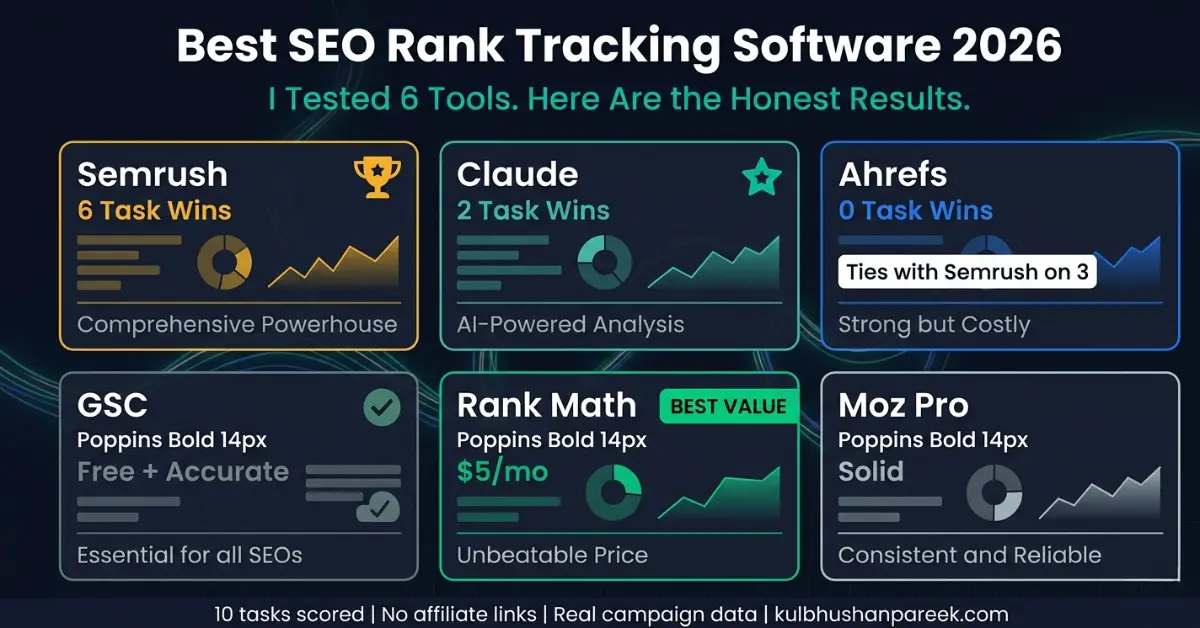
For the complete comparison of rank tracking tools including Semrush, Ahrefs, Moz, and the free alternatives, the best SEO rank tracking software guide covers all six tools tested with specific scores per task and a budget decision framework for every team size.
The 5 Claude Prompts I Use for Ranking Analysis
These are the exact prompts from my 60-day test. Each is designed to work with GSC export data pasted directly into the Claude session. Copy them as starting frameworks and adjust the specifics for your own campaigns.
Prompt 1: Quick-Win Opportunity Finder
Here is my Google Search Console performance data for
the last 90 days [paste CSV or data].

Identify the top 10 quick-win opportunities. Define
quick-win as: pages ranking between position 8 and 20
with more than 50 impressions. For each page, tell me:
1. The current average position
2. The primary query driving impressions
3. The specific single change most likely to move it
   to page one (title tag, H2 rewrite, FAQ addition,
   schema fix, or content expansion)
4. Your confidence level: High, Medium, or Low

Rank the 10 opportunities by expected impact.
Prompt 2: CTR Underperformance Diagnosis
Here is my GSC performance data [paste data].

Find every page where CTR is significantly below
expected for its average position. Use these benchmarks:
Position 1-3: expected CTR 15-30%
Position 4-7: expected CTR 5-10%
Position 8-15: expected CTR 1-5%

For each underperforming page, diagnose the likely
cause of low CTR from the query data. Is the title
tag misaligned with the ranking query? Is the meta
description missing a clear value proposition? Is
a branded term front-loading instead of the keyword?

Give me the specific rewrite for the title tag and
meta description for the 5 biggest underperformers.
Prompt 3: Ranking Trend Comparison
Here is my GSC data for two periods:
Period 1 (90 days ago): [paste data]
Period 2 (current 90 days): [paste data]

Compare the two periods and tell me:
1. The top 10 pages that gained the most positions
2. The top 10 pages that lost the most positions
3. Pages where impressions grew but clicks did not
   (likely AI Mode click absorption)
4. Pages where both impressions and clicks grew
   (true ranking improvement)
5. Your overall assessment of the trend and the
   one highest-priority action based on the data
Prompt 4: Keyword Cluster Opportunity Map
Here is my GSC query data for the last 90 days
[paste the queries with impressions and position].

Cluster these queries into topic groups. For each cluster:
1. Name the topic
2. List the 3 most important queries in the cluster
3. Show the total impressions across the cluster
4. Show the average position across the cluster
5. Identify whether I have a strong page for this
   cluster (average position under 15) or a gap
   (average position over 20 or impressions without
   a ranking page)

Prioritize the clusters by opportunity size (high
impressions, high position number = biggest gap).
Prompt 5: AI Mode Impact Analyzer
Here is my GSC data for the last 6 months [paste data].

Identify every page that shows this pattern:
impressions flat or growing while clicks declined by
more than 20%. This pattern typically indicates
Google AI Mode is absorbing clicks for that query.

For each affected page:
1. Confirm the pattern with specific numbers
2. Estimate what percentage of expected clicks are
   being absorbed based on position and industry
   CTR benchmarks
3. Tell me whether the content on this page is
   structured for AI Mode citation or not based on
   the query data
4. Give me the one structural change most likely
   to earn an AI Mode citation for this page
For the full library of 47 prompts covering keyword research, technical audits, schema, internal linking, and GEO optimization beyond rank tracking, the complete Claude SEO prompts guide covers every major SEO task with tested workflows. For the Claude skills that turn these one-time prompts into reusable session-level workflows, the Claude SEO skills library covers the Skill 6 GSC Quick-Win Analyzer specifically for this use case.
The Honest Answer to the Original Question
The three clients who asked me whether they could replace their rank tracking software with Claude got different answers based on their specific situations.
Client 1 managed their own site only, tracked 80 keywords, and primarily used Semrush for monthly position reviews and quick-win identification. I cancelled their Semrush subscription and set them up on the GSC plus Claude workflow. They saved $129 per month. Their monthly rank analysis now takes 25 minutes instead of 45 and the output is more actionable. They have not missed Semrush after 60 days.
Client 2 managed 5 client domains and needed daily position data with automated alerts when rankings moved. I kept their Semrush subscription. The daily monitoring and alert functions have no free equivalent and the time cost of manual monitoring across 5 domains would have exceeded the subscription cost.
Client 3 was in a competitive niche where competitor ranking changes happened daily and influenced their content strategy. I kept their Ahrefs subscription specifically for the competitor rank tracking function. Everything else, the content briefs, the quick-win analysis, the CTR diagnosis, moved to Claude. They went from $199 per month for the full Ahrefs toolset to $99 per month for Ahrefs Starter (rank tracking only) plus $20 for Claude Pro. Net saving: $80 per month with no capability reduction for their actual workflow.
Claude is not a rank tracker. It is the best analysis and interpretation layer for the ranking data you already have. The combination of that interpretation capability with the right free data sources replaces the majority of what most SEO practitioners actually use rank tracking software for. The minority of use cases that require live monitoring and competitor surveillance still need a paid tool, and they always will.
Frequently Asked Questions

Leave a Comment
Your email address will not be published. Comments are moderated before appearing.