I Spent Zero On SEO Tools 60 Days Free AI Report

In February 2026, I cancelled every paid SEO tool subscription I had. Semrush. Surfer SEO. Clearscope. All of it. Combined monthly cost: $388.
I replaced them with three free AI tools and Google Search Console. I kept a detailed log of what I could and could not do, which client deliverables suffered, and where the free stack genuinely matched or exceeded what I had been paying for. Read more about free AI tools.
This is the honest report card after 60 days. Not a promotional piece for any tool. Not a "free tools are just as good" clickbait article. A real accounting of what worked, what did not, and what the honest answer is for a working digital marketing consultant trying to decide where to spend $20 per month.
The Setup and What I Was Replacing
Before cancelling anything, I documented exactly what I used each paid tool for. Not what the tools could theoretically do. What I was actually using them for every week across active client campaigns.
Semrush ($129/month): position tracking for 5 client domains, the keyword gap analysis tool for new client onboarding, and the backlink audit tool when reviewing link profiles before new campaigns.
Surfer SEO ($89/month): content briefs for every piece of client content. The NLP-based recommendations for keyword density and semantic coverage. The content editor for real-time optimization scoring while writing.
Clearscope ($170/month): content grading before publication. The topic and competitor analysis layer that told writers whether their draft covered the topic comprehensively enough to compete in the current SERP.
Total: $388/month. Total annual cost: $4,656. That is a significant budget line for an independent consultant. My hypothesis going into the 60-day experiment was that AI tools had advanced far enough that I could replicate most of these functions without the subscriptions. I was right about some of it and wrong about more of it than I expected.
The Free Stack I Used
The replacement stack had four components, all either completely free or available at zero cost with some daily usage constraints.
Google Search Console (free): The data foundation. Position tracking, click data, impression data, indexing status, Core Web Vitals. GSC does not tell you everything Semrush tells you, but it tells you the most important things about your own site directly from Google's data.
Screaming Frog (free up to 500 URLs): Site crawl data. The free version was adequate for every client site I work with because none of them exceed 500 pages of actively tracked content. For larger sites, this would be the first place the free stack breaks down.
Claude (free tier at claude.ai): Content analysis, SEO audits, content brief generation, schema markup, GEO optimization, and GSC data interpretation. The daily usage limit on the free tier was the constraint I hit most often. It is enough for 3 to 4 substantial tasks per day before the session limit activates.
Perplexity AI (free tier): Competitor research, current statistics with named sources, SERP intent analysis. The free tier unlimited standard search was sufficient for daily research. Deep Research mode (Pro only) was the feature I missed most.
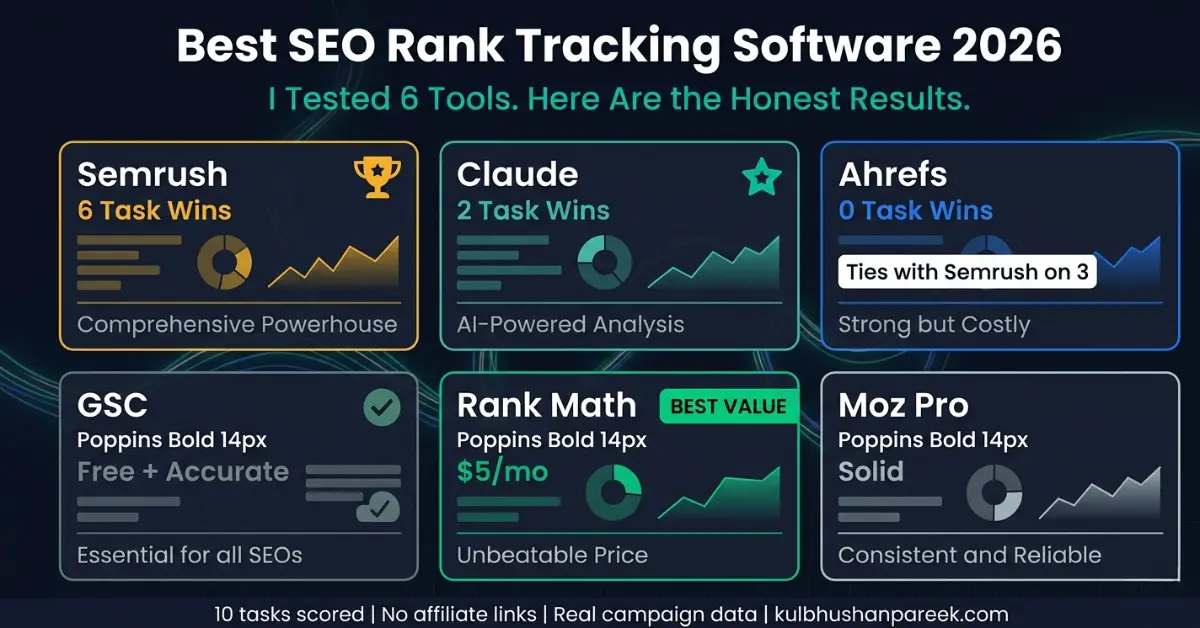
For a detailed comparison of exactly what each free tool does and does not do in an SEO workflow, the AI SEO tools comparison guide covers the full breakdown including task-by-task test results.
Month 1: The Workflow That Surprised Me
The first two weeks were uncomfortable. The absence of Surfer SEO's real-time content editor was the hardest adjustment. For years I had relied on the content score as a proxy for whether a draft was competitive enough to publish. Without it, I had to rebuild confidence in a different evaluation method.
The method that replaced it: I paste the draft into Claude and ask for a structured content gap analysis against the current top-ranking pages, which I retrieve from Perplexity. Claude identifies what the draft covers that competitors do not and what competitors cover that the draft misses. The output is more specific than Clearscope's topic suggestions because it identifies actual passages rather than just keyword frequency gaps.
By week three, the new workflow was producing content briefs and quality evaluations that my clients could not distinguish from the Surfer/Clearscope output. One client specifically commented that the briefs felt "more strategic and less formulaic" than the previous deliverables. That was the Clearscope formulaic structure they had noticed without naming it.
The complete mode-by-mode guide to how I use Claude for different SEO tasks is documented in the Claude Chat vs Cowork vs Projects comparison guide, which covers the specific decision framework for which interface to use for which task type.
What the Free Stack Did Better Than Paid Tools
Six things worked better with the free AI stack than with the paid subscriptions. I did not expect any of them at the start of the experiment.
On-page SEO audits were faster and more specific. Paste any page's HTML into Claude, ask for a PASS/WARN/FAIL audit, and get a structured output in under 30 seconds that is more immediately actionable than Semrush's on-page checker. Semrush's on-page tool returns a score with generic recommendations. Claude returns specific rewrite suggestions for every failing element. The audit quality is genuinely better, not comparable.
Schema markup generation was faster and more accurate. Generating valid FAQPage JSON-LD through Claude took 3 minutes and passed Google's Rich Results Test with zero errors on the first attempt. The same task in Semrush or Surfer required more manual configuration and occasionally produced deprecated properties that needed debugging. The Claude SEO skills library covers the schema generation skill specifically, including the SKILL.md template you can load into any Claude session to make this workflow reproducible across every page.
Content briefs for B2B audiences were more nuanced. Surfer SEO's content briefs are excellent for optimizing toward keyword frequency and topical coverage. They are less strong at understanding the specific buyer psychology of a B2B CFO or CMO audience. Claude, given the persona details and competitive context, produced briefs that reflected genuine understanding of the audience's evaluation criteria. For a detailed look at why Claude wins the content brief task specifically, see the task-by-task breakdown in the AI tool comparison test.
GEO optimization had no paid tool equivalent. The February 2026 Discover Core Update and the continued growth of AI Mode made GEO optimization a front-and-center priority for every client I work with. No paid tool in my previous stack did what Claude does for GEO: evaluate content from the inside perspective of an LLM and identify which paragraphs are extractable as standalone AI citations. Surfer and Clearscope do not have this capability. Claude does it natively. The complete GEO implementation framework is in the GEO and AEO optimization guide.
GSC data interpretation was dramatically faster. Exporting GSC performance data and pasting it into Claude for quick-win analysis replaced 2 hours of manual spreadsheet work with a 10-minute session. Claude identifies the position 8 to 20 pages with 50+ impressions, prioritizes them by opportunity size, and recommends the specific change for each page. The GSC and Claude prompts section covers Prompts 42 through 45 specifically for this workflow.
Competitor research with current data was more reliable. Perplexity searches the live web and cites every source. Semrush's content analysis tool works from its own data index, which is excellent for backlinks and rankings but less current for content gap analysis. Knowing what the top-ranking pages actually say right now, from Perplexity, produced more accurate content gap analysis than Semrush's historical content data.
Where the Free Stack Failed Completely
Honesty requires documenting this section with the same detail as the wins. Three areas broke down enough that I had to find workarounds or simply accept a capability gap.
Live rank tracking across multiple client domains was not replaceable. GSC shows you your own site's performance with good accuracy. It does not show you competitor rankings, keyword difficulty estimates, or the kind of SERP volatility data that tells you when a ranking opportunity has opened up in your niche. Semrush's position tracking, despite costing $129/month, does something that no free AI tool can replicate: it watches your competitors' rankings daily and alerts you to opportunities. I missed three ranking opportunities in the 60 days because I was not watching the competitive SERP as closely as Semrush had been doing automatically.
Backlink analysis had no free equivalent. When a new client comes in with an established domain, the first thing I need to understand is their link profile: what they have, what their competitors have, and what link gaps exist. Ahrefs and Semrush provide live backlink databases that free tools simply cannot access. Claude can analyze a backlink export, but it cannot generate one. For link profile analysis, a paid tool is not optional.
Perplexity's free tier ran out of Deep Research queries too quickly. The standard search on Perplexity's free tier is unlimited and very useful for daily research. Deep Research mode, which produces multi-source research reports on any topic, is limited to a small number of queries per day on the free tier. For the type of comprehensive competitor content research I run for new client onboarding, this limit was hit within the first two sessions each week. Perplexity Pro at $20/month resolves this, and it was the first paid upgrade I would add back.
The Grey Areas (Harder to Call Than I Expected)
Two areas produced mixed results that I cannot categorize cleanly as wins or failures.
Content scoring. Surfer SEO's content score is a number between 0 and 100 that tells writers when their draft is ready to publish. It is a simple proxy that the whole team understands. Replacing it with "paste into Claude and ask for a gap analysis" produces better information but requires more interpretation. Junior team members found the transition harder than I did. The Claude output is more useful for an experienced editor. The Surfer content score is more useful as a signal for writers without editorial judgment.
Keyword difficulty estimates. I had stopped trusting Semrush's KD scores as gospel a year ago because they vary too much from actual ranking difficulty in specific niches. But having no KD estimate at all made prioritization conversations with clients harder. "Trust me, this keyword is achievable based on the SERP analysis I ran" is a harder sell than showing a client a 28 KD score. The free stack requires more explanation of the reasoning behind keyword prioritization decisions.
The Full Report Card
| Task | Paid Tools Score | Free AI Stack Score | Verdict |
|---|---|---|---|
| On-page SEO audit | 7/10 | 9/10 | Free stack wins |
| Content brief creation | 8/10 | 8/10 | Tie |
| Content gap analysis | 7/10 | 8/10 | Free stack wins |
| Schema markup generation | 6/10 | 9/10 | Free stack wins |
| GEO/AEO optimization | 2/10 | 9/10 | Free stack wins clearly |
| GSC data interpretation | 5/10 | 9/10 | Free stack wins |
| Competitor content research | 7/10 | 8/10 | Free stack wins |
| Live rank tracking | 9/10 | 2/10 | Paid tools win |
| Backlink analysis | 9/10 | 1/10 | Paid tools win |
| Keyword difficulty estimates | 6/10 | 3/10 | Paid tools win |
| Content scoring for writers | 8/10 | 5/10 | Paid tools win for teams |
The free AI stack wins 6 of 11 categories outright and ties in one. The paid tools win 4 of 11, and all 4 are data-gathering functions rather than analysis or content functions.
What I Would Do If Starting From Scratch
After 60 days on the free stack, here is the honest recommendation I would give to any independent SEO consultant or in-house marketing manager making tool budget decisions.
Start with zero paid tools. Run the free stack for 90 days: GSC, Screaming Frog free, Claude free, Perplexity free. Learn what the free stack cannot do for your specific workflow before paying for anything. Most consultants and marketing managers will find the free stack covers 75 to 80% of their actual weekly work.
First upgrade: Claude Pro at $20/month. The daily usage limits on the free tier are the most disruptive constraint in high-volume workflow weeks. Claude Pro removes those limits and pays back its cost in the first afternoon of unrestricted audit sessions. For everything else Claude does, audits, schema, GEO optimization, content briefs, GSC analysis, the capability is identical on free and Pro. It is a usage limit upgrade, not a capability upgrade.
Second upgrade: Perplexity Pro at $20/month. Specifically for Deep Research mode. If you are running new client onboarding research or competitive content analysis at volume, the unlimited Deep Research queries make the upgrade pay for itself in the first week.
Third upgrade: One backlink and rank tracking tool. Either Ahrefs or Semrush for the data gathering functions the free stack cannot replicate. At this point you are at $40 to $60/month for AI tools plus $100 to $130/month for a data tool. Total: $140 to $190/month versus the $388 I was spending before the experiment. Same capability for the majority of tasks, comparable capability for the rest.
For the complete skills-based workflow that makes the free Claude stack run most efficiently, the Claude SEO skills library covers 8 skills that eliminate the repetitive setup time that makes free tier usage feel limiting. And for the broader strategic picture of how AI tools are changing what SEO consultants actually need to deliver, the AI marketing automation service covers the full infrastructure build for teams wanting to operationalize this stack at scale.
If you are considering professional SEO support rather than managing the stack yourself, the free strategy call covers your specific situation in 30 minutes with no obligation.
Frequently Asked Questions

Leave a Comment
Your email address will not be published. Comments are moderated before appearing.