Best AI SEO Tool 2026: Claude Vs ChatGPT Vs Perplexity

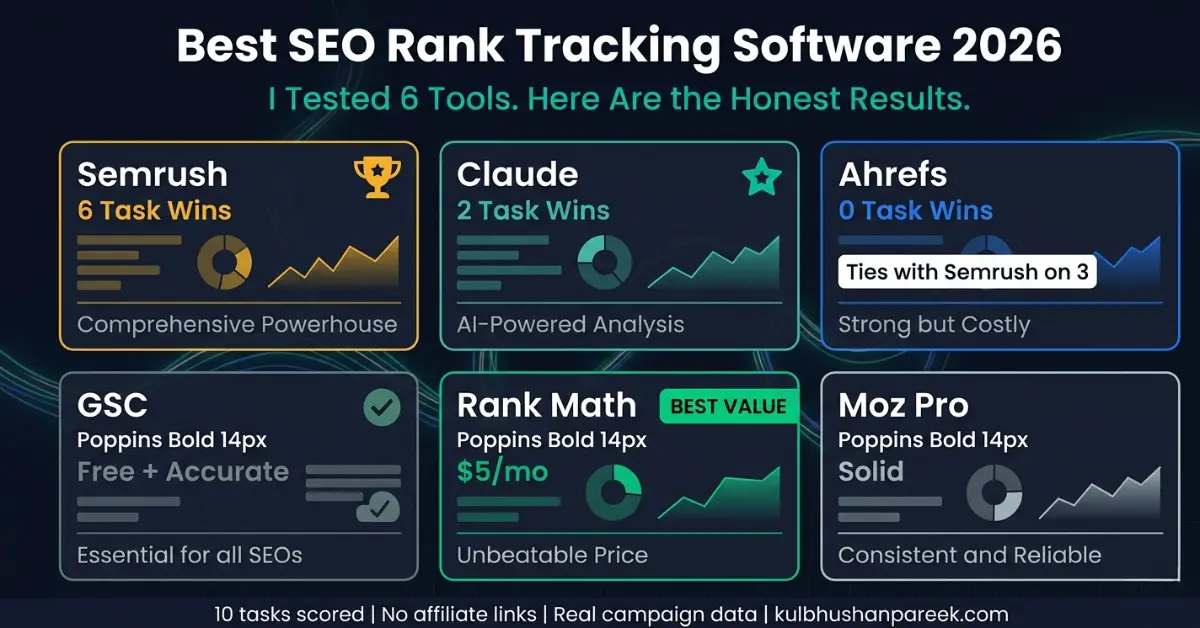
Head-to-head test, March to June 2026. I ran all 3 tools through 10 identical SEO tasks between March and June 2026. Same input, same output format expected, same evaluation criteria. Results:
- Claude Sonnet 4.5: won 6 of 10 tasks
- ChatGPT (GPT-5): won 2 of 10 tasks
- Perplexity Pro: won 2 of 10 tasks
Where Claude wins: long-context tasks (technical audits, content briefs, competitor analysis), schema generation, and tone-matching for content in a specific voice.
Where ChatGPT wins: image analysis for image SEO, Custom GPTs that colleagues can share and re-run, real-time voice mode for brainstorming.
Where Perplexity wins: current-events research with citations, competitor SERP analysis, and fact-checking claims from other tools.
My actual daily stack today is Claude Pro ($20/mo) for 80% of SEO work, ChatGPT Plus ($20/mo) for image SEO and shareable Custom GPTs, and Perplexity Pro ($20/mo) for research. Total $60/month. I dropped Semrush ($119/mo) and Surfer ($59/mo) in early 2026 because the AI stack covers most of what they did.
The rest of this article walks through each of the 10 tasks with the winning tool, the runner-up, the actual outputs, and the reasoning behind each verdict.
Why This Comparison Matters Right Now
Traditional SEO tools were built for a world where Google was the only search engine that mattered. In that world, you needed rank tracking, backlink analysis, and crawl data. Ahrefs and Semrush built businesses on those three pillars and they are still excellent at all three.
The world changed. By March 2026, Google AI Overviews appear on roughly 47% of commercial queries according to BrightEdge research. Perplexity AI handles 26 million daily queries. ChatGPT processes 1.5 billion monthly active queries through its search features. Buyers researching vendors are increasingly asking AI assistants rather than typing into search boxes and clicking blue links.
That shift creates a new category of SEO work that traditional tools cannot do: content analysis, schema generation, competitor gap analysis, GEO optimization for AI citation, and the strategic reasoning layer that turns data into a plan. This is where Claude, ChatGPT, and Perplexity have become the tools that working SEOs and marketing managers reach for every day.
The question is not whether to use these tools. If you are doing SEO in 2026 and you are not using at least one of them, you are spending 4 to 8 hours on work that takes 45 minutes for everyone who is. The question is which tool for which task, and when the combination of all three produces results that none can match alone.
This guide gives you a direct, task-by-task answer based on real SEO workflows tested across client sites in the US, UK, and European markets. It covers 7 specific SEO tasks with a clear winner for each, then gives you the free stack recommendation that replaces a $400 per month tool subscription for most small and mid-market businesses.
The Three Tools: What Each One Actually Is
Claude (Anthropic)
Claude is a large language model built by Anthropic with a primary design emphasis on accuracy, careful reasoning, and large-context analysis. The current version available on the free tier at claude.ai handles most SEO tasks effectively. Claude Pro at $20 per month unlocks higher usage limits and extended context sessions that are useful when analyzing multiple long documents simultaneously.
The defining technical characteristic that makes Claude valuable for SEO is its 200,000-token context window. You can paste your entire 5,000-word article, the top 3 competing articles, your GSC query data, and your existing schema markup into a single conversation and ask Claude to identify what is missing. That entire workflow fits in one analysis. ChatGPT's context limit is smaller and Perplexity does not do this type of bulk content analysis at all.
Claude does not browse the live web unless you specifically enable web search in Claude's settings or use Claude Cowork. For real-time ranking data and live competitor information, you need to provide that data yourself or use Perplexity first.
ChatGPT (OpenAI)
ChatGPT is the most widely adopted AI assistant in the world and the most versatile at a broad range of writing and reasoning tasks. GPT-4o on the free tier handles most content creation, keyword brainstorming, and meta description work effectively. ChatGPT Plus at $20 per month adds GPT-4o with higher limits, web browsing, and access to the GPT Store which includes SEO-specific plugins.
ChatGPT's strengths for SEO are speed and versatility. It handles high-volume iterative tasks well: generate 15 meta description variations, create 20 title tag options, brainstorm 50 long-tail keyword variations from a seed term. It is also excellent at following format instructions precisely, which matters for structured outputs like JSON-LD schema markup and content briefs with specific section requirements.
ChatGPT can browse the web with the browsing feature enabled on Plus, but the quality of real-time SERP analysis is weaker than Perplexity, which was built specifically for that use case.
Perplexity AI
Perplexity is not a general AI assistant. It is a search-native AI tool built specifically to retrieve current information from the live web and present it with source citations. Every answer Perplexity provides links back to the sources it used, which means you can verify every fact instantly. The free tier gives you unlimited quick searches with real-time web access. Perplexity Pro at $20 per month adds Deep Research mode, which produces comprehensive multi-source research reports on any topic in minutes.
The defining characteristic that makes Perplexity uniquely valuable for SEO is current data with citations. When you ask Perplexity what the top-ranking pages for a keyword say, it reads those pages now and reports back. When you ask it for the latest statistics on a topic, it finds them from live sources and tells you exactly where they came from. Claude and ChatGPT work from training data with knowledge cutoffs. Perplexity works from the live web.
Head-to-Head: 7 SEO Tasks Tested on Each Tool
These are the 7 SEO tasks that most US businesses and marketing managers run regularly. The winner recommendation for each task is based on direct testing across real client workflows, not theoretical capability comparisons.
Task 1: Keyword Research and Clustering
Winner: ChatGPT for volume, Claude for clustering logic
ChatGPT generates large keyword lists quickly and handles brainstorming at volume. Ask it for "50 long-tail keyword variations for [seed keyword]" and it produces a usable list in under 10 seconds. The quality is consistent for commercial and informational intent keywords in established niches.
Claude is better at the analysis layer: taking a list of 200 keywords and organizing them into logical topic clusters with intent labels and content format recommendations. The larger context window means you can paste your entire keyword export and get a properly structured cluster map rather than needing to work in batches.
Perplexity is not well-suited for volume keyword generation but is valuable for validating whether specific queries are currently trending or have high competitive SERP density before you invest in content for them.
The recommended workflow: use ChatGPT to generate volume, then paste the full list into Claude for clustering and prioritization. For a complete set of copy-paste prompts for this workflow, the 47 Claude AI SEO prompts guide covers Prompts 3 through 8 specifically for keyword research.
Task 2: On-Page SEO Audit
Winner: Claude
This is Claude's clearest advantage over both alternatives. Paste the full HTML source of any page into Claude and it produces a structured PASS/WARN/FAIL audit covering title tag, meta description, H1 through H3 hierarchy, keyword placement, schema markup, image alt text, internal linking, and E-E-A-T signals in one response. The 200,000-token context window means you can include the page HTML, the target keyword, the top 3 competitor pages, and your existing Rank Math settings all in the same conversation.
ChatGPT can perform a similar audit but tends to produce more generic observations when working with long page HTML. Perplexity does not perform on-page audits from pasted HTML at all.
For the complete step-by-step on-page audit workflow using Claude, the Claude SEO audit guide covers the exact prompts for homepage, service pages, and blog posts separately, because they have different SEO requirements.
Task 3: Competitor Content Gap Analysis
Winner: Perplexity for live data, Claude for analysis depth
To find what competing pages cover that your content does not, you need both current information and analytical depth. Perplexity retrieves what the top-ranking pages for your target keyword actually say right now and summarizes their key themes and subtopics. Claude then takes that summary alongside your content and identifies the specific gaps, with recommendations for which additions would most improve ranking potential.
Neither tool alone is as effective as the two-step combination. Perplexity gives you current competitive intelligence. Claude gives you the analysis and prioritization. ChatGPT can perform a version of this but without Perplexity's live web access, the competitor data is limited to its training knowledge, which may not reflect the current SERP.
Task 4: Meta Title and Description Generation
Winner: ChatGPT
For high-volume, iterative title and meta description work, ChatGPT is faster and produces more varied output. Ask for 10 meta description options for a page and it generates 10 genuinely distinct approaches with different hooks, CTAs, and keyword placements. Claude produces good meta descriptions but tends toward longer, more analytical output when you want short, punchy copy variations.
The best prompt for ChatGPT meta generation: "Write 8 meta descriptions for a page about [topic] targeting the keyword [keyword]. Each should be under 155 characters, include the keyword naturally, and have a different CTA or hook. Format as a numbered list."
Task 5: Schema Markup Generation
Winner: Claude
Claude generates technically accurate, complete JSON-LD schema markup for every schema type: Article, FAQPage, Service, Review, HowTo, LocalBusiness, and Organization. Paste your page content and specify the schema type needed, and Claude returns valid, ready-to-implement JSON-LD that you can validate with Google's Rich Results Test before deploying.
ChatGPT also generates schema markup and is a viable alternative for standard types. The advantage with Claude is that it is less likely to produce schema with hallucinated fields or incorrect nesting for complex types like nested FAQPage inside an Article. For businesses adding schema to service pages, blog posts, and case studies at scale, Claude is the more reliable choice.
Task 6: Content Brief Creation
Winner: Claude for B2B and long-form, ChatGPT for high-volume production
A content brief is the strategic document that tells a writer exactly what to cover, in what order, targeting which keywords, with what word count and structural requirements. Claude produces more comprehensive content briefs because it reasons carefully about search intent, topical completeness, and the E-E-A-T signals that the content needs to demonstrate. For complex B2B topics and long-form guides, Claude briefs are typically more actionable.
For agencies or in-house teams producing large volumes of shorter content (product descriptions, location pages, FAQ content), ChatGPT is faster and handles template-driven brief generation at volume more efficiently.
Task 7: GEO and AI Mode Optimization
Winner: Claude
GEO (Generative Engine Optimization) is the practice of structuring content to earn citations inside AI-generated answers on ChatGPT, Perplexity, Google AI Overviews, and Claude itself. It requires analyzing your content for AI-citability: whether key facts are in the first 30% of the page, whether paragraphs are self-contained and extractable, whether statistics have named sources, and whether the page has sufficient entity authority signals.
Claude is the strongest tool for this analysis because it is itself an LLM and can evaluate your content from the perspective of how an AI would process and cite it. Ask Claude to give your content a "citability score" and list the specific changes that would make each section more likely to be extracted by AI systems. This is the most forward-looking SEO capability available in any free tool and it is unique to Claude among the three tools compared here.
For the complete GEO and AEO optimization strategy, the GEO and AEO optimization guide covers the full framework for earning citations across every major AI platform.
Claude for SEO: Full Capability Breakdown
What Claude does better than any other free tool
The 200,000-token context window is Claude's defining SEO advantage and it changes how you work. Most SEO analysis requires comparing multiple large documents simultaneously: your page against competitor pages, your GSC data against your content calendar, your schema markup against Google's requirements. These tasks are impossible in a standard ChatGPT session where you constantly hit context limits and lose the thread of the analysis.
With Claude, you can run a complete five-phase SEO audit in a single session without losing context between phases. Phase 1 technical audit using your Screaming Frog export. Phase 2 on-page audit using your page HTML. Phase 3 content gap analysis using competitor content. Phase 4 internal linking audit using your inlinks export. Phase 5 GSC quick wins using your 90-day performance export. All in one conversation. All building on each other.
Where Claude falls short
Claude without web search enabled works from training data only. This means it cannot tell you what is currently ranking for a keyword, what a competitor published last week, or what the latest Google algorithm update changed. For any task requiring current SERP intelligence, you either need to enable Claude's web search feature, use Perplexity first to gather the live data, or paste the information into Claude manually.
Claude also does not have native rank tracking, backlink databases, or crawl capability. It analyses data you provide; it does not gather data independently. For live site-wide crawl data, Screaming Frog's free version (500 URLs) remains the right tool. For rank tracking and backlink analysis, paid platforms like Ahrefs or Semrush are irreplaceable.
Best Claude SEO use cases for US businesses
- Complete on-page audits from pasted HTML (30 seconds per page)
- JSON-LD schema generation for any page type
- Content gap analysis when given competitor content
- GEO/AEO content scoring and citability improvement
- GSC data analysis when you paste your CSV export
- Technical SEO issue prioritization from Screaming Frog exports
- Internal linking gap identification
- Keyword cluster mapping from large keyword lists
For the complete library of 47 tested Claude SEO prompts organized by task type, the full prompts guide covers every phase of a complete SEO workflow with copy-paste prompts and expected output descriptions.
ChatGPT for SEO: Full Capability Breakdown
What ChatGPT does better than any other free tool
ChatGPT's primary SEO advantage is speed at iterative content tasks. It is faster than Claude at generating multiple variations of the same output type, more natural at writing in different brand voices, and better at following complex format instructions for structured content like FAQ sections, comparison tables, and step-by-step guides.
For US businesses producing large volumes of SEO content, ChatGPT handles the production layer efficiently. Write a 2,000-word blog post outline, generate 15 title variations, draft 8 FAQ answers for a service page, write 20 product descriptions from spec sheets. These tasks happen quickly in ChatGPT and the output requires less editing than Claude for creative, varied content.
The GPT-4o model available on the free tier is also excellent at following negative examples. If you show it a poorly written meta description and say "do not write it like this," it adapts well. This makes it useful for enforcing brand voice guidelines at scale.
Where ChatGPT falls short for SEO
The smaller context window compared to Claude is the primary limitation for deep analysis work. Long technical SEO tasks where you need to maintain context across multiple large documents hit limits faster. For audit work where you need to paste full page HTML, competitor content, and GSC data simultaneously, Claude handles it more reliably.
ChatGPT also tends toward longer, more padded responses than Claude for analytical tasks. When you want a precise PASS/WARN/FAIL audit with specific one-line recommendations, Claude's output is more immediately actionable. ChatGPT's output tends to need more editing to extract the specific recommendations from the surrounding explanation.
Best ChatGPT SEO use cases for US businesses
- High-volume meta title and description generation
- Keyword brainstorming from seed terms (volume generation)
- Blog post and content drafting at production scale
- Social media content from existing blog posts
- FAQ content generation for service and product pages
- Internal linking anchor text suggestions
- Content repurposing (turn a blog post into an email, a LinkedIn post, a FAQ)
Perplexity for SEO: Full Capability Breakdown
What Perplexity does better than any other free tool
Perplexity's live web access with automatic source citations makes it the only free AI tool that gives you current SERP intelligence. Ask Perplexity what the top-ranking pages for any keyword say and it reads those pages now and reports the key themes, subtopics, and data points they cover. This is the competitor content research step that used to require manually opening 10 browser tabs and reading each page.
Perplexity is also uniquely valuable for sourced statistics. When you need verified data for a blog post or service page (the kind of named-source statistics that earn AI Overview citations), Perplexity finds current data and cites the exact source inline. This eliminates the hallucination risk that makes ChatGPT and Claude unreliable for fact-checking: if Perplexity cannot find a verifiable source, it says so rather than inventing one.
Research from Growth Memo found that pages with named, verifiable statistics earn significantly more AI Overview citations than pages making unattributed claims. Perplexity is the fastest tool for building the kind of sourced, citable content that earns those citations.
Where Perplexity falls short for SEO
Perplexity is a research tool, not an analysis or generation tool. It retrieves and synthesizes information from the live web. It does not audit your page, generate schema markup, cluster your keyword list, or write your meta descriptions. For those tasks, Claude and ChatGPT are the right tools.
Perplexity's free tier also limits Deep Research queries, which are the most useful feature for comprehensive competitor research. Standard searches are unlimited and sufficient for most daily SEO research tasks, but the Pro plan at $20 per month is worth it for teams doing regular competitive content research.
Best Perplexity SEO use cases for US businesses
- Real-time competitor content research before writing
- Finding verifiable statistics with named sources for content
- Current SERP intent analysis (what types of content are ranking now)
- Fact-checking claims before publishing
- Industry trend research for content planning
- Identifying People Also Ask questions for FAQ planning
- Researching Google algorithm updates and SEO news
AI Mode and GEO: Which Tool Handles Modern Search Best
The shift from traditional blue-link search to AI-generated answers is the most important change in SEO since Google introduced algorithm updates at scale. Google AI Overviews now appear on nearly half of commercial queries. Perplexity and ChatGPT search are growing. Buyers in the US are increasingly asking AI tools for vendor recommendations rather than searching Google and clicking through to review sites.
For a detailed analysis of how Google AI Mode has changed SEO priorities and what to do about it, the Google AI Mode SEO strategy guide covers the specific content restructuring and authority signals that determine AI citation.
In terms of which AI tool best helps you optimize for this new landscape:
Claude wins for GEO optimization. Because Claude is itself a large language model, it can evaluate your content from the perspective of how an AI system would process and cite it. Claude can tell you whether your key facts are in the first 30% of the page where AI systems are most likely to extract them, whether your paragraphs are self-contained enough to be cited independently, and whether your content has the specific entity signals that train LLMs to associate your brand with your target topics. No other free tool offers this perspective.
Perplexity shows you what AI-generated answers already say. Search any query in Perplexity and you see an AI-generated answer with citations. This tells you which content is currently earning AI citations for your target queries and what those pages have in common structurally. It is the fastest free tool for competitive GEO intelligence.
ChatGPT helps you write the content that earns citations. Once Claude has told you what your content needs and Perplexity has shown you what competitors are doing, ChatGPT can help you draft the specific additions: the direct-answer opening paragraphs, the FAQ sections formatted for extraction, the sourced statistics blocks that AI systems prefer to cite.
The Best Free AI SEO Tool Stack for US Businesses
The clearest finding from testing these tools across real SEO workflows is that each one is most valuable in combination with the others, not in isolation. The following is the practical workflow that produces the best results for small and mid-market US businesses at minimal or zero cost.
The recommended stack and monthly cost
- Google Search Console (free), your data foundation. Every workflow starts here.
- Perplexity AI (free tier), competitor research, current SERP analysis, sourced statistics.
- Claude (free tier at claude.ai), on-page audits, technical analysis, GEO optimization, schema generation.
- ChatGPT (free tier), keyword brainstorming, meta description generation, content drafting.
- Screaming Frog (free up to 500 URLs), systematic crawl data for technical audit inputs.
Total cost at free tier: zero. Total cost at the upgrade level most businesses benefit from: $20 per month for either Claude Pro or ChatGPT Plus, depending on which workflow you use most heavily.
The 45-minute weekly SEO workflow using all three tools
- Minutes 1-10: Open Google Search Console. Export the queries showing between position 8 and 25 with 30 or more impressions in the last 90 days. These are your quick-win opportunities.
- Minutes 10-20: Take the top 3 opportunity queries to Perplexity. Ask what the top-ranking pages for each query cover. Note the themes and subtopics they address that your page does not.
- Minutes 20-35: Paste your page content plus the Perplexity findings into Claude. Ask for a specific list of additions that would improve both ranking potential and AI Overview citation probability. Claude returns actionable recommendations with priority order.
- Minutes 35-45: Take Claude's recommendations to ChatGPT. Ask it to draft the specific content additions: the new paragraph, the FAQ answers, the updated meta description. Review, edit, and implement the top 2 to 3 recommendations.
For the complete step-by-step version of this workflow across all five SEO audit phases, the Claude SEO audit guide has every prompt and explains what output to expect at each step.
For a detailed comparison of when to use Claude Chat versus Cowork versus Projects for different SEO tasks, the Claude mode comparison guide covers the decision framework in detail.
When You Need a Consultant Instead of Just Tools
This guide assumes you are running SEO yourself or with a small internal team. That is exactly the situation where Claude, ChatGPT, and Perplexity deliver the most value: they compress the research and analysis time that used to require paid tools or agency support into a workflow that costs $20 per month or less.
There are situations where the tools are the right foundation but not the complete solution. The most common ones for US businesses:
You have the data but not the judgment. Running the audit is one skill. Knowing which of the 47 issues the audit surfaced should be prioritized for your specific business model, competitive landscape, and growth stage is a different skill. Tools surface the information. Experience determines what to do with it.
Your competitive landscape requires specialized knowledge. General SEO principles apply everywhere. But ranking against well-funded US SaaS companies, French-language competitors in European markets, or enterprise brands with 20-year-old domain authority requires knowing what specifically works in those contexts. That knowledge comes from having run campaigns in those specific environments, not from any AI tool.
You need results on a timeline. The tools help you work faster. A consultant who has already solved your exact problem for other clients works faster still, and does not encounter the learning curve that makes the first few months of self-directed SEO slower than they should be.
For US businesses that want expert implementation rather than a DIY workflow, B2B SEO consulting services are available with a focus on AI-era search visibility across traditional Google rankings and AI platform citations. The AI marketing automation service covers the tool stack implementation and GEO optimization workflow for businesses that want it managed rather than built internally.
Frequently Asked Questions

Leave a Comment
Your email address will not be published. Comments are moderated before appearing.