Google I/O 2026 SEO: What Changed & How To Rank In AI Mode
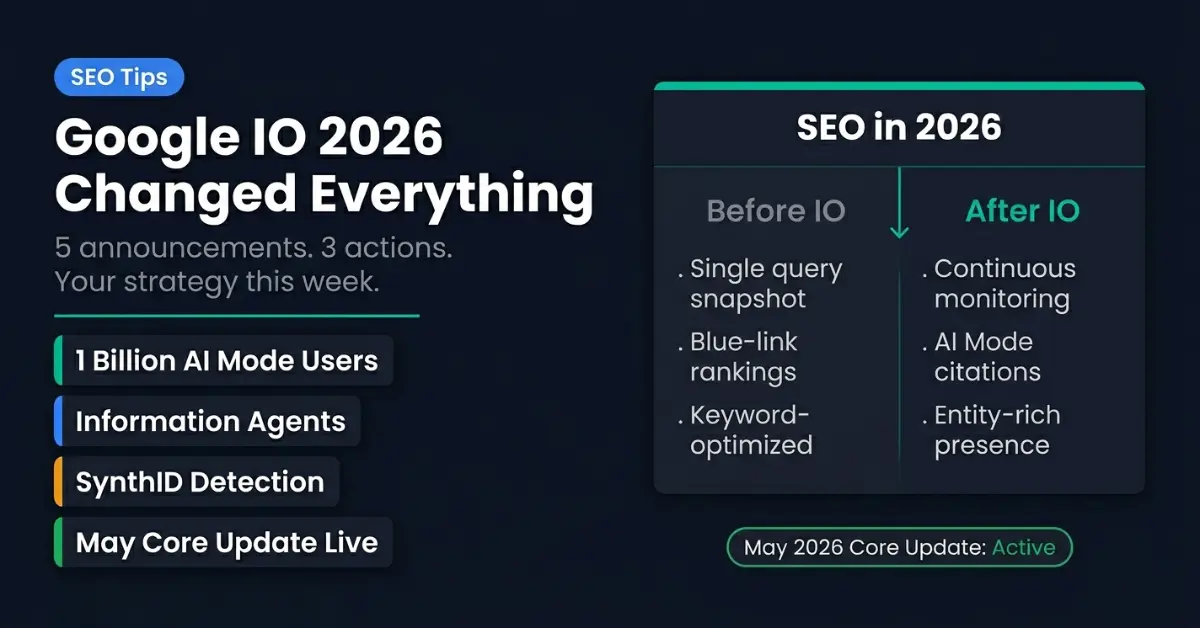
Google IO 2026 ran on May 19 and 20. If you work in SEO, digital marketing, or run a B2B business that depends on search visibility, this was the most consequential two days for your strategy since AI Overviews launched in 2024. And it happened simultaneously with the May 2026 core update going live on May 21, the second broad core update of 2026.
There are already dozens of news recaps summarizing what Google announced. This is not a recap. This is a practitioner guide written from 13 years of running SEO campaigns for B2B clients in the US, UK, Canada, Australia, UAE and India. It covers five announcements that directly change what you should be doing, the specific action for each one, and three things worth doing before you read anything else this week.
The three things to do this week are at the end. But if you are impatient: run the free 31-check SEO and GEO audit on your site right now to find which of the IO 2026 signals you are already failing, export your GSC performance data from before May 21 as your core update baseline, and check your robots.txt for explicit ChatGPT-User and PerplexityBot Allow rules.
Key Takeaways
- Google IO 2026 confirmed AI Mode has passed 1 billion monthly users and queries have more than doubled every quarter since launch. This is no longer an experiment. It is the primary search surface for a growing share of your target audience.
- The May 2026 core update launched May 21, the same week as IO, making attribution of any ranking changes you see in the next two weeks complex. Establish a pre-May-21 GSC baseline now before comparing against post-update data.
- Information Agents are the most structurally significant announcement for SEO practitioners. Background-running AI agents that monitor the web continuously change the optimization target from a single search moment to persistent brand presence across multiple platforms.
- SynthID and C2PA content verification expanded to Search and Chrome. Google can now identify and label AI-generated content at scale. Brands using unreviewed AI content at volume face active downside risk in the second half of 2026.
- Google's May 15 official optimization guide, published by John Mueller through Google Search Central Blog, confirmed that AEO and GEO are not separate strategies. Strong foundational SEO applied to AI surfaces is the complete framework. No separate optimization layer is required.
What This Guide Covers
- What Actually Happened at Google IO 2026
- Announcement 1: AI Mode at 1 Billion Users and the New Search Box
- Announcement 2: Information Agents Launch This Summer
- Announcement 3: Gemini 3.5 Flash Becomes the Default Model in AI Mode
- Announcement 4: SynthID and C2PA Expand to Search and Chrome
- Announcement 5: Universal Cart and Agentic Commerce
- The May 2026 Core Update: What to Do During the Rollout
- Google Sent Mixed Signals on llms.txt. Here Is the Honest Assessment.
- What Not to Do in Response to IO 2026
- 3 Things to Do This Week
- Frequently Asked Questions
What Actually Happened at Google IO 2026
Google IO 2026 ran at the Shoreline Amphitheatre in Mountain View on May 19 and 20. Liz Reid, VP and Head of Google Search, published the official announcement on the Google Blog under the title "A new era for AI Search." The conference covered four major threads relevant to anyone managing search visibility: a redesigned and significantly expanded AI Mode in Search, the launch of Universal Cart as a consumer-facing agentic shopping layer, an expansion of SynthID and C2PA content verification across Search and Chrome, and a broad rollout of agentic capabilities across Gemini and developer tools.
Two days later, on May 21, Google launched the May 2026 core update, confirmed via the Google Search Status Dashboard. This is the second broad core update of 2026 following the March 2026 core update that rolled out over 12 days. The May update is expected to take up to two weeks to complete, meaning the rollout finishes around June 4.
The combination of IO announcements and a simultaneous core update launch creates a specific diagnostic challenge: any ranking movement you observe in Search Console over the next two weeks may reflect the core update, the model change from Gemini 3.5 Flash becoming the default, or both. Marie Haynes, founder of Marie Haynes Consulting, connected the timing: the core update makes sense because Gemini 3.5 Flash is now powering the AI features of Search.
Announcement 1: AI Mode at 1 Billion Users and the Biggest Search Box Redesign in 25 Years
Liz Reid confirmed at IO 2026 that AI Mode has passed 1 billion monthly users and that queries have more than doubled every quarter since launch. This is the single most important number from the conference because it ends the debate about whether AI Mode is a niche product for early adopters. One billion monthly users is mass-market usage by any measurement.
Alongside the user count, Google redesigned the search box for the first time in over 25 years. The new box expands dynamically to accommodate longer conversational queries and offers AI-powered suggestions beyond traditional autocomplete. It accepts multimodal inputs directly, including images, files, videos, and open Chrome tabs, reflecting the same shift toward visual and AI-driven search that makes using a free image SEO tool with AI alt-text increasingly valuable for optimizing visual content. Users can now ask follow-up questions directly from an AI Overview, which flows into a continuous AI Mode session with context carrying forward. Classic ranked results still appear alongside AI features. The redesigned box is rolling out in all countries and languages where AI Mode is available.
The practitioner implication is direct. Queries are getting longer, more conversational, and more multimodal. Traditional SEO keyword research built around two and three-word queries is increasingly misaligned with how users actually search in AI Mode. Content built around question-and-answer structures, direct comparative claims, and entity-rich passages absorbs the new query volume better than pages optimized for short keyword phrases alone.
For B2B businesses specifically: your buyers are using AI Mode to research vendors, compare services, and evaluate consultants before they ever speak to a human. If your content is not structured to be cited in AI Mode responses, you are invisible in the channel where a growing proportion of high-intent research happens. The complete GEO and AEO optimization guide covers the full content structuring framework for AI Mode citation eligibility.
Action for this announcement: Search your primary service or product category in Google AI Mode right now. Note whether your brand appears in any AI-generated answer. If it does not, that is the gap this guide is designed to help you close.
Announcement 2: Information Agents Launch This Summer, SEO Is No Longer About One Moment in Time
Information Agents are the most structurally significant announcement from IO 2026 for SEO practitioners. Google described them as background-running AI agents that monitor the web continuously on a user's behalf. A user specifies what they want monitored (competitor news, market developments, vendor options in a category, regulatory changes), and the agent looks across blogs, news sites, social posts, and Google's real-time data on finance and shopping, then delivers synthesized updates with the ability to take action. Users can run multiple Information Agents simultaneously. The feature launches this summer for Google AI Pro and Ultra subscribers in the United States.
Marie Haynes framed the implication with precision in PPC Land coverage: currently, SEO is optimized for a single snapshot in time, a user typing a query right now. With Information Agents, you are optimizing for continuous tracking. A B2B buyer who sets up an Information Agent to monitor their software category will receive ongoing synthesized updates. Your brand appears in those updates only if you have consistent, citeable content across the web.
The brands that win in Information Agent results share three characteristics. They publish consistently, two to three substantive pieces of content per week at minimum, so there is always fresh content for the agent to discover and include. They have platform presence beyond their own website: active LinkedIn publishing, community participation on Reddit, verified profiles on G2 and Trustpilot, and at least occasional expert quotes in industry publications. And their content is structured for AI extraction, with direct-answer openings in every major section and self-contained paragraphs that read as complete answers without requiring surrounding context.
The brands that will be invisible to Information Agents are publishing occasionally, have no platform presence beyond their website, and produce content that requires a human to read multiple paragraphs to extract the key claim. The LLM citation and backlink strategy guide covers the platform presence approach that generates citations across ChatGPT, Perplexity, and now Google Information Agents through the same set of tactics.
Action for this announcement: Audit your current publishing frequency and platform presence. If you are publishing fewer than two pieces per week and have no active LinkedIn presence, Reddit community engagement, or review platform profiles, build those now before Information Agents go live this summer. The window between now and summer launch is your preparation period, not your reaction period.
Announcement 3: Gemini 3.5 Flash Becomes the Default Model in AI Mode Globally
Gemini 3.5 Flash became the default model powering AI Mode globally on May 19, 2026, simultaneously across the Gemini app, Google Search, Antigravity 2.0, and the Gemini API. The model surpasses Gemini 3.1 Pro on coding, agentic, and multimodal benchmarks while running approximately four times faster on output tokens per second. Gemini 3.5 Pro is in testing and expected to ship in June 2026.
The content strategy implication of the model upgrade is the one most practitioners are underestimating. A more capable model means higher quality AI Mode answers, which means the content bar for being cited rises. When AI Mode used a weaker model, content with partial relevance and acceptable structure could earn citations. Gemini 3.5 Flash has better direct-answer extraction, stronger entity recognition, and more accurate comparative claim evaluation. Content structured for direct-answer extraction, entity consistency, and clear comparative claims is more likely to be surfaced and synthesized accurately than content that depends on dense prose or implicit relationships.
This is not a reason to panic or rewrite everything. Google's May 15 guide, announced by John Mueller, confirmed that strong foundational SEO remains the correct strategy. The model upgrade reinforces rather than replaces the existing GEO framework: direct-answer H2 openings, named statistics with sources, self-contained paragraphs, and FAQPage schema. What changes is the precision required. Average execution of these principles was sufficient under Gemini 1.5. Strong execution is needed under Gemini 3.5.
The 12-point technical SEO audit checklist covers the schema and content structure checks that directly affect AI Mode citation eligibility under the new model. Running the free 31-check audit tool on your site identifies the specific GEO signals failing right now before the model upgrade fully propagates across all AI Mode responses.
Action for this announcement: Open your 5 highest-traffic blog posts. Check whether each H2 section opens with a direct answer in the first sentence. Check whether every major claim includes a named statistic with a specific source. These are the two content structure elements most directly affected by the Gemini 3.5 Flash upgrade. Improve these before anything else.
Announcement 4: SynthID and C2PA Expand to Search and Chrome, AI Content Detection Is Now a Ranking Signal
Google expanded SynthID and C2PA Content Credentials verification to Search and Chrome at IO 2026. SynthID embeds imperceptible watermarks into AI-generated images, video, audio, and text. C2PA is an open standard supported by Adobe, Microsoft, and OpenAI that embeds metadata about the origin and modification history of any piece of media. Together these technologies allow Google to identify whether content was created with AI tools even if the output has been edited or reformatted after generation. Google also launched an AI Content Detection API on Google Cloud's Gemini Enterprise Agent Platform, available to select partners. Users can now check whether an image is AI-generated directly through Google Lens. Chrome integration is rolling out in the coming weeks.
The practical SEO implication is the one Coalition Technologies identified most directly: Google is investing heavily in detecting and labeling AI-generated content across SynthID, C2PA, Search, Lens, AI Mode, Circle to Search, Gemini, Chrome, and its AI Content Detection API simultaneously. Brands using AI indiscriminately to produce high-volume content without meaningful human oversight are facing the infrastructure being built to identify and discount exactly that approach.
Google's May 15 guide confirmed the content type that earns AI citations: unique content that reflects genuine expertise, original research, or first-hand experience. Generic summaries that AI can generate itself add no citation value. This is not new guidance. SynthID expanding to Search makes it operational rather than aspirational. The detection capability now exists at the infrastructure level to identify and label content that fails this standard.
For practitioners using AI in content production, the distinction that matters is not whether you use AI but how. AI as a research and drafting tool within an editorial process that adds genuine expertise, original data, and practitioner judgment produces content that the SynthID infrastructure cannot dismiss as low-value. AI as a replacement for that process produces content that is increasingly identifiable and discountable.
Every article on this site combines AI-assisted research and structuring with campaign data from real client work, specific verified statistics, and practitioner judgment built from 13 years of managing campaigns. The $583,956 in verified organic revenue from the Indigo Software case study is not an AI-generated estimate. It is a verified GA4 number from a real campaign. That specificity is exactly what SynthID cannot generate and what Gemini 3.5 Flash increasingly prefers to cite.
Action for this announcement: Review your content production process. If any piece of content on your site was published from an AI-generated draft without adding original data, first-person experience, or practitioner perspective, update it before the SynthID integration completes across Search and Chrome in the coming weeks. Prioritize your highest-traffic pages first.
Announcement 5: Universal Cart and Agentic Commerce, The Implications Beyond E-Commerce
Universal Cart launched at IO 2026 as a Gemini-powered shopping cart that works across Google Search, Gemini, YouTube, and Gmail. A user can add a product from any of those surfaces and manage everything in a single unified cart. The moment a product is added, Universal Cart works in the background finding deals, tracking price drops, providing price history, and sending stock alerts. It runs on Google's Gemini models and improves as those models improve.
Google simultaneously introduced Agent Payments Protocol (AP2), a secure framework for AI agents to make purchases on behalf of users within strict guardrails the user defines. The user specifies brands, products, and maximum spend. The agent completes the purchase only when all criteria are met. AP2 rolls out to Google products in the coming months, starting with Gemini Spark.
For e-commerce brands, the direct implication is clear: a user may discover, evaluate, and purchase a product entirely inside the Google and Gemini ecosystem without ever visiting the brand's website. The brand's Google Merchant Center feed quality, pricing competitiveness, and review profile become the primary conversion levers rather than on-site user experience.
For B2B services companies, the parallel is not Universal Cart but Information Agents and AI Mode citations. The buyer journey for enterprise software and consulting services is moving in the same direction: more research happening inside AI-generated answers, fewer visits to vendor websites for initial evaluation. The website is becoming the validation layer for buyers who have already seen the brand cited in AI responses. The discovery and evaluation now happens upstream in AI Mode.
The attribution consequence applies to both e-commerce and B2B: as more discovery and evaluation happens inside AI surfaces before any visit to your site, traditional analytics will increasingly undercount the role AI visibility plays in your pipeline. The Indigo Software campaign data showed AI-sourced leads converting 40% better in discovery calls than paid channel leads, in part because prospects arrived pre-educated from AI citation exposure. Measuring that conversion premium requires tracking leads by source, including AI referral traffic from Perplexity and direct brand searches that originate from AI-prompted awareness.
Action for this announcement: If you run e-commerce, verify your Google Merchant Center feed is complete, accurate, and updated. If you run a B2B services business, check your AI citation presence this week by searching your primary service category in Google AI Mode, ChatGPT, and Perplexity. Note which competitors appear and which signals their content has that yours lacks.
The May 2026 Core Update: What to Do During the Rollout
The May 2026 core update launched May 21, two days after IO 2026 concluded. It is the second broad core update of 2026 and the fourth confirmed ranking update this year overall. Google has not published a companion blog post or shared specific goals. The rollout is expected to take up to two weeks, finishing around June 4.
The timing creates a genuine attribution problem. Any ranking movement you see in Search Console between now and June 4 may reflect the core update, the Gemini 3.5 Flash model change propagating through AI Mode, or both. Harpreet Singh Chatha, SEO and AI Search Consultant, raised the possibility that this update could target sites that have been over-optimizing for AI citations through inauthentic brand mentions. Google's May 15 guide specifically cautioned against chasing inauthentic brand mentions across forums, blogs, and social platforms.
The correct behavior during the active rollout is to establish your baseline and wait. Export your GSC Performance data from the three weeks before May 21 right now. Save this as your pre-update baseline document. After the rollout completes around June 4, compare post-update performance against that baseline. Do not make significant content or technical changes during the rollout. Core update ranking shifts continue to settle for 7 to 10 days after official completion, meaning your final post-update position may not stabilize until around June 14.
If your site experienced ranking drops after the March 2026 core update that never recovered, review whether those drops correlate with the content quality signals the May 15 guide names: thin content that summarizes what AI can generate itself, inauthentic platform mentions, or pages without clear E-E-A-T signals. Those are the categories most directly targeted by recent core updates.
For a March drop specifically, check the dates first: the March 2026 spam update finished on March 25, two days before the core update began, and I show how to tell the two apart in my analysis of the March 2026 spam update.
Google Sent Mixed Signals on llms.txt at IO 2026. Here Is the Honest Assessment.
Search Engine Journal's May 22 SEO Pulse noted that IO 2026 sent mixed signals on llms.txt. Google has not officially confirmed that its systems read llms.txt as a first-class input for AI Mode or Search. John Mueller has noted in multiple statements that Google's crawlers do not prioritize llms.txt over standard HTML.
The honest assessment has not changed from what the complete llms.txt guide documented in April 2026: developer-facing AI tools including Cursor, GitHub Copilot, and various RAG frameworks do read llms.txt when it is present. Major consumer AI platforms have not officially committed to automatic reading. The file provides a clean, token-efficient summary of your site that any AI system can read when prompted, and it positions your site for forward compatibility when platform support formalizes.
The effort-to-risk ratio remains favorable: creating a llms.txt file takes 30 minutes, costs nothing, and causes no harm if major platforms never formally support it. The counter-position, not creating one and discovering later that it mattered, has a higher downside. Implement it and move on to higher-impact work.
What Not to Do in Response to IO 2026
There are several reactive responses to IO 2026 that will hurt more than help.
Do not rewrite all your content immediately. Google's May 15 guide confirmed that strong foundational SEO remains the strategy. Mass rewrites during an active core update rollout introduce changes that cannot be evaluated cleanly and may accelerate ranking volatility rather than resolve it.
Do not start building inauthentic brand mentions to influence Information Agent results. Google's May 15 guide specifically cautioned against this. The core update now live may be targeting exactly this pattern. Build genuine platform presence through content that earns community validation, not manufactured mentions.
Do not pause publishing. Some practitioners advise stopping content publication during core update rollouts. This is incorrect. Google is actively crawling during rollouts. Fresh, high-quality, expert-led content published during a core update can benefit from the recrawl activity. Your site has strong authority signals with 300 clicks in 28 days confirmed May 17. New content published now benefits from that authority context.
Do not treat IO 2026 as a reason to abandon keyword-based SEO. Stan Ventures correctly noted that your audience now includes their agents, which check your site repeatedly looking for changes. This means consistent content publishing that targets both traditional keyword queries and the conversational AI Mode query patterns your buyers use is more important, not less. The 47 Claude SEO prompts library covers the specific prompts for auditing both traditional keyword alignment and AI Mode query coverage in your existing content.
3 Things to Do This Week Before Anything Else
With five major announcements and a simultaneous core update, the risk is becoming overwhelmed and doing nothing. Three actions this week will cover the highest-impact changes from IO 2026 before the news cycle moves on.
Action 1: Run the Free Audit and Find Your IO 2026 Gaps (20 Minutes)
The free 31-check SEO and GEO audit tool checks seven GEO signals that directly correspond to the IO 2026 announcements: AI crawler access in robots.txt (Check 25), llms.txt file presence (Check 26), author schema for E-E-A-T signals (Check 27), AI-answer schema including FAQPage and Article (Check 28), HSTS security header (Check 29), XML sitemap discovery (Check 30), and HTML language attribute (Check 31). Run the audit on your homepage and your top three blog posts. The tool identifies which signals are failing and generates a Claude Haiku AI diagnosis with a fix-in-this-order plan for sites scoring below 80. This is the fastest way to find your IO 2026 gaps without reading every announcement and manually comparing against your site.
Action 2: Establish Your Core Update Baseline in GSC (15 Minutes)
Go to Google Search Console. Click Performance in the left sidebar. Set the date range to a custom range: May 1 to May 20, 2026. This is your pre-core-update baseline period. Export this data as a CSV and save it with the filename "gsc-pre-may-2026-core-update-baseline.csv" with today's date. After the rollout completes around June 4, export the same metrics for June 4 to June 21 and compare. Without this baseline document saved today, attribution of any ranking changes becomes subjective rather than data-driven.
If the comparison does show a decline, rule out tracking errors, technical blocks and seasonal dips before you blame the update, using my guide on how to diagnose a website traffic drop.
If you use the free GSC to Claude AI connection, paste the exported CSV into Claude with this prompt: "This is my GSC performance data from before the May 2026 core update. Save it as my baseline. After June 4, I will paste the post-update data and ask you to compare the two periods and identify which pages gained, which lost, and the most likely cause for each change."
Action 3: Check Your AI Crawler Access and Platform Presence (30 Minutes)
Open your site's robots.txt file at yourdomain.com/robots.txt in a browser. Copy the contents and paste into Claude with this prompt: "Check whether ChatGPT-User, PerplexityBot, ClaudeBot, and GPTBot each have explicit Allow rules in my robots.txt. ChatGPT-User is the retrieval crawler that powers live ChatGPT answers and must be explicitly allowed for my content to appear in ChatGPT responses. Flag any missing or incorrect rules and provide the corrected robots.txt lines."
Then search your primary service category in Google AI Mode, ChatGPT, and Perplexity. Record which competitors appear and which do not. This 15-minute exercise tells you more about your actual AI visibility gap than any analysis tool can, because it shows you exactly what your buyers see when they research vendors in your category right now. The 12-point technical audit checklist covers the complete robots.txt AI crawler configuration in Check 12 with the specific rules for each crawler.
Frequently Asked Questions



Leave a Comment
Your email address will not be published. Comments are moderated before appearing.