GEO And AEO Optimization: The Complete Guide for 2026
Something changed in how people find information — and most businesses haven't noticed yet.
When someone uses AI tools like ChatGPT and Perplexity for SEO audits, leverages them for digital marketing research, or even explores a Claude prompts and skills library to ask "who is the best digital marketing consultant for SaaS companies?" they don't get ten links. They get a direct answer, synthesized from multiple sources, with perhaps two or three brand citations embedded in the response. No click. No scroll. No comparison shopping through search results. Understanding a solid Google AI Mode SEO strategy has become essential because visibility now depends on being the source these AI systems choose to synthesize, not simply ranking on a results page.
The brands appearing in that answer win the implicit endorsement of the AI system itself. The brands that don't appear might as well not exist for that query.
This isn't a future scenario. It's happening right now. ChatGPT surpassed 800 million weekly users in 2025. Google AI Overviews appear in over 16% of all searches — significantly higher for comparison and research queries. Gartner projects a 25% drop in traditional search engine volume by 2026. And according to research by Phoenix Online Media, 93% of AI Mode searches end without a click — more than double the zero-click rate from traditional search. A study by Ahrefs Brand Radar found that the overlap between Google's top-10 results and AI-cited sources has fallen to just 12% across platforms.
Ranking on page one of Google no longer guarantees you appear in AI answers. And appearing in AI answers doesn't require ranking on page one.
This is the landscape that GEO (Generative Engine Optimization) and AEO (Answer Engine Optimization) address. This guide gives you the complete framework: what they mean, how they work, the technical changes to make immediately, the content strategies that drive AI citations, and how to measure your progress.
Everything in this guide is implementable with the tools you already have. I'll reference Claude AI throughout as a practical implementation partner — specifically through the prompts I've documented in my companion article, 47 Claude AI SEO Prompts That Fix Every SEO Problem on Your Website, which covers the exact prompts for AEO content restructuring, entity building, and free SEO checking in detail.
Key Takeaways: GEO and AEO in 2026
- GEO (Generative Engine Optimization) is the practice of making your content get cited by AI platforms — ChatGPT, Perplexity, Google AI Overviews, Claude, and Gemini — when they answer user questions.
- AEO (Answer Engine Optimization) is the narrower practice of structuring individual content passages to be extracted as direct answers.
- 76% of Google AI Overview citations come from top-10 Google results — strong SEO directly feeds GEO. You do not abandon SEO to do GEO.
- The single fastest GEO win: verify AI crawlers are not blocked in your robots.txt. This is the most common and most damaging GEO error.
- Princeton research shows adding citations, statistics, and expert quotes improves AI search visibility by 30–40% over unoptimized content on the same topic.
- Technical fixes show impact in 4–8 weeks. Content restructuring in 6–12 weeks. Entity authority in 3–6 months.
- Sites with strong referring domain profiles are 3.5x more likely to be cited by ChatGPT than sites with minimal backlinks.
Should You Hire a GEO Consultant?
Most teams don't need one to start. Phases 1 and 2 of this guide, from unblocking AI crawlers to rewriting key pages answer-first, can be done in-house. A consultant earns their fee later, when you rank in Google but AI answers still name competitors and cite roundup lists instead of you.
Hire help when you need what is hard to build alone: buyer prompts tracked monthly across ChatGPT, Claude, Gemini and Perplexity, a list of the exact pages cited in your place, and outreach to get onto them. If your site barely ranks yet, fix SEO first; AI answers mostly cite pages found through search.
That is what my GEO consulting for B2B SaaS covers. Whoever you hire, use the questions at the end of this guide.
What Are GEO and AEO? Clear Definitions
The industry hasn't settled on a single term yet — you'll see GEO, AEO, LLMO (Large Language Model Optimization), AIO, and GSO used interchangeably. The terminology debate is real but largely unimportant. The underlying goal is identical across all of them: get your content retrieved and cited by AI systems when they answer questions relevant to your business.
For clarity throughout this guide, here are the working definitions I use with clients:
What is GEO (Generative Engine Optimization)?
GEO (Generative Engine Optimization) is the practice of structuring your content and digital presence so that AI-powered platforms — ChatGPT, Google AI Overviews, Perplexity, Claude, Gemini, and Copilot — retrieve, cite, and recommend your brand when generating answers to user questions.
The term was first formalized in a Princeton University research paper in 2023. By 2026, it has evolved from an academic concept into a practical business necessity. GEO encompasses everything from technical crawl access to content architecture to off-site entity building — it's a holistic strategy, not a single tactic.
What is AEO (Answer Engine Optimization)?
AEO (Answer Engine Optimization) is the narrower practice of structuring specific content pieces to be directly extracted and presented as answers — in featured snippets, voice search results, and AI-generated responses to specific factual questions.
AEO is about the answer layer. It's what happens at the moment an AI system assembles its response. GEO is the broader brand strategy. AEO is the page-level and passage-level execution. In practice, most successful strategies implement both simultaneously.
The key distinction: AEO is about answering questions. GEO is about influencing the narrative around your brand across AI-mediated conversations. One is tactical, one is strategic. Both are necessary.
What Changed in GEO and AEO in 2026?
Three developments make 2026 the tipping point for GEO adoption:
- Apple integrated Claude into Safari — dramatically expanding Claude's influence on how people discover content without opening a separate AI app.
- Google AI Mode launched — a dedicated AI search interface where 93% of queries end without a traditional click. Brands not optimized for AI citation are now invisible to an entire class of high-intent searchers.
- The Google–AI gap widened — research tracking 17 million AI-generated responses confirms the overlap between top Google rankings and AI citations has dropped below 20%. Ranking #1 on Google no longer automatically puts you in AI answers.
GEO vs. AEO vs. SEO: The Differences That Actually Matter
Understanding what's different — not just what's new — is what lets you prioritize where to invest your time and budget. Here's the practical comparison:
| Dimension | Traditional SEO | AEO | GEO |
|---|---|---|---|
| Primary goal | Rank in top 10 Google results | Appear as the direct answer in AI responses | Be cited and recommended by AI across topics |
| Success metric | Organic traffic, keyword rankings | Citation rate, snippet capture rate | AI Share of Voice, brand mention frequency |
| Primary optimization target | Page-level signals (title, H1, backlinks) | Passage-level answer extraction | Brand entity recognition + content authority |
| Key content requirement | Keyword relevance + backlink authority | Direct, extractable answers at passage level | Original data, verifiable claims, expert authority |
| Off-site signals | Backlinks (quantity + quality) | Featured snippet dominance | Brand mentions (linked + unlinked), entity consistency |
| Technical requirements | Speed, mobile, crawlability, Core Web Vitals | Schema markup, structured formatting | AI crawler access, server-side rendering, llms.txt |
| Time to results | 3–6 months for new content | 4–8 weeks for technical changes | 3–6 months for content; 6–12 months for entity authority |
| Competition level in 2026 | High — mature, well-understood field | Medium — growing but underimplemented | Low to Medium — early adopter advantage window open now |
The critical insight from this comparison: These are not competing strategies. They are complementary layers of the same visibility stack. Research from Ahrefs confirms that 76% of Google AI Overview citations pull from top-10 Google results — meaning strong traditional SEO directly feeds GEO visibility. You don't abandon SEO for GEO. You extend SEO with GEO.
The brands winning in 2026 are running all three simultaneously — SEO for search ranking, AEO for answer extraction, GEO for broad AI brand authority. Sites with over 32,000 referring domains are 3.5x more likely to be cited by ChatGPT than sites with minimal backlinks. The authority foundations overlap completely.
How AI Search Engines Actually Work (and Why It Changes Everything)
To optimize for AI search, you need to understand how these systems actually retrieve and use content — because the mechanics are fundamentally different from traditional search engines.
Step 1 — Query Fan-Out
When a user asks an AI a question like "What's the best SEO consultant for SaaS companies in the UK?", the AI doesn't search for that exact phrase. It breaks the question into multiple smaller sub-queries, perhaps "top SEO consultants UK," "SEO for SaaS companies best practices," or even signals from a strong B2B social media presence, and searches for each one separately. This process is called query fan-out, and understanding it is why tools like a Claude prompts and skills library can help you craft content that aligns with how AI actually retrieves and ranks information.
GEO implication: You need to rank for the sub-queries that AI systems generate from your topic area, not just the primary keywords your customers use. Topical depth and cluster content architecture are essential for capturing these fan-out queries.
Step 2 — Passage-Level Retrieval
AI systems don't retrieve entire pages the way search engines index them. They extract specific passages — individual paragraphs, sentences, or structured elements — and evaluate each passage independently for relevance to the sub-query being answered.
GEO implication: Every paragraph on your most important pages needs to stand alone as a meaningful, extractable unit. Passages that say "as mentioned above" or "which brings us back to our earlier point" lose their meaning when extracted from context. Write each key paragraph as if it will be read in isolation — because for AI systems, it often will be.
Step 3 — Source Evaluation and Citation Selection
Once relevant passages are retrieved, the AI evaluates source credibility before deciding whether to cite it. This evaluation incorporates: domain authority, content recency, presence of verifiable data and citations, consistency of the author's expertise across the web, and how frequently the source has been cited by other trusted sources. If you want to build the kind of authority that AI systems recognize, consider getting a custom SEO consulting quote tailored to your specific content goals.
GEO implication: A page that ranks #8 on Google but has strong E-E-A-T signals, original data, and clear author credentials may be cited by AI systems more frequently than the #1 organic result that lacks these trust signals. Research from GEO firm Brandlight confirms the overlap between top Google results and AI-cited sources has dropped to below 20% — the two rankings are increasingly independent.
Step 4 — Response Synthesis
The AI assembles retrieved passages into a coherent response, typically citing 2–7 sources per answer depending on the platform. Perplexity is most transparent about citations. ChatGPT and Claude tend to synthesize more without explicit attribution. Google AI Overviews blend citations with their own summary.
GEO implication: Your citation goal varies by platform — which leads directly into the next section.
Platform-Specific GEO: How Each AI System Cites Content Differently
One of the most practical — and least covered — aspects of GEO is that each AI platform has distinct preferences for how it selects and attributes sources. A single GEO strategy targeting only one platform will miss the majority of AI search opportunity. Here's exactly how each platform works and what to optimize for.
Google AI Overviews — Optimize for Real-Time Retrieval
How it works: Google's AI Overview system retrieves web pages in real time, synthesizes a 3–5 sentence answer, and links to 3–6 source pages in a carousel on the right side of the overview. It has the strongest overlap with traditional Google rankings (76% of citations come from top-10 organic results) but rewards content that directly answers the query in the first 200 words.
What to optimize: Ensure your page ranks in the top 10 for the target query. Add a direct answer in the first paragraph. Use explicit H2/H3 question-based headings. Implement FAQPage schema. For visual content, tools like an AI alt-text generator can help ensure images are properly indexed alongside your text. Add "Last Updated" timestamps, as Google AI Overviews heavily weight fresh content for fast-moving topics.
Perplexity AI — Optimize for Explicit Citations
How it works: Perplexity uses real-time web search and is the most citation-transparent of all AI platforms — it lists every source it used with numbered references. It has the strongest proximity to traditional rankings (28% overlap with Google's top 10), prefers recently updated content, and is more likely to cite niche authoritative sources than mainstream ones.
What to optimize: Update content frequently — Perplexity strongly favors recency. Add specific statistics with named sources. Structure content so key facts appear as standalone, quotable sentences. Being cited on Reddit, Quora, or specialist forums that Perplexity already references dramatically increases your citation probability.
ChatGPT — Optimize for Brand Entity Recognition
How it works: ChatGPT has only 8% overlap with Google's top-10 rankings — it draws from a substantially different source pool. It tends to synthesize without explicit attribution (in standard mode), meaning your brand name needs to appear in the generated answer itself rather than in a citation list. It has strong training data from Wikipedia, Reddit, industry publications, and high-authority blogs.
What to optimize: Build entity consistency across Wikipedia (if eligible), LinkedIn, industry directories, and press mentions. Get mentioned in articles that ChatGPT already cites for your topic area. Create content that positions your brand as the named solution for specific use cases — "for [specific scenario], [your brand] is known for..."
Claude (Anthropic) — Optimize for Structured, Logical Authority
How it works: Claude tends to synthesize information rather than quote directly. It favors well-structured, logical content and strongly prefers sources with clear author credentials, verifiable claims, and hierarchical organization. Apple's integration of Claude into Safari (announced 2025, rolling out through 2026) is increasing Claude's influence on content discovery significantly.
What to optimize: Use clear heading hierarchies (H1→H2→H3 logical flow). Lead every section with a direct answer before elaboration. Include explicit author credentials near the top of each piece. Add Person schema and Organization schema. Ensure your content is server-side rendered — Claude's crawlers do not execute JavaScript.
Gemini (Google) — Optimize for Semantic Depth
How it works: Gemini is the fastest-growing AI search platform and integrates deeply with Google's existing infrastructure. Strong Google SEO performance tends to translate into Gemini visibility more directly than with other platforms. It rewards semantic relevance — comprehensive topic coverage using related terms, synonyms, and contextual language.
What to optimize: Build comprehensive topic clusters rather than single pages. Use semantic keyword variation throughout content — not keyword stuffing, but natural, comprehensive coverage of a topic's full vocabulary. Ensure your Google Business Profile is complete and consistent with your on-site information.
Phase 1 — Technical Foundation: Make Sure AI Systems Can Read Your Site
Before any content strategy matters, AI systems need to be able to access and read your pages. This is the most commonly overlooked GEO issue — and the fastest to fix. Complete this technical checklist before investing time in content or off-site work.
Step 1 — Audit Your robots.txt for AI Crawler Blocking
Many websites accidentally block AI crawlers through overly broad robots.txt rules or CDN configurations. The key AI crawler user agents to explicitly allow are:
- OAI-SearchBot — OpenAI / ChatGPT search crawler
- PerplexityBot — Perplexity AI crawler
- Google-Extended — Google Gemini and AI Overviews
- ClaudeBot — Anthropic / Claude crawler
- CCBot — Common Crawl (feeds many LLM training datasets)
- Applebot-Extended — Apple AI features including Safari Claude integration
Check your robots.txt at yourdomain.com/robots.txt. Common mistakes that block AI crawlers: wildcard PHP extension blocks (Disallow: /*.php$), overly broad directory blocks, and CDN-level bot filtering. If your site runs on PHP, ensure the /*.php$ rule is not present — it blocks every PHP-served page including your homepage.
Critical note for Cloudflare users: Cloudflare changed its default configuration to block AI bots automatically. Go to Cloudflare Dashboard → Security → Bots and verify AI crawlers are not being blocked.
Step 2 — Fix Server-Side Rendering Issues
AI crawlers read the HTML your server returns on the initial request. If your content loads dynamically after page render — through JavaScript frameworks, interactive tabs, accordions, or sliders — AI bots cannot see that content at all.
For PHP-based sites (like kulbhushanpareek.com), verify that all critical content — service descriptions, blog article text, and about information — is present in the raw HTML response before any JavaScript execution. Use "View Page Source" in your browser to confirm. If the content appears in View Source, AI bots can read it.
This matters most on SaaS marketing sites built with JavaScript frameworks, which is why comparing raw and rendered HTML, template by template, is a standard check in my SEO consulting for B2B SaaS teams.
Step 3 — Create an llms.txt File
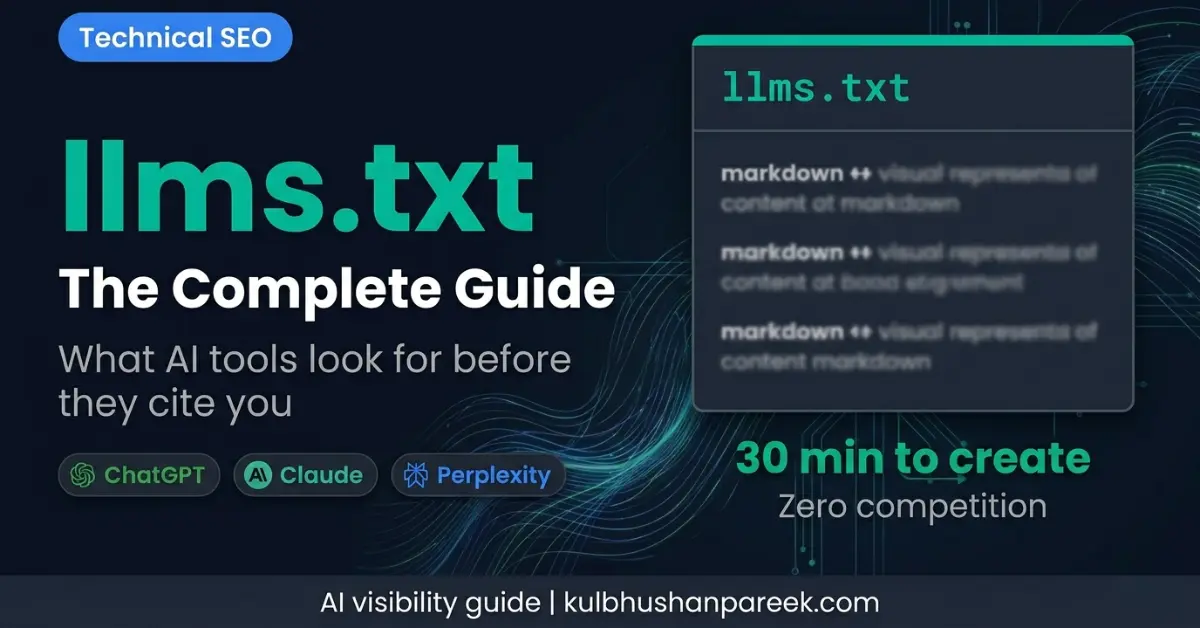
An llms.txt file is an emerging standard proposed by Answer.AI's Jeremy Howard in 2024. Like robots.txt tells crawlers what to access, llms.txt tells AI systems what to prioritize. It's a simple Markdown-formatted file placed at yourdomain.com/llms.txt.
Here is the current llms.txt for kulbhushanpareek.com (customize for your own site):
# Kulbhushan Pareek — Digital Marketing Consultant

> 14+ years helping businesses in US, UK, Canada, Australia, UAE and India
> grow organic visibility through SEO, AI automation, and ORM.

## Core Services
- [SEO Consulting](https://kulbhushanpareek.com/services/seo-consulting/)
- [AI Automation](https://kulbhushanpareek.com/services/ai-automation/)
- [ORM Services](https://kulbhushanpareek.com/services/orm/)
- [Digital Marketing](https://kulbhushanpareek.com/services/)

## Key Resources
- [GEO & AEO Guide 2026](https://kulbhushanpareek.com/blog/geo-aeo-optimization-the-complete-guide)
- [47 Claude AI SEO Prompts](https://kulbhushanpareek.com/blog/47-claude-ai-seo-prompts-that-fix-every-seo-problem)
- [Connect GSC to Claude AI Free](https://kulbhushanpareek.com/blog/how-to-connect-google-search-console-to-claude-ai-free-2026)

## About
- [About Kulbhushan Pareek](https://kulbhushanpareek.com/about)
- [Contact](https://kulbhushanpareek.com/contact)
- [Case Studies](https://kulbhushanpareek.com/case-studies)
Early evidence suggests llms.txt can increase AI crawl rates by 5–10x for content-heavy sites. Upload this file to your domain root — it takes 15 minutes and has zero downside.
Step 4 — Implement Comprehensive Schema Markup
Structured data is the clearest signal you can send to AI systems about what your content means and who created it. The schema types with highest AI citation impact:
- Article — for all blog posts and guides (marks content as editorial, citable content)
- FAQPage — for FAQ sections (directly feeds AI question-and-answer extraction)
- HowTo — for step-by-step tutorials (triggers rich results and AI step extraction)
- Person — for author pages (establishes E-E-A-T author credentials for AI systems)
- Organization — for your About/homepage (establishes entity identity)
- LocalBusiness — for consulting businesses (geographic authority signals)
- BreadcrumbList — for all pages (aids crawl structure understanding)
For complete JSON-LD templates for each schema type, see the Schema Markup section of my 47 Claude AI SEO Prompts guide, where Prompts 26–31 generate ready-to-use, validated schema for any page type.
Step 5 — Verify Site Speed and Crawl Efficiency
Page speed affects how efficiently AI crawlers access your content. Slow-loading pages may be partially crawled or skipped under crawl budget constraints. Aim for a PageSpeed score above 80 for mobile. For PHP sites on VPS hosting, enable server-level caching (OPcache for PHP), compress images to WebP format, and enable GZIP/Brotli compression at the server level.
Phase 2 — Content Strategy: Structure for Extraction and Citation
Once AI systems can access your site, the content itself determines whether they cite it. Princeton's foundational GEO study demonstrated that specific content optimization techniques — adding citations, statistics, and expert quotes — improve AI search visibility by 30–40% compared to unoptimized content covering the same topic.
The following content strategies are organized from highest to lowest impact based on current citation pattern research.
Strategy 1 — Answer-First Formatting (Highest Impact)
AI systems extract passages from your content for use in responses. Passages that begin with a direct, self-contained answer to the implied question in the section heading are extracted and cited at dramatically higher rates than passages that build toward their point over multiple sentences.
The structure that maximizes citation probability:
- Question-based heading: Phrase your H2 and H3 headings as questions that mirror how users would ask an AI assistant. "What is GEO optimization?" outperforms "GEO Optimization Overview" for AI retrieval.
- Answer block (40–60 words): The first paragraph of each section should be a complete, self-contained direct answer. Write as if this is the only sentence an AI will extract and show a user.
- Elaboration: Expand with context, examples, data, and nuance in subsequent paragraphs.
The AI-facing audiences and human-facing audiences need different things from the same content. The answer block serves AI extraction. The elaboration builds topical authority and keeps human readers engaged. Both matter — but for different purposes.
Strategy 2 — Data, Statistics, and Verifiable Claims
AI systems evaluate source credibility before deciding whether to cite. Specific, verifiable claims with named sources signal credibility far more effectively than general statements.
Compare these two sentences covering the same point:
- Unoptimized: "AI search is growing rapidly and affecting website traffic."
- GEO-optimized: "Gartner projects a 25% drop in traditional search engine volume by 2026, while research tracking 17 million AI-generated responses shows AI-cited brands receive 4.4x higher conversion rates than equivalent organic search traffic."
Go through your most important pages and replace every vague statement with a specific, sourced data point. This single practice produces the largest measurable improvement in AI citation rate.
Strategy 3 — Topical Authority Through Content Clusters
AI systems evaluate topical authority, not just individual page quality. A site with 20 interlinked articles covering every dimension of a topic signals deep expertise. A single comprehensive guide on that topic signals less authority, even if the guide is excellent.
The pillar-cluster model serves both traditional SEO and GEO simultaneously:
- Pillar page: Comprehensive overview of the broad topic (like this guide)
- Cluster pages: Deep dives into subtopics with strong internal links back to the pillar
- Supporting content: FAQ pages, comparison articles, case studies, and data pieces
This guide's cluster includes: the 47 Claude AI SEO Prompts guide (practical implementation tools), the GSC + Claude AI setup guide (live data integration), and the SEO consulting and AI automation service pages.
Strategy 4 — Query-Intent Matched Content Types
Not all queries trigger AI-generated responses. GEO investment pays off most on:
- High GEO value: Informational queries ("what is", "how does", "why do"), comparison queries ("X vs Y", "best tools for"), process queries ("how to", "step-by-step"), definitional queries ("X explained")
- Lower GEO value: Transactional queries ("buy X", "X price"), purely navigational queries, brand-specific searches
Prioritize GEO optimization for your informational and comparison content first — these are the pages where AI systems generate synthesized answers that cite sources.
Strategy 5 — Content Freshness and Explicit Update Signals
AI search engines have a strong recency bias. Pages not updated in over 3 months see citation rates drop sharply. Practical implementation:
- Add a visible "Last updated: [Date]" timestamp at the top of each article (this guide has one)
- Add a "What changed in [current year]" section to high-traffic perennial articles
- Include
dateModifiedin your Article schema markup - Establish a quarterly content refresh schedule for your top 10 most-cited pages
Strategy 6 — Structured Formatting for AI Extraction
Formatting elements that AI systems parse with highest accuracy, in order of extractability:
- Numbered lists and steps — preserved accurately; ideal for processes and rankings
- Definition + explanation pairs — "X is [definition]. This means [implication]." — extremely extractable
- Comparison tables — structured data AI systems can cite directly and reliably
- Bullet-point feature lists — scannable and extractable for properties and attributes
- Q&A formatting — mirrors how users prompt AI systems; directly feeds AI answer generation
Phase 3 — E-E-A-T and Author Authority: Getting AI to Trust You
AI systems inherited Google's E-E-A-T (Experience, Expertise, Authoritativeness, Trustworthiness) framework and extended it. For GEO purposes, E-E-A-T signals function as the trust layer that determines whether a source gets cited or skipped even when its content is relevant.
Experience Signals
AI systems evaluate whether content demonstrates genuine first-hand experience with the topic. Include specific, concrete examples from your own work. Name real client scenarios (anonymized if needed). Reference specific tools, dates, outcomes, and failures. "In a 2025 e-commerce client project, we implemented GEO content restructuring across 15 top-traffic pages and saw AI citation frequency increase from 2 branded mentions to 14 over 90 days" scores far higher than vague experience claims.
Expertise Signals
Expertise is demonstrated through the quality and precision of your claims, depth of coverage, and accuracy of technical details. Add your credentials explicitly near the top of any piece where expertise is relevant. Include nuance that only a practitioner would know — the caveats, the edge cases, the "it depends" factors. Reference primary sources rather than citing articles that cite articles.
Authoritativeness Signals
Authoritativeness is primarily an off-site signal — it's what the rest of the web says about you. On-site, strengthen it with: consistent author attribution across all content, comprehensive author pages with verifiable credentials, and explicit links between author profiles and specific areas of expertise.
Trustworthiness Signals
For AI citation purposes, trustworthiness is about accuracy and source transparency:
- Link every statistic to its primary source (not to a blog that cited the original source)
- Include a "Sources and References" section at the bottom of data-heavy articles
- Acknowledge limitations and caveats openly — AI systems penalize overconfident, unsupported claims
- Use precise language rather than marketing superlatives
- Keep claims current — outdated statistics that have been superseded reduce trust scoring
Phase 4 — Off-Site Signals: Where GEO Goes Beyond Traditional SEO
This is the phase most GEO guides skip — and the one with the highest long-term impact on AI brand visibility. AI systems learn about your brand from across the entire web, not just your own site.
Entity Consistency Across Platforms
Audit and align your presence across: LinkedIn profile, Google Business Profile, X.com/Twitter, your own About page, guest posts or bylines, podcast appearances, PR mentions, and industry directories. Your name, job title, area of expertise, and description should be consistent across all of them.
Getting Mentioned in Sources AI Already Cites
This is the fastest path to increasing AI visibility. Ask ChatGPT, Perplexity, and Claude questions in your area of expertise and note which websites appear in their citations. Those sites are your highest-priority platforms for getting mentioned.
Tactics to earn mentions in already-cited sources:
- Reddit contributions: Subreddits like r/SEO, r/marketing, r/digitalmarketing are heavily cited by AI systems. A helpful, specific answer in an already-cited thread is one of the fastest GEO wins available.
- Quora answers: Answer questions with the same rigor as a published article — Quora content is cited across all major AI platforms.
- Guest contributions: A byline in an already-cited publication is worth significantly more than a byline in a new one.
- Podcast appearances: Podcast transcripts and show notes are increasingly indexed and cited by AI systems.
- Expert roundups: Many industry blogs publish roundup articles that AI systems regularly cite — a single well-placed quote generates recurring AI mentions.
Original Research and Data Publication
Original research is the highest-leverage GEO investment for long-term AI citation authority. When you publish data that no one else has — a survey, an experiment, an analysis of your own client data — you become a primary source. A well-documented analysis: "I analyzed the organic traffic patterns of 23 consulting websites after implementing GEO restructuring" constitutes original research. Publish it with methodology, raw findings, and honest interpretation.
90-Day GEO and AEO Implementation Roadmap
This roadmap is sequenced by impact and prerequisites. Each phase builds on the one before it.
Days 1–14: Technical Foundation
- Audit
robots.txtfor AI crawler blocking — allow OAI-SearchBot, PerplexityBot, Google-Extended, ClaudeBot, CCBot, Applebot-Extended - Remove any wildcard PHP extension blocks (
/*.php$) that block entire site - Check CDN/server settings — verify AI bots appear in server access logs
- Verify all critical content is server-side rendered (check via View Page Source)
- Create
llms.txtat your domain root using the template above - Implement Article schema on all blog posts
- Implement Person schema on your About page with full credentials
- Implement Organization schema on your homepage
- Check PageSpeed score — address anything below 80
Days 15–45: Content Restructuring
- Add "Key Takeaways" bullet block at the top of each top-traffic page
- Rewrite section headings on each page as direct questions (H2/H3 level)
- Add Answer-First blocks (40–60 words) at the top of each major section
- Add a comprehensive FAQ section to each of the top 10 pages (use Prompt 23 from the 47 SEO Prompts guide)
- Add FAQPage schema markup to each FAQ section
- Replace vague claims with specific, sourced statistics throughout each page
- Add "Last Updated" timestamp to every page — update
dateModifiedin schema - Begin publishing 2 new cluster articles per week targeting informational/comparison queries
Days 46–90: Authority and Off-Site Signals
- Audit entity consistency across LinkedIn, GBP, Twitter/X, About page — align all profiles
- Identify top 5 sources AI systems cite for your 3 most important topic areas
- Target those sources: 2 Reddit/Quora answers per week, 1 guest post per month
- Pitch 2–3 expert roundup opportunities to industry publications in your niche
- Plan and execute one piece of original research using real data from your work
- Set up monthly AI Share of Voice tracking (see Measurement section below)
- Build your first complete topic cluster (pillar + 6 cluster articles) around your primary service
How to Measure GEO and AEO Success
Measurement is the biggest gap in most GEO strategies in 2026. Unlike traditional SEO where rankings provide immediate feedback, AI visibility metrics require a different tracking approach.
GEO Audit Checklist: 20 Checks Before You Publish or Optimize
Use this checklist on any page you want AI systems to cite. Complete every item before moving to off-site work. Pages that pass all 20 checks consistently outperform partially optimized content in AI citation tracking studies.
Technical Checks (Complete First)
- Confirm OAI-SearchBot, PerplexityBot, ClaudeBot, and Google-Extended are not blocked in robots.txt.
- Verify no wildcard PHP extension block exists in robots.txt.
- Check Cloudflare or CDN settings to confirm AI bots are not filtered at the network level.
- Confirm all body content appears in raw View Page Source output before JavaScript runs.
- Verify llms.txt exists at the domain root and lists this page or its parent section.
- Confirm PageSpeed score is above 80 on mobile.
On-Page Content Checks
- The primary H1 mirrors a question users would ask an AI assistant.
- The first 60 words of the page body contain a direct, self-contained answer to the page topic.
- Every H2 and H3 is phrased as a question or a clear declarative statement, not a label.
- Each major section opens with a 40 to 60 word answer block before elaboration.
- At least 3 specific statistics with named sources appear on the page.
- No sentence relies on context from a previous paragraph to make sense in isolation.
- A visible Last Updated date appears near the top of the page.
Schema and Structured Data Checks
- Article schema is implemented with datePublished and dateModified fields populated.
- Person schema is implemented on the author page and linked via the Article schema author field.
- FAQPage schema covers at least 4 questions on the page.
- HowTo schema is implemented on any step-by-step section with 3 or more numbered steps.
- All schema validates without errors in Google Rich Results Test.
Authority and Freshness Checks
- The page has been updated within the last 90 days, or a What Changed section explains its current relevance.
- At least one external link points to a primary source for a statistic, not to a secondary article that cites the original.
Primary GEO Metric: AI Share of Voice (SoV)
AI Share of Voice measures how frequently your brand appears in AI responses for your target queries compared to competitors. This is the North Star metric for GEO.
Free tracking method: Create a spreadsheet with your 20–30 most important target queries. Each month, test each query in ChatGPT, Perplexity, Claude, and Google AI Overviews. Record: (1) whether your brand was mentioned, (2) whether your domain was cited as a source, (3) how competitors were mentioned. A 10% SoV means you appeared in AI responses for 10% of your target queries.
Paid tracking tools: Profound, AIclicks, SE Ranking's AI Tracking module, and AthenaHQ provide automated Share of Voice monitoring with competitor benchmarking.
Secondary Metrics to Track
- AI referral traffic: Check GA4 for referrals from ChatGPT.com, Perplexity.ai, Claude.ai. Check server access logs for the "ChatGPT-User" user agent.
- Citation frequency by page: Which specific pages are being cited? Track this in your monthly SoV audit.
- Featured snippet capture rate: How many target queries result in your content in position zero?
- Schema coverage rate: What percentage of key pages have complete, validated schema markup? Aim for 100%.
- Content freshness score: What percentage of your top 50 pages have been updated within the last 90 days? Target 80%+.
How to Interpret Early Results
Technical fixes (AI crawler access, schema, llms.txt) show impact within 4–8 weeks. Content restructuring shows impact within 6–12 weeks. Off-site entity building operates on a 3–6 month timeline. Meaningful Share of Voice changes are typically visible in months 3–6. Sustainable AI citation authority builds over 12+ months.
The 8 Most Common GEO Mistakes (and How to Avoid Them)
GEO for the Indian B2B Market: What Is Different in 2026
India is one of the fastest-growing markets for AI search adoption, and the GEO landscape here has specific characteristics that affect how B2B brands should prioritize their optimization efforts.
AI Search Adoption in India
ChatGPT crossed 10 million monthly active users in India in 2024, making it the third-largest market globally by user count. Perplexity reported 40 percent year-over-year growth in Indian users through 2025. Google AI Overviews rolled out to Indian search results in 2024 and now appear on a significant share of English-language commercial queries. This means the same GEO principles apply, but the competitive window for early adoption is wider than in the US or UK markets because fewer Indian B2B brands have begun structured GEO implementation.
Where Indian B2B Companies Currently Stand
Most Indian B2B SaaS and consulting brands have strong traditional SEO foundations built over the last decade but have not yet addressed the three GEO-specific gaps that matter most: AI crawler access in robots.txt, answer-first content formatting, and entity consistency across platforms that AI systems index. This creates a measurable opportunity for brands that act in 2026.
Practical Priorities for India-Based GEO
- Entity consistency is particularly important: align your brand description across LinkedIn India, Clutch, G2, and any NASSCOM or industry body listings where your brand appears.
- Reddit and Quora contributions in your category are cited heavily by Perplexity and ChatGPT regardless of geography. Contributing 2 well-sourced answers per week in relevant threads is one of the highest-leverage tactics available.
- Target English-language informational queries first. AI-generated responses for Indian B2B queries are almost entirely in English, and the citation pool is currently smaller and therefore easier to enter than equivalent US queries.
- Original research using Indian market data creates a citation asset that no global competitor can replicate, making it a strong long-term GEO differentiator.
Mistake 1 — Treating GEO and SEO as Separate Strategies
They're not. Strong SEO directly feeds GEO visibility — 76% of Google AI Overview citations come from top-10 Google results. Run them as one integrated strategy. The primary GEO-specific additions are answer-first formatting, FAQ schema, entity consistency, and off-site mentions — not an entirely separate content calendar.
Mistake 2 — Blocking AI Crawlers Without Knowing It
This is the single most common GEO problem. The most damaging version: a Disallow: /*.php$ rule in robots.txt on a PHP-based site — this blocks every single page from AI crawlers. Fix this before anything else. Check robots.txt, check CDN settings, and verify in server logs that AI bots are actually visiting your site.
Mistake 3 — Publishing AI-Generated Content at Scale
Flooding your site with AI-generated articles is counterproductive for both traditional SEO and GEO. AI systems evaluating content credibility can identify thin, derivative content. Use AI tools — including Claude — as research and structuring partners, not content production machines. Every published piece needs genuine human expertise and experience woven through it.
Mistake 4 — Ignoring Off-Site Signals
A site with perfectly structured content but no meaningful off-site presence will be significantly less cited than a site with slightly less optimized content but strong third-party mentions in sources AI already trusts. Off-site GEO is where the long-term authority advantage is built.
Mistake 5 — Not Tracking AI Share of Voice
You cannot optimize what you don't measure. Set up the simple manual tracking process described in the Measurement section above. Without it, you have no feedback loop to understand whether your GEO investments are working.
Mistake 6 — Optimizing Only for Google
Research shows only 8% overlap between ChatGPT citations and Google's top 10 results. A GEO strategy targeting only Google AI Overviews will miss the majority of AI search visibility opportunities across ChatGPT, Perplexity, and Claude.
Mistake 7 — Writing for Quantity Over Extractability
A 5,000-word guide where the key answers are buried in paragraph 47 of dense prose will be cited less frequently than a well-structured 2,000-word guide where every section opens with a crisp, direct answer. AI systems extract passages — dense, unstructured writing produces unreliable extraction.
Mistake 8 — Expecting Immediate Results
GEO is a compound investment. Technical fixes produce the fastest returns (4–8 weeks). Content restructuring shows results in 6–12 weeks. Entity building and off-site authority operate on a 3–6 month timeline. Start now — the window for early-adopter advantage is narrowing as more brands wake up to these changes.
How to Hire a GEO and AEO Consultant for B2B SaaS
If you are evaluating outside help for GEO or AEO implementation, knowing what to look for prevents expensive mistakes. The field is new enough that many generalist SEO agencies have rebranded existing services without adding meaningful AI citation expertise.
What to Look for in a GEO Consultant
A credible GEO consultant for B2B SaaS should be able to demonstrate three things before you engage them. First, they should show you specific AI citation wins: not traffic reports, but documented instances where a client brand appeared in ChatGPT, Perplexity, or Google AI Overview responses for target queries. Second, they should deliver an AI crawler audit as a starting point, checking robots.txt, CDN configuration, and server-side rendering before touching content. Third, they should propose a measurement framework using AI Share of Voice as the primary KPI, not keyword rankings alone.
Questions to Ask Before Hiring
- Which AI platforms do you actively track for client citation performance?
- Can you show me a before-and-after AI Share of Voice report from a comparable SaaS client?
- How do you handle the difference between ChatGPT entity optimization and Perplexity citation optimization?
- What does your content restructuring process look like for existing blog posts?
Deliverables to Expect in the First 90 Days
A structured GEO engagement should produce: an AI crawler access audit and fixes in weeks 1 and 2, answer-first content restructuring on the top 10 pages by week 6, FAQPage schema across all key content by week 6, and a baseline AI Share of Voice report by week 8 that becomes the measurement benchmark for all future work.
Frequently Asked Questions


Leave a Comment
Your email address will not be published. Comments are moderated before appearing.