How To Get Cited In Google AI Overviews

Google AI Overviews are now present on roughly half of commercial queries. For the queries where they appear, they absorb a significant portion of the clicks that used to go to organic results. Ranking in position one for a query where an AI Overview is present delivers fewer clicks than ranking in position one without one.
The response that does not work is ignoring them or trying to write content that avoids the queries where AI Overviews appear. The response that does work is getting your content cited inside the AI Overview, so that you receive both the brand association with users who read the AI answer and the click from users who want more detail than the AI provided.
This guide gives you the seven steps, in order, to increase the probability that Google's AI Overview system selects your content as a citation source for your target queries. Every step is specific and actionable. None requires paid tools. The changes can be implemented on your existing pages without rebuilding them from scratch.
What Google AI Overviews Are and How They Choose Sources
A Google AI Overview is a short AI-generated answer that appears at the top of search results for certain queries, above the traditional ranked list of links. It synthesizes information from multiple sources and presents it as a direct answer to the searcher's question. Links to the sources used in the AI Overview typically appear as a collapsed panel that users can expand to see which pages were cited.
Google has not published a complete technical specification of exactly how AI Overviews select citation sources. However, a combination of research from Ahrefs, BrightEdge, Semrush, and independent SEO analysis has produced a consistent picture of what drives citation selection. The key finding: AI Overviews are not selecting pages based primarily on domain authority or backlink counts. They are selecting specific passages within pages based on whether those passages directly answer the query in a clear, extractable format.
This is called passage-level ranking. Google's AI system evaluates your page paragraph by paragraph, not as a whole. It identifies the individual passages that directly address the query and evaluates whether those passages are clear, specific, sourced, and free of the hedging and filler language that makes extraction difficult. A page with one excellent, directly answering paragraph can get cited over a page that covers the same topic at greater length but buries its key answers in qualifications and preamble.
Understanding this passage-level evaluation is the foundation of every step in this guide. Every optimization you make is designed to make individual passages more extractable by the AI Overview system.
The 7 Content Signals AI Overviews Prioritize
Based on published research and direct implementation testing, these are the seven signals that most consistently correlate with AI Overview citation inclusion:
- Answer-first paragraph structure. The key answer to a question appears in the first one to two sentences of a section, before any context, background, or qualification.
- Named statistics with verifiable sources. Specific numbers attributed to specific named organizations. "According to [Source], X% of [population] [does/experiences Y]."
- Self-contained paragraphs. Each paragraph makes complete sense when read in isolation, without needing the paragraphs before or after it for context. AI systems extract individual passages, not coherent narrative flows.
- FAQPage schema markup. Structured data that explicitly tells Google what the question is and what the answer is. This is the most direct signal that a passage is intended to answer a specific query.
- Topical authority and content depth. Pages that cover the full scope of a topic, addressing the main question and the surrounding subtopics that a knowledgeable person would also address.
- Content freshness. AI systems show preference for recently published or recently updated content, particularly for topics where information changes over time. Dating your content and updating it regularly is more important in the AI citation era than it was in traditional SEO.
- Traditional ranking signals. Ahrefs data confirms that 76.1% of AI Overview citations come from pages already in the top 10. The AI Overview system is built on top of Google's traditional ranking infrastructure. You need to rank to be considered for citation.
Step 1: Structure Your Content for Passage-Level Extraction
The most common structural problem that prevents AI Overview citation is the way most web content is written: context first, answer last. A typical blog post introduction spends the first three paragraphs explaining what the topic is and why it matters before saying anything directly answerable. A typical section under an H2 heading starts with background and transitions before reaching the specific answer.
AI Overview systems do not read your content in the order you intended it. They identify and evaluate individual passages. A passage that starts with "The answer to this question is X, for Y reason" is more extractable than a passage that arrives at X after three sentences of setup. Research from Growth Memo found that 44.2% of AI citations come from content in the first 30% of a page. Burying your key answers in the middle or end of long sections significantly reduces citation probability.
How to restructure a page for passage-level extraction
Take any H2 section on a page you want to get cited. Read the first sentence. Does it state the key answer to the implied question of that heading directly? If not, rewrite the opening so it does. The rest of the section can then expand on that answer with context, examples, and supporting data. The AI Overview does not need the expansion. It extracts the opening answer. The expansion serves your human readers who clicked through.
Apply this to every H2 section on your target pages. Each section should open with a direct answer that could stand alone as a response to the question implied by the heading.
Step 2: Write Answer-First Paragraphs for Every H2 Section
Answer-first formatting is specific enough to deserve its own step separate from the general passage-level structure discussion above. The pattern looks like this:
The structure: [Direct answer to implied question in one sentence.] [Supporting evidence or explanation in two to three sentences.] [Specific example or application in one to two sentences.]
What this looks like in practice: If your H2 heading is "What is GEO optimization," the opening paragraph should not begin with "In recent years, the search landscape has changed..." It should begin with "GEO (Generative Engine Optimization) is the practice of structuring content and brand signals to earn citations inside AI-generated answers from platforms like ChatGPT, Perplexity, and Google AI Overviews." That first sentence is extractable. Everything that follows expands it for human readers.
Go through your target pages section by section and rewrite every opening paragraph to lead with the direct answer. This single change consistently produces the largest improvement in AI citation probability of any content modification, because it directly addresses how passage-level extraction works.
Step 3: Add Named Statistics with Verifiable Sources
AI Overview systems show a strong preference for content that includes specific, verifiable data attributed to named sources. A claim like "most businesses see improved results" is not extractable. A claim like "76.1% of URLs cited in AI Overviews also rank in the top 10 of regular search results, according to Ahrefs 2026 data" is extractable and citable.
This preference exists because AI systems are trained to weight sources that demonstrate factual precision. A passage with specific numbers and named sources signals accuracy and trustworthiness. A passage with hedged generalizations signals the opposite.
How to find verifiable statistics for your content
Perplexity AI is the fastest free tool for this. Ask Perplexity for current statistics on any topic and it returns sourced data with the original publication cited. You can then verify the original source and use the statistic in your content with proper attribution. This ensures the statistics in your content are current, verifiable, and properly attributed, which is exactly what AI Overview systems look for when evaluating passage credibility.
For a broader approach to building the kind of sourced, citable content that earns AI citations across all major platforms, the GEO and AEO optimization guide covers the complete framework including entity authority building and cross-platform citation strategy.
Step 4: Build and Schema-Markup Your FAQ Section
FAQ sections with FAQPage schema markup are the most direct signal you can give Google's AI Overview system that a passage is explicitly designed to answer a question. The schema markup tells Google: "This is the question, and this is the answer." For AI Overview purposes, this eliminates the ambiguity about what your content is answering and makes it significantly easier for the passage-level evaluation system to match your content to queries.
What makes an AIO-optimized FAQ section
The FAQ questions should match exactly how searchers phrase queries, not how you prefer to frame your expertise. Open Google and type your target keyword. Look at the People Also Ask section. Those questions are the ones your FAQ should answer, in the same wording Google's users are using.
Each FAQ answer should be 50 to 80 words: long enough to be useful, short enough to be fully extractable as a standalone passage. Start every answer with a direct response to the question in the first sentence. Include at least one specific, sourced fact per answer where relevant.
The FAQPage JSON-LD schema implementation looks like this:
{
  "@context": "https://schema.org",
  "@type": "FAQPage",
  "mainEntity": [
    {
      "@type": "Question",
      "name": "Your exact question here",
      "acceptedAnswer": {
        "@type": "Answer",
        "text": "Your direct answer here in 50-80 words."
      }
    }
  ]
}
Add this to every service page, blog post, and guide page on your site. The 47 Claude SEO prompts guide includes specific prompts for generating FAQPage schema from any page content automatically.
Step 5: Strengthen Your Entity Authority Signals
Entity authority is how well Google's knowledge systems recognize your site, brand, and author as genuine, consistent entities associated with specific topics. The higher your entity authority in a topic area, the more frequently your content is considered for AI Overview citations on queries in that area.
LinkedIn is the most cited domain for professional queries in AI Overviews and AI Mode according to Profound research from March 2026. For professional service businesses, a consistent, authoritative LinkedIn presence contributes to entity recognition. Reddit also appears in 37% of Google SERPs and is consistently one of the most cited sources in AI Overviews, according to Sitebulb research.
The four entity authority signals that matter most for AI citation
Consistent NAP and brand information across all platforms. Your business name, description, and core topic associations should be identical on your website, LinkedIn profile, Google Business Profile, and any other platform where your brand appears. Inconsistency signals different entities to AI systems.
Author credentials visible on every content page. AI systems use E-E-A-T (Experience, Expertise, Authoritativeness, Trustworthiness) signals to evaluate whether content comes from a credible source. An author bio with specific credentials, a LinkedIn profile link, and years of experience stated clearly on each page improves the E-E-A-T signals associated with your content.
Topical consistency across your content library. Sites that consistently publish on the same topic cluster build stronger entity associations in that area than sites that publish broadly across unrelated topics. Every new piece of content on your target topic strengthens your entity authority in that area.
Third-party mentions and citations. When other authoritative sites in your space mention your brand, cite your research, or link to your content, those mentions contribute to how AI systems perceive your authority. Digital PR, thought leadership contributions to industry publications, and being cited in other well-trafficked content all contribute to entity authority.
Step 6: Fix the Technical Signals That Block AIO Eligibility
Excellent content that Google cannot properly crawl, index, and evaluate cannot appear in AI Overviews. Technical issues are elimination-round filters. You can have the best-structured, most-cited content in your niche, and if your page is slow, poorly structured, or blocked from proper evaluation, it will not appear in AI Overviews.
Four technical checks for every target page
Page speed and Core Web Vitals. Pages that take too long to load are cited less frequently by AI systems than fast-loading pages. Open Google PageSpeed Insights for each of your target pages and fix any Largest Contentful Paint (LCP) issues above 2.5 seconds. This typically means optimizing images to WebP format, adding descriptive alt text with a free AI alt-text generator, deferring non-critical JavaScript, and eliminating render-blocking resources.
Indexing and crawlability. Use the URL Inspection tool in Google Search Console for each target page and verify it is indexed, not blocked by robots.txt, and not carrying a noindex directive. A page that is not indexed cannot be cited in AI Overviews. Fix any indexing issues before spending time on content optimization.
Structured data validity. Use Google's Rich Results Test to verify that any schema markup on your pages is valid and error-free. An invalid FAQPage schema is worse than no schema, because it signals to Google that your structured data implementation is unreliable.
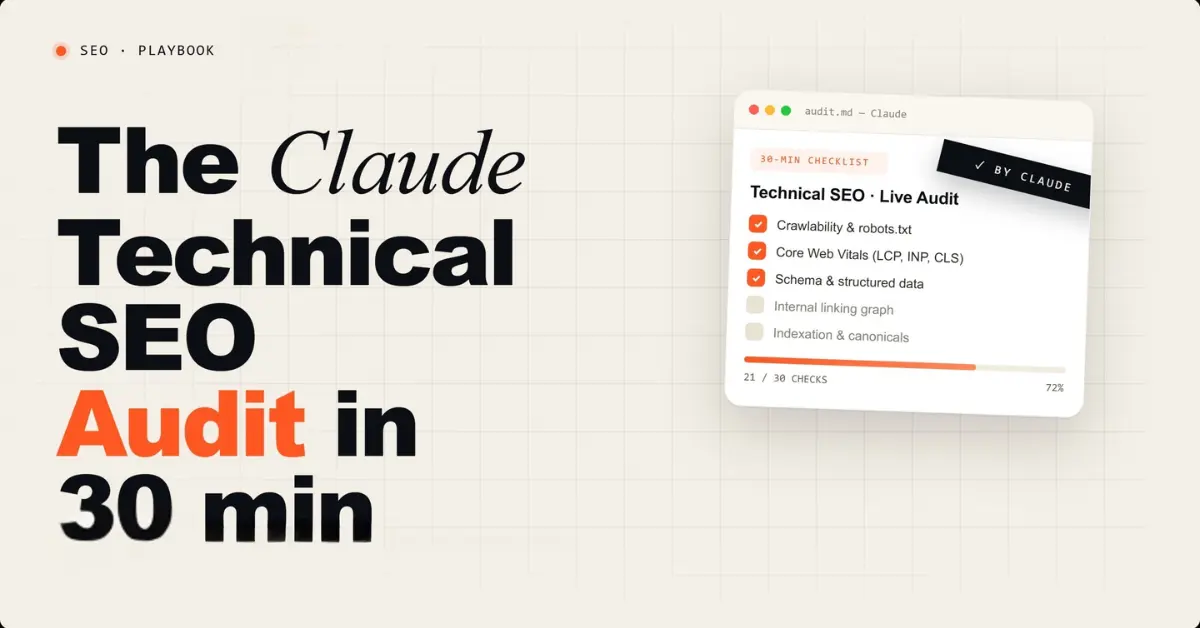
Internal linking to target pages. Pages with more internal links pointing to them from other pages on your site receive more crawl priority and carry more internal authority signals. If a page you want to get cited does not have at least three to five internal links from other pages on your site with relevant anchor text, add them. The Claude SEO audit guide covers the internal linking audit process in detail.
Step 7: Track Whether You Are Appearing in AI Overviews
You cannot optimize for AI Overview citations without knowing whether your current efforts are producing results. Tracking requires a combination of manual testing and GSC data interpretation.
Manual testing method (free)
Open a private browser window (Incognito in Chrome) so that your personal search history does not influence results. Search your target keyword and note: whether an AI Overview appears, whether your site or content is cited in it, and how the AI Overview answer is structured. Do this for your top 10 target queries once per week and record the results in a simple spreadsheet. Manual testing shows you exactly what the AI Overview says and whether your brand is mentioned.
GSC impression analysis
In Google Search Console, click on a specific query in the Performance report and look at the impression-to-click ratio over time. If a query shows growing impressions but flat or declining clicks, an AI Overview has likely started appearing for that query and absorbing clicks. This is not confirmation that you are cited, but it tells you which queries are affected by AI Overviews so you can prioritize your optimization efforts on them.
AI platform testing
Search your target queries in Perplexity, ChatGPT with search enabled, and Claude with web search enabled. Note which sites appear as cited sources in the AI-generated answers. This tells you which competitors are earning citations and what their content structure looks like, which directly informs your own optimization priorities.
How Long Does It Take to Appear in AI Overviews?
The timeline for appearing in Google AI Overviews is shorter than most SEOs expect, because AI Overview citation is driven more by content quality signals than by domain authority accumulation.
For pages that already rank in the top 10 for a query where an AI Overview appears: content restructuring improvements (Steps 1, 2, and 3) typically produce first citation appearances within 2 to 4 weeks of implementation. Google's crawl frequency means changes to well-established pages are evaluated relatively quickly.
For pages ranking between positions 11 and 20: you need both traditional ranking improvement and content restructuring simultaneously. Getting into the top 10 typically takes 60 to 90 days of consistent SEO work. Once you reach the top 10, the content restructuring produces citations relatively quickly.
For new pages with no existing rankings: the AI Overview citation timeline tracks the traditional ranking timeline. You need to rank before you can be cited. New pages in competitive niches typically take 3 to 6 months to rank in the top 10, after which the citation optimization work produces results.
The important caveat: these timelines assume consistent implementation of the seven steps in this guide, regular content freshness updates, and no technical issues blocking crawl or indexing. Any of those factors being absent extends the timeline significantly.
The AIO Optimization Checklist
Use this checklist for every page you want to get cited in Google AI Overviews. Run through it in order. Do not skip to later steps without completing earlier ones.
- Page is indexed and confirmed crawlable in Google Search Console URL Inspection tool
- Page is ranking in the top 20 for its primary target keyword (check in GSC)
- Page speed LCP is under 2.5 seconds on mobile (check in PageSpeed Insights)
- Every H2 section opens with a direct-answer first sentence
- Every paragraph is self-contained and makes sense read in isolation
- At least two named statistics with source attribution are present in the body content
- A FAQ section with 5 or more questions exists at the bottom of the page
- FAQPage JSON-LD schema is implemented and validated with no errors (check in Rich Results Test)
- Author name and credentials are visible on the page
- Published or last-updated date is visible on the page
- At least three internal links from other relevant pages on the site point to this page
- The page has been re-submitted for indexing in GSC after the most recent round of improvements
- Manual AI Overview check performed after 3 weeks to verify citation status
Related Resources
- Why Did My Website Traffic Drop? The 7 Real Reasons, if your traffic has declined because AI Overviews are absorbing your clicks, this diagnostic guide covers every cause and fix.
- GEO and AEO Optimization: The Complete Guide, the full strategy for earning citations across Google AI Overviews, ChatGPT, Perplexity, and Claude simultaneously.
- Google AI Mode Changed SEO: What to Do Now, how Google AI Mode differs from AI Overviews and what content changes it requires.
- 47 Claude AI SEO Prompts, includes specific prompts for generating FAQPage schema, identifying passage-level improvements, and running a complete AI citability audit on any page.
Frequently Asked Questions


Leave a Comment
Your email address will not be published. Comments are moderated before appearing.