Google AI Mode Changed SEO. Here Is What To Do Now (2026)

For most of the past 25 years, the core promise of SEO was simple. Rank at the top of Google and your website gets visited. The higher the position, the more the clicks. Traffic was the proof that the strategy worked. Google AI Mode has broken that model, and every digital marketer needs a new Google AI Mode SEO strategy to replace it. Read more about digital marketing consultant. Read more about agentic AI tools.
That model has a structural problem now. Google is no longer primarily in the traffic business. It is in the answer business. And when Google provides the answer directly on the search page, there is no traffic to capture, no matter where you rank.
This is not a warning about what might happen. The data is already in. Organic click-through rates for queries where an AI Overview appears have dropped 61%, from 1.76% to 0.61%, according to a September 2025 study by Seer Interactive that analyzed 25.1 million organic impressions across 42 organizations over 15 months. Google’s dedicated AI Mode delivers a 93% zero-click rate, more than double the rate of standard search results pages.
At the same time, something less discussed is happening on the other side of this shift. Brands that do get cited inside AI-generated answers receive 35% more organic clicks and 91% more paid clicks than competitors who do not. AI search traffic converts at 14.2% compared to 2.8% for traditional Google organic traffic.
The problem is not that SEO stopped working. The problem is that a specific type of SEO stopped working, and a different type of SEO is becoming dramatically more valuable. This article explains the difference and what your Google AI Mode SEO strategy needs to include right now.
What Google AI Mode Actually Is (and How It Differs from AI Overviews)
A common source of confusion in current SEO discussions is treating Google AI Mode and Google AI Overviews as the same thing. They are not, and the distinction matters for how you measure and respond to both.
Google AI Overviews are the AI-generated summaries that appear at the top of standard Google search results pages. As of late 2025, they appear on approximately 47 to 50% of all tracked US search queries, according to data from Semrush and BrightEdge. They are part of the traditional SERP layout, sitting above organic results alongside ads, images, and other features.
Google AI Mode is a separate, dedicated AI-first search experience. Instead of the standard results page, users get a conversational interface that synthesizes answers and conducts multiple search cycles within the same session. It became available in 200-plus countries in October 2025. The zero-click rate in AI Mode is 93%, compared to 43% for standard searches with AI Overviews and 34% for standard searches without them.
Understanding which surface your target queries land on changes which optimization tactics are most urgent. For standard informational queries that now trigger AI Overviews, the priority is getting cited within those overviews. For AI Mode sessions, which involve more complex, multi-step research queries, the priority is building the topical depth and authority that earns inclusion across multiple related questions in a single session.
The Citation Economy: From Traffic to Attribution
The old SEO game was about position. You wanted to be number one because number one got clicked. The implicit assumption was that position and traffic were the same thing.
That assumption no longer holds when an AI-generated answer sits above your number-one ranking. Research by E2M Solutions found that only 53% of domains cited in AI Mode match the top 10 organic search results, and only 35% of specific URLs match. You can rank in the top 10 and still be invisible if AI cites someone else. You can sit outside the top 10 and be prominently cited if your content better fits the AI’s source evaluation criteria.
This is the shift that most SEO strategies have not fully internalized yet. The competition is no longer for position number one on a page of ten blue links. The competition is for attribution, being one of the two to five sources an AI system names when it synthesizes an answer, which is why a dedicated step-by-step guide to getting cited in Google AI Overviews belongs in your 2026 playbook.
Attribution requires something different from what earns traditional rankings. It requires recognized expertise in a specific domain. It requires structured content that AI systems evaluate as credible, current, and extractable. It requires a digital footprint across the web that signals your brand knows what it is talking about, not just on your own site but in the broader web of publications, forums, and platforms that AI systems crawl to build their understanding of which sources are trustworthy.
Research from SE Ranking’s study of 2.3 million pages confirms that domain traffic is the strongest single predictor of AI citation frequency, with high-traffic sites earning three times more citations than low-traffic ones. Sites with over 32,000 referring domains are 3.5x more likely to be cited by ChatGPT than those with minimal backlinks. The authority signals that earned traditional rankings also feed AI citation likelihood, but they are necessary rather than sufficient. Content structure, freshness, and extractability now matter in ways traditional ranking algorithms weighted less heavily.
For a full technical breakdown of how to structure content to earn AI citations, the GEO and AEO optimization guide covers the complete implementation framework, including what each major AI platform looks for when deciding which sources to cite.
The Zero-Click Reality: What the Data Actually Shows
Before making decisions based on the zero-click trend, it is worth being precise about what the data actually says, because some of the numbers circulating in marketing discussions are imprecise or mix different measurement methodologies.
Here are the verified figures with their sources:
-
58.5% of US Google searches now end without a click to any website. Source: Bain and Click-Vision, 2026.
-
93% of Google AI Mode sessions end without a website click. Source: Semrush, September 2025.
-
43% of standard Google searches that include an AI Overview end without a click. Source: Semrush, September 2025.
-
34% of standard Google searches without any AI Overview end without a click. Source: Semrush, September 2025.
-
Organic CTR dropped 61% for queries where AI Overviews are present (from 1.76% to 0.61%). Source: Seer Interactive, September 2025.
-
AI Overviews reduce clicks to the top-ranking organic page by 58%. Source: Ahrefs, February 2026.
Two things are true simultaneously. Zero-click behavior is dominant and growing. Brands that earn citation inside AI-generated answers perform better than they did under purely traditional ranking. Seer Interactive’s data shows that cited brands earn 35% more organic clicks and 91% more paid clicks compared to competitors on the same queries who are not cited.
One counterintuitive finding is worth noting because it complicates the simple narrative that AI Overviews always kill traffic. Semrush’s study found that when they compared the same keywords before and after an AI Overview appeared, zero-click rates actually fell slightly, from 33.75% to 31.53%. This suggests AI Overviews do not uniformly suppress clicks. For some query types, a well-cited AI Overview can drive more qualified traffic than a standard organic listing, because the user’s intent has been more clearly framed by the AI’s response.
The practical conclusion is not that traffic is dead. It is that traffic from undifferentiated, generic informational content is declining, while traffic driven by AI citation to specific, authoritative, depth-first content is holding or growing.
Why Complex Queries Are the Opportunity
Not all queries are equally affected by AI-generated answers. Understanding which query types generate AI Overviews and which do not is the starting point for identifying where to invest content resources in 2026.
The pattern is clear in the research. Long-tail queries of seven words or more trigger AI Overviews 46% of the time, according to Ahrefs’ November 2025 analysis. Question-based queries trigger AI Overviews in 57.9% of instances. SE Ranking’s study found long-tail queries of four or more words trigger AI Overviews 60.85% of the time. Conversely, local queries trigger AI Overviews in only 7.9% of cases, and shopping queries in only 3.2%. A structured, AI-focused SEO audit workflow that includes GEO checks helps identify which of your existing pages are actually positioned to benefit from these AI Overview triggers.
Informational and research-intent content faces the most significant structural challenge, because these are the query types where AI-generated summaries are most common and most complete. A search for “what is technical SEO” is now answered directly by Google without the user needing to visit a site. A search for “technical SEO strategy for an e-commerce site with 50,000 product pages targeting enterprise buyers in Europe” requires nuance, expertise, and specific contextual knowledge that AI systems still struggle to synthesize without citing external sources.
This is the shift that creates opportunity. Simple questions are increasingly answered by AI directly, requiring no citation. Complex, layered, use-case-specific questions require AI to cite sources because the answer cannot be synthesized from general knowledge alone. To create content for these queries, use a conversational, human tone that mirrors how people speak to voice assistants. The businesses that win in this environment are not the ones chasing high-volume, short-tail keywords anymore. They are the ones building comprehensive resources around specific, nuanced problems that require depth, real-world experience, and proprietary insight to answer well.
A practical test: take your five most important target queries and search them in Google today. If AI generates a complete, useful answer without citing any specific domain, that query is increasingly difficult to drive traffic from. If AI cites two or three sources and still leaves the reader wanting more detail, that query has active citation opportunity. Prioritize your content investment around the second type. These pages should anticipate follow-up questions so they cover the full topic, not just the first query.
Authority Is No Longer Optional: What AI Systems Actually Evaluate
One of the more honest observations about the current SEO transition is that authority signals, which sophisticated SEOs always knew mattered, now matter in ways that are much harder to fake or shortcut.
Traditional SEO rewarded a set of proxies for authority: keyword optimization, backlink volume, page speed, and precise structured data. These worked well when the evaluator was an algorithm matching signals against a ranking formula and using it to help search engines categorize the page. They work less well when the evaluator is an AI system synthesizing answers from multiple sources and making judgment calls about which sources are trustworthy enough to cite.
What AI systems actually evaluate when deciding whether to cite a source includes the following factors, verified across multiple research sources:
Domain authority and backlink profile. SE Ranking’s study of 2.3 million pages found domain traffic is the number-one predictor of AI citation frequency. Sites with over 32,000 referring domains are 3.5x more likely to be cited by ChatGPT than those with minimal backlink profiles. Traditional authority building remains the foundation.
Content freshness. Ahrefs’ 2025 study found AI-cited content is 25.7% fresher than typical organic Google results. Content updated within 30 days receives 3.2x more citations than older material on the same topics. This makes quarterly content refreshes an AI citation strategy, not just a user experience improvement.
Passage-level extractability. Research published by Growth Memo in February 2026 found that 44.2% of all LLM citations come from the first 30% of an article’s text. AI systems read for extractable passages, not full articles. Content with direct answers near the top of each section gets cited more than content that buries conclusions at the end of long paragraphs.
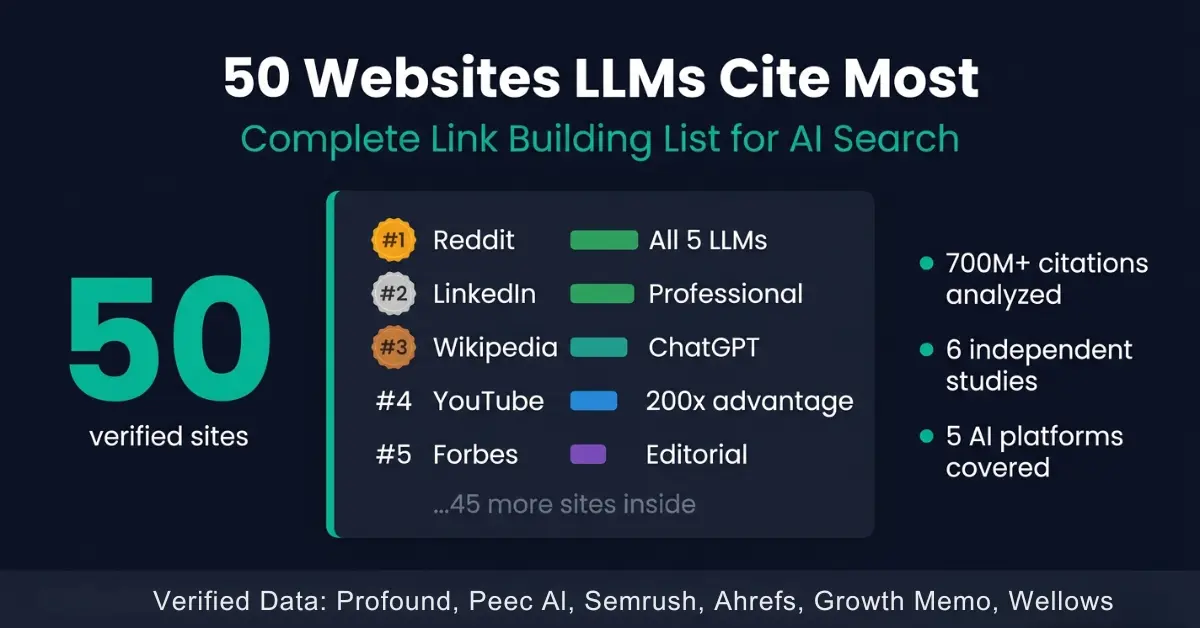
Third-party mentions and brand signals. SE Ranking found that domains with substantial brand mentions on Quora and Reddit have roughly 4x higher chances of being cited by ChatGPT than domains with minimal off-site activity. Domains listed on Trustpilot, G2, Capterra, and similar review platforms show 3x higher citation probability. The broader web’s recognition of your brand feeds AI citation decisions.
E-E-A-T compliance. Google’s Quality Rater Guidelines framework for Experience, Expertise, Authoritativeness, and Trustworthiness is the on-site expression of what AI systems look for, and Google’s algorithms reward content that proves Experience, Expertise, Authoritativeness, and Trustworthiness. Content with named authors, verifiable credentials, sourced claims, and specific real-world examples scores higher across every major AI platform than anonymous, generic content covering the same topics, because Google’s AI prioritizes content that is helpful, reliable, and grounded in firsthand experience.
AI models digest structured information faster and are more likely to cite it. A focused Claude-powered technical SEO audit checklist is one of the fastest ways to make sure crawlability, indexation, and structured data are not the bottlenecks on that visibility.
The honest reality is that many of these signals take months to years to build properly. That is not a reason to delay. It is a reason to start immediately, because every competitor who waits longer compounds your advantage.
Search Is Not Just Google Anymore
Google remains the dominant search platform by significant margin. According to January 2026 data from DemandSage, Google still processes an estimated 13.7 billion daily searches globally. But the search landscape has fragmented in ways that affect where your buyers first encounter information about your industry, your category, and your brand.
ChatGPT recorded 5.72 billion monthly visits in January 2026, processes approximately 2 billion queries daily, and holds roughly 80% market share in the AI chatbot space. Perplexity AI processed 780 million queries in May 2025 alone. Amazon, TikTok, YouTube, Instagram, and LinkedIn each handle hundreds of millions of search queries daily, though independently verified daily figures for each platform are not consistently published by these companies and specific numbers circulating in marketing content are often estimates rather than confirmed data.
What matters practically is not the exact volume on each platform. It is the behavioral implication. Users researching a professional service in 2026 might search Google for background information, ask ChatGPT or Perplexity for a synthesis of options, check LinkedIn for social proof about specific providers, and watch YouTube for demonstrations. This reflects a broader shift in search behavior toward multi-step, conversational evaluation. All of those touch points influence their decision. Monitor direct referral traffic from LLM platforms like ChatGPT and Perplexity. Visibility on only one of them means missing potential buyers at multiple stages of their evaluation.
Each of these platforms favors content that demonstrates the same core signals: authority, depth, consistency, and structure. The brands winning across multiple search surfaces are not running separate strategies for each platform. They are building genuine expertise that earns discovery across all of them simultaneously, often supported by an AI SEO tools comparison of Claude, ChatGPT, and Perplexity that assigns each platform to the tasks it does best.
For a practical framework covering how to optimize content for AI citation across ChatGPT, Perplexity, Google AI Overviews, Claude, and Gemini, the GEO and AEO Complete Guide for 2026 covers platform-specific optimization tactics in detail.
Google AI Mode SEO Strategy: The 2026 Action Framework
The goal here is not to catalog everything that has changed. It is to give you a sequenced, prioritized set of actions that address the most impactful shifts. This is the Google AI Mode SEO strategy framework organized by timeline, from what you do this week to what you maintain ongoing.
This week: Audit your current AI visibility
Before changing anything, establish your baseline. Search your 20 to 30 most important target queries in Google and note which ones trigger AI Overviews and whether your brand is cited. Do the same in ChatGPT and Perplexity. This takes 45 minutes and gives you a concrete picture of where you are visible in AI-generated answers and where you are not. Record the results in a spreadsheet. This becomes your AI Share of Voice baseline for tracking progress over time, and you can validate on-page gaps quickly with a free Claude SEO checker workflow before investing in larger changes.
This week checklist:
-
List your top 25 target queries in a spreadsheet
-
Search each in Google, note: AI Overview present? Your brand cited?
-
Search the same 25 in ChatGPT, note: your brand mentioned?
-
Search the same 25 in Perplexity, note: your brand cited?
-
Mark each query as: Cited / Visible but not cited / Invisible
-
Prioritize the “Visible but not cited” group, these are your fastest wins
Research by Growth Memo (February 2026) found that 44.2% of AI citations come from the first 30% of an article’s text. If your most important pages bury their key points in dense prose paragraphs, they are structurally disadvantaged for AI citation regardless of their ranking position. Rewrite the first section of each page to lead with a direct, complete answer to the primary question the page targets. Make each major section heading a question. Add a Key Takeaways block near the top, and use bullet points where they make answers easier to scan.
These changes do not require new content. They require restructuring what you already have. The 47 Claude AI SEO prompts guide includes copy-paste prompts specifically for AEO content restructuring in Prompts 46 and 47. For a broader look at how to use Claude AI tools to implement this Google AI Mode SEO strategy, read the guide on which Claude mode works best for each SEO task
This month checklist:
-
Identify your top 10 pages by organic impressions in GSC
-
For each: add a Key Takeaways section within the first 200 words
-
Rewrite each major H2 as a question where possible
-
Add a 40 to 60 word direct answer immediately after each H2
-
Verify each page has an author name, bio link, and publication date visible
-
Add or update Article schema as precise structured data that helps search engines categorize the page, with dateModified reflecting today’s date
-
Request re-indexing for each updated page in Google Search Console
This quarter: Shift from volume to depth
If your content strategy has been producing a high volume of short informational articles targeting broad keywords, that model is underperforming. The query types most vulnerable to AI summarization are exactly the ones that model targets: short, high-volume, informational keywords with broad audience appeal. Shift investment toward fewer, deeper pieces targeting complex questions and multi part questions that require genuine expertise to answer. Pieces covering nuanced use cases, containing proprietary data or original analysis, and requiring first-hand experience to write are both harder for AI to summarize without citing you and more valuable to readers who still click through, because optimizing content now means covering layered use cases deeply, not just publishing more short articles, and a structured Claude SEO audit playbook with multi-phase workflows can help you prioritize which topics deserve that depth.
This quarter checklist:
-
Audit your content calendar: remove or defer broad, short-tail informational posts
-
Identify 5 complex, niche questions in your space that have no definitive authoritative answer yet
-
Commission or write one deep-dive piece per month targeting each
-
Include original data, named case studies, or first-hand analysis in each piece
-
Publish each with full author credentials, sourced statistics, and FAQ schema
Ongoing: Build off-site authority that AI systems can verify
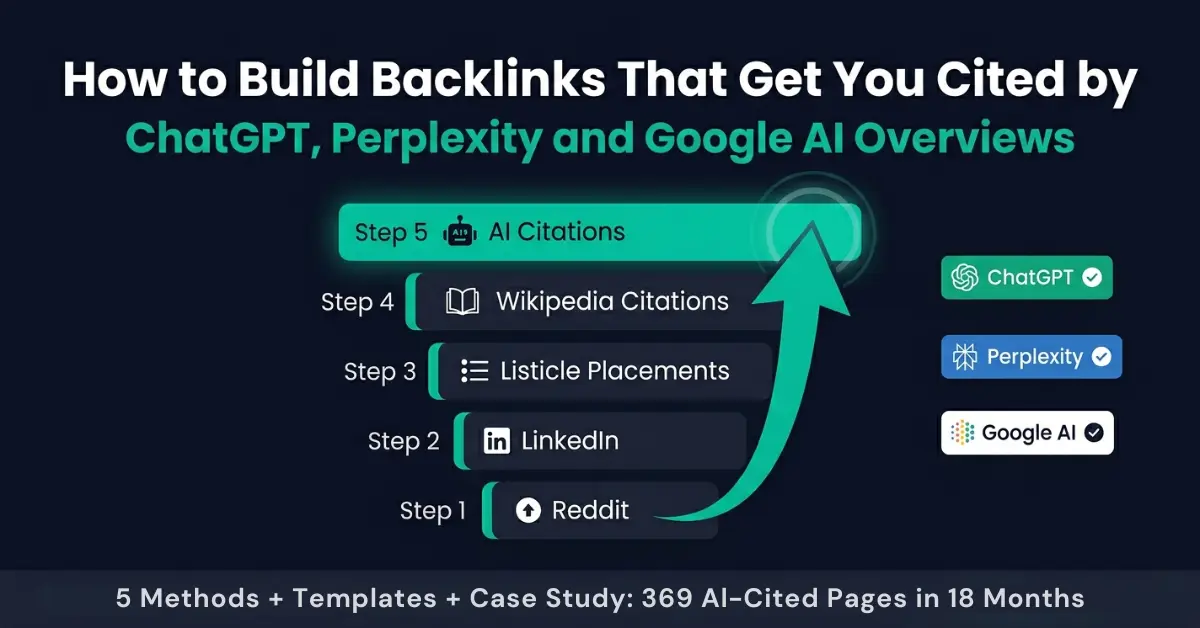
Contributing to forums and communities that Google’s AI already cites helps strengthen your off-site visibility. Getting mentioned in industry publications. Being listed on relevant professional directories. Appearing on podcasts and in expert roundup articles. These activities build the cross-web brand signal that SE Ranking’s research confirms is a strong predictor of AI citation frequency, reflecting a strategic shift from isolated seo tactics to verifiable brand authority across the web. This is not a quarterly campaign. It is an ongoing program that compounds in value as your brand entity becomes more recognizable to ai driven search across more sources over time, and reusable Claude Skills for SEO make it easier to run those audits and content updates consistently every month.
Ongoing monthly checklist:
-
Contribute one substantive answer per week on Reddit or Quora in your niche
-
Pitch one guest article or expert quote to an industry publication per month
-
Verify your brand profiles are complete and consistent on LinkedIn, G2, Trustpilot, and Clutch
-
Monitor AI Share of Voice monthly: re-run your 25-query audit and track changes
-
Update your top 5 articles with new data or statistics at least once per quarter
Measure differently going forward
Traffic and rankings remain worth tracking, but the google search experience now requires broader attribution measurement beyond classic SERP metrics. But they measure an incomplete picture of your current visibility. Add AI Share of Voice to your measurement framework: how often your brand appears in AI-generated responses for your target queries. Track this manually at first, testing the same queries monthly across Google AI Overviews, ChatGPT, Perplexity, and Claude. Add self-reporting fields to your forms so prospects can say if they found you via AI. When budget allows, tools like Profound, AIclicks, and SE Ranking’s AI tracking module automate this tracking with competitor benchmarking. You can also run periodic checks with a free Claude AI SEO + GEO audit tool to catch structural issues that might quietly undermine AI visibility. The brands that measure AI visibility now will have the historical data to prove attribution when AI search becomes the dominant channel later, because visibility is no longer just about a link list on search engine results pages.
-
GEO and AEO Optimization: The Complete Guide for 2026. The full implementation framework for getting cited by ChatGPT, Perplexity, Google AI Overviews, and Claude. Covers technical setup, content restructuring, off-site signals, and AI Share of Voice measurement.
-
47 Claude AI SEO Prompts That Fix Every SEO Problem (2026). Includes Prompts 46 and 47 for AEO content restructuring, which directly apply the extractability improvements covered in this article.
-
Best Free Claude AI SEO Checker: Chat vs Cowork vs Projects. Which Claude mode handles each part of the Google AI Mode SEO strategy: quick audits, bulk analysis, and ongoing optimization.
-
Connect Google Search Console to Claude AI Free. How to set up live GSC data access in Claude, which enables the performance analysis prompts that make tracking AI visibility shifts measurable without paid tools.
-
SEO Consulting Services. For businesses that want expert implementation of this Google AI Mode SEO strategy rather than DIY.
Frequently Asked Questions
What is the best SEO strategy for Google AI Mode in 2026?
The best Google AI Mode SEO strategy in 2026 focuses on citation rather than ranking. Because AI Mode delivers a 93 percent zero click rate, traditional position based visibility metrics no longer reflect real audience reach. The strategy includes four parts. First, structure content for extractability by leading each section with a direct 40 to 60 word answer that helps AI systems resolve more of the user journey in one response. Second, build off site authority through publications, communities, and directories. Third, update content regularly since recently updated content earns significantly more citations. Fourth, measure AI Share of Voice monthly by testing your top queries across AI platforms. AI Mode sessions average 2 to 3 queries compared to 5 or more in traditional search paths, which makes citation matter more than repeated clicks.
How do AI Overviews affect SEO and organic traffic in 2026?
Using multiple AI assistants for analysis matters here; a tested comparison of Claude vs ChatGPT vs Perplexity across SEO tasks shows how each can model zero-click impacts and opportunity by query type before you adjust strategy.
Google AI Overviews appear on roughly 47 to 50 percent of users search queries. Their impact is significant but depends on citation. Studies show organic click through rates drop by around 61 percent when AI Overviews are present. However, brands that are cited gain 35 percent more organic clicks and 91 percent more paid clicks compared to non cited competitors. The outcome depends on whether your brand earns citation within AI results. The same applies to AI summaries.
What is Google AI Mode and how is it different from Google AI Overviews?
Google AI Overviews are AI generated summaries that appear at the top of standard search result pages for informational queries and remain part of the traditional SERP. Google AI Mode is a separate conversational search experience where the entire interface is AI first, showing how ai mode works by synthesizing answers across multiple searches within one interface instead of presenting traditional blue links. AI Mode became available in more than 200 countries in October 2025 and has a zero click rate of about 93 percent, so users no longer move through multiple pages of results because it replaces the classic search engine flow with one synthesized answer.
Is traditional SEO still worth doing in 2026?
Yes. Research shows that over 92 percent of AI Overview citations come from domains ranking in the top 10 of Google results. Traditional SEO remains the foundation for AI visibility, but keyword density alone does not determine visibility in AI-first environments. However, ranking alone is not enough. Content structure, extractability, freshness, and off site authority all influence whether content gets cited.
How much has organic CTR actually declined because of AI Overviews?
Research analyzing 25.1 million impressions found that organic CTR dropped by about 61 percent for queries with AI Overviews, decreasing from 1.76 percent to 0.61 percent. Other data shows clicks to the top ranking page drop by around 58 percent. However, cited brands can see increased organic and paid clicks compared to competitors.
What types of queries trigger Google AI Overviews most often?
Nearly all triggering queries are informational. Long tail queries with seven or more words, the kind of complex questions and advanced reasoning tasks Google’s AI handles well, trigger AI Overviews around 46 percent of the time. Question based queries trigger them in about 57.9 percent of cases. Topics such as science, health, pets, and people related content show the highest rates, while local and shopping queries trigger them much less frequently. In AI environments, people search with longer, more layered prompts, which is why these query types trigger overviews more often.
How do I know if my brand is being cited in AI generated answers?
Detailed workflows for this kind of monitoring, plus real examples of AI-era reporting, are covered regularly on the SEO blog and marketing insights hub.
Start by manually searching your main queries across Google, ChatGPT, Perplexity, and Claude to check if your brand appears in generated responses and whether people still use cited sources for further exploration. Track this monthly to build an AI Share of Voice baseline. For automation, use tools that monitor AI citations and competitor presence. Google Search Console also provides some AI related data within performance reports. What the user sees first is the AI-generated response, so source visibility matters before clicks happen.
What content changes have the biggest impact on AI citation rates?
These changes help produce well structured content for AI extraction. First, start each section with a clear 40 to 60 word answer, since a large portion of citations come from early content and direct answers work best when the page uses structured content consistently across headings and summaries. Second, include statistics and named sources because this increases citation likelihood. Third, update content frequently since recently updated content earns significantly more citations.
Does building brand presence on platforms like Reddit and Quora actually help AI visibility?
Yes. Domains with strong brand mentions on platforms like Reddit and Quora are about four times more likely to be cited by AI systems. AI models evaluate credibility based on signals from across the web, especially as user behavior shifts toward fewer, more intent-driven searches. Active and helpful participation in relevant communities can significantly improve citation frequency. This matters because broader search behavior increasingly pushes discovery onto community platforms before a click ever reaches your site.
Frequently Asked Questions

Leave a Comment
Your email address will not be published. Comments are moderated before appearing.