50 Websites LLMs Cite Most: Complete Link Building List For AI Search (2026)
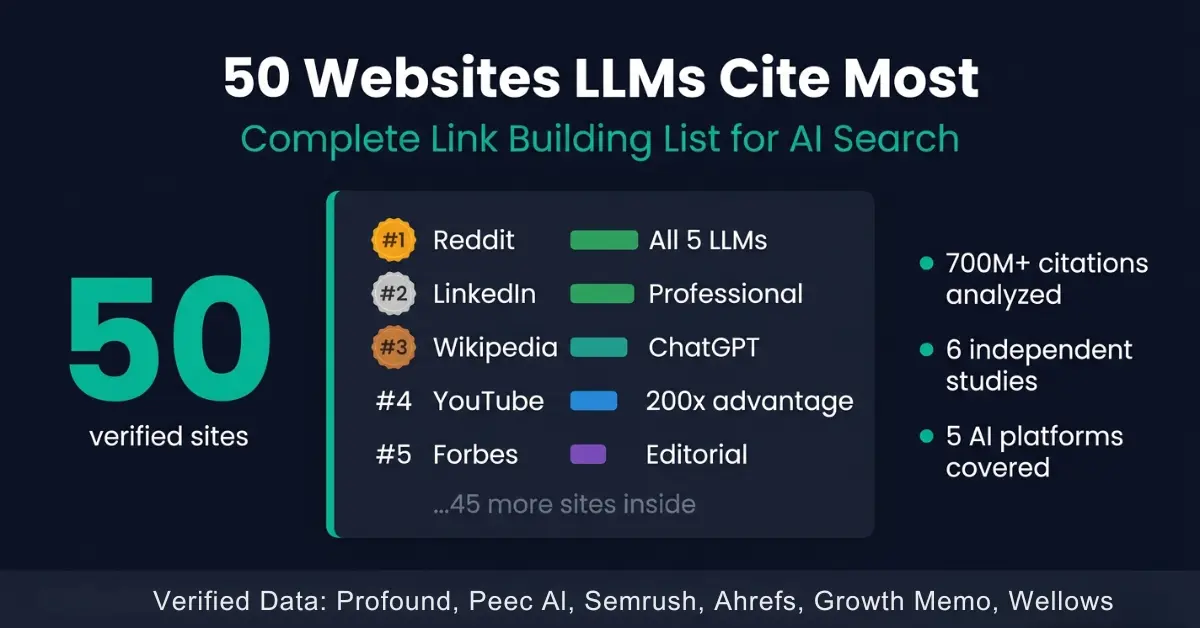
Traditional link building targets domain authority. AI link building targets citation frequency. These two goals overlap on about 12% of URLs, according to Ahrefs research analyzing how AI citation patterns compare to Google's top 10 results. The other 88% of AI citations come from sources that Google's algorithm does not rank highly, or does not rank at all.
This creates a significant opportunity for digital marketers, SEO consultants, and link building teams who understand the new rules. The sites that large language models cite most are not necessarily the sites with the highest domain authority. They are the sites that appear most frequently in the specific formats, on the specific platforms, and with the specific structural signals that AI retrieval systems weight most heavily.
This article gives you the verified list of 50 sites that ChatGPT, Perplexity, Google AI Mode, Gemini, and Claude cite most frequently. Every entry includes which LLMs cite it, why it gets cited, the realistic effort required to earn a presence there, and the specific action your link building team can execute this week. The data comes from six independent research studies covering more than 700 million verified citations.
What This Article Covers
- Key Takeaways
- Why Traditional Link Building Misses 88% of AI Citations
- How LLMs Choose Which Sites to Cite
- Research Methodology and Data Sources
- Tier 1: Universal Sources (Cited by All Major LLMs)
- Tier 2: High Impact Sources (Widely Cited, Growing Fast)
- Tier 3: B2B and Marketing Niche Sources
- Tier 4: Review and Trust Platforms
- Tier 5: News and Editorial Sources
- Tier 6: Academic and Research Sources
- Tier 7: Social and Community Platforms
- Tier 8: Professional and Platform-Specific Sources
- Per-Platform Citation Strategy
- How to Prioritize This List for Your Niche
- 5 Use Cases for Different Business Types
- The Outreach Strategy for the Top 3 Platforms
- Frequently Asked Questions
Key Takeaways
- Only 12% of AI citations overlap with Google's top 10 results, according to Ahrefs research from August 2025. Getting cited by LLMs requires a different strategy than ranking in traditional search.
- Reddit is the most cited domain across ChatGPT, Google AI Mode, Gemini, Perplexity, and AI Overviews combined, based on Peec AI analysis of 30 million citations (March 2026).
- LinkedIn is the most cited domain for professional queries across all six major AI platforms according to Profound research covering 1.4 million citations from November 2025 to February 2026. LinkedIn's citation frequency doubled during that period.
- Listicle content gets 21.9% of all AI citations, the highest of any content format, according to Wix research from March 2026 analyzing AI Mode, ChatGPT, and Perplexity citations.
- 85% of AI Overview citations come from content published in the last two years, with 44% from 2025 alone, according to Seer Interactive research from June 2025. Freshness is a hard requirement for AI citation eligibility.
Why Traditional Link Building Misses 88% of AI Citations
Traditional link building prioritizes domain authority because Google's algorithm weights the authority of the linking domain as a ranking signal. Build links from high-DA sites, improve your own DA, rank higher on page one. This strategy has worked for 20 years and continues to work for traditional Google search rankings.
AI citation operates on a different logic. Large language models do not evaluate your website's link profile when deciding whether to cite you. They evaluate three things: whether your content is in their retrieval index, whether the format of your content makes individual passages easy to extract, and whether the platform your content lives on is one the model has been trained to treat as authoritative for that query type.
The practical consequence is stark. ChatGPT primarily searches Bing's index, not Google's. Perplexity crawls the live web on every query with its own crawler. Google AI Mode has strong preference for Google's owned properties and community platforms like Reddit and YouTube. Claude draws from training data with structural content preferences that favor depth and precision over popularity.
A site with a Moz DA of 30 that has consistent, well-structured presence on Reddit, LinkedIn, and Quora can earn more AI citations than a site with DA 70 that exists only on its own domain. The 50 sites in this article represent the platforms and publishers where AI citation opportunity is highest, organized by the effort required to build a credible presence on each one.
For the broader context of how AI search is changing organic visibility strategy, the Google AI Mode SEO strategy guide covers what changed in the underlying ranking signals and which content types are most and least affected.
How LLMs Choose Which Sites to Cite
LLMs choose which sites to cite through a process called Retrieval-Augmented Generation, or RAG. Before generating an answer, the model queries an external knowledge index, retrieves the most relevant content passages, and uses those passages as the factual foundation for its response. The sites that appear most frequently in citation outputs are the sites that consistently appear in that retrieval step.
RAG systems evaluate content on three dimensions that are distinct from traditional SEO signals. Semantic clarity means the passage answers the query directly and unambiguously in its first sentence. Structural retrievability means the passage can be extracted and read independently without context from surrounding text. Third-party validation means the platform hosting the content is recognized by the model as a credible source type for that category of query.
Platform recognition is the factor most link building teams overlook. ChatGPT's retrieval architecture, which uses Bing's real-time index, does not weight Reddit and Wikipedia because they have high domain authority in the traditional sense. It weights them because they appeared overwhelmingly in the training data as sources that human users cited, shared, and engaged with when seeking factual answers. The model learned that these platforms signal reliable information. That learned pattern persists in how it evaluates retrieval results.
This explains why 80% of LLM citations do not rank in Google's top 100 for the original query, according to Ahrefs August 2025 research. The AI retrieval evaluation and the Google ranking evaluation are measuring fundamentally different signals. A forum thread on Reddit with 200 upvotes on a specific technical question can outperform a well-optimized blog post in AI citation frequency because the upvote signal, the community engagement pattern, and the specific answer format all align with what the RAG retrieval system learned to weight.
Understanding this mechanism is the prerequisite for using the 50-site list strategically rather than treating it as a link building checklist. Getting onto a high-citation platform does not automatically earn you citations. You need to produce content on that platform in the format the platform's community rewards, so the AI system encounters your content repeatedly in contexts that signal credibility for your topic area.
Research Methodology and Data Sources
The 50-site list in this article is based on cross-referencing six independent research studies, each using different methodologies and different time windows. No single study is used as the sole source for any site's placement. A site appears on this list only when it shows up in multiple independent datasets.
The six data sources are as follows. Profound analyzed 680 million citations across its full dataset plus 1.4 million citations in a specific three-month study from November 2025 to February 2026, covering ChatGPT, Gemini, Google AI Overviews, Google AI Mode, Microsoft Copilot, and Perplexity. Peec AI analyzed 30 million directly cited sources across five AI platforms in March 2026, counting only URLs that appeared as direct citations in model responses. Semrush conducted a 13-week study covering 230,000 prompts with weekly tracking of citation frequency changes across ChatGPT, Google AI Mode, and Perplexity. Wellows analyzed 350,000 citations across all major platforms specifically focused on social media platform citations during January and February 2026. Growth Memo analyzed 1.2 million verified ChatGPT citations published in February 2026, with specific analysis of content position and format signals. Ahrefs published a comparative analysis of ChatGPT citation patterns versus Google ranking patterns, finding the 12% overlap figure that frames the strategic argument of this article.
The combined dataset represents over 700 million citation data points. Tier placement in this article reflects citation frequency consistency across studies, not just peak citation in any single dataset.
Tier 1: Universal Sources (Cited by All Major LLMs)
The five sites in Tier 1 appear consistently in the top citation sources across every major AI platform in every study reviewed. These are the platforms where a presence is not optional for serious AI visibility work. If your content, brand, or expertise is not represented on all five of these platforms, that gap is the first thing to address before any other link building activity.
1. Reddit (reddit.com)
Citation frequency: Ranked number 1 across ChatGPT, Google AI Mode, Gemini, Perplexity, and AI Overviews in Peec AI's 30-million-citation study (March 2026).
Why LLMs cite it: Reddit captures authentic user discussions with community-validated quality signals (upvotes, award systems). LLMs were trained on Reddit's vast conversational dataset, which means the model has learned to recognize Reddit's format as a reliable signal for practical, experience-based answers. RAG systems retrieve Reddit threads because the question-and-answer structure maps cleanly onto query-answer retrieval patterns.
Which LLMs cite it most: Perplexity cites Reddit in approximately 46.7% of responses where a community perspective is relevant, according to Profound data. ChatGPT cited Reddit in close to 60% of prompt responses before a citation pattern shift in September 2025, stabilizing at a lower but still significant frequency. Google AI Mode cited Reddit in about 15% of its responses with notable consistency throughout the Semrush study period.
How to earn citations: Create a Reddit account with consistent posting history in subreddits relevant to your niche. For digital marketing and SEO topics, the priority subreddits are r/SEO (500,000+ members), r/digital_marketing (200,000+ members), r/PPC, r/bigseo, and r/juststart. The citation trigger is not a link drop. It is a substantive answer to a specific question that earns 50 or more upvotes. Answers with high upvotes in active threads are the exact content pattern that Perplexity and Google AI Mode extract as citations. The contextual mention of your site as a resource within a well-received answer is the link building mechanism.
Effort level: Low cost, medium time investment. Consistent weekly answers over 60 days produces measurable citation frequency improvement.
Action this week: Search Reddit for the top 10 questions in your niche that have not received a comprehensive answer in the past 6 months. Write one definitive answer per week with your best expertise. No promotional links. Just the best answer possible.
2. LinkedIn (linkedin.com)
Citation frequency: LinkedIn is the most cited domain for professional queries across ChatGPT, Google AI Mode, Google AI Overviews, Microsoft Copilot, and Perplexity according to Profound research covering 1.4 million citations. LinkedIn's domain rank on ChatGPT moved from approximately number 11 in November 2025 to approximately number 5 in February 2026, representing the largest citation frequency shift Profound observed in that period.
Why LLMs cite it: LinkedIn content carries implicit professional credibility signals. When a model retrieves content for a professional query, a LinkedIn post written by someone with verifiable credentials in the relevant field aligns strongly with E-E-A-T signals the model learned to weight. Posts and long-form articles together now account for approximately 35% of all LinkedIn citations within ChatGPT responses, up from 27% at the start of the Profound study period.
Which LLMs cite it most: ChatGPT Search cited LinkedIn content in 14.3% of responses. Google AI Mode cited LinkedIn in 13.5% of responses. Perplexity cited LinkedIn in 5.3% of responses. For professional queries specifically, LinkedIn was the number one cited domain across all six platforms studied.
How to earn citations: The Semrush data shows that approximately 75% of cited LinkedIn post authors posted more than five times in the four weeks before the citation appeared. Consistency is the citation trigger, not individual viral posts. Publish posts that include specific claims with named sources, answer the exact questions your target audience is asking in AI tools, and use the long-form article format for comprehensive answers that benefit from persistent URL structure. Both company pages and personal profiles earn citations. Perplexity cites company pages in 59% of its LinkedIn citations. ChatGPT and Google AI Mode each cite individual profiles in 59% of their LinkedIn citations. A complete strategy uses both.
Effort level: Low cost. The time investment is consistent weekly publishing at 5 or more posts per week plus one long-form article per month.
Action this week: Publish one LinkedIn post today answering a specific professional question in your niche with named statistics and a source citation. Post the same question angle as a direct question in your opening line. This format matches how AI retrieval systems pattern-match queries to cited content.
3. Wikipedia (wikipedia.org)
Citation frequency: Wikipedia serves as ChatGPT's most cited source at 7.8% of total citations according to Profound, making it the single highest-cited individual domain in ChatGPT's overall citation dataset. It appears consistently in Gemini and Claude citations for definitional and background queries.
Why LLMs cite it: Wikipedia was a foundational dataset in training nearly every major LLM. The model's internal representation of factual knowledge is substantially grounded in Wikipedia's structure, language, and citation conventions. When a RAG system retrieves Wikipedia content, the model already has strong internal alignment with that content, making it the path of least resistance for citation.
Which LLMs cite it most: ChatGPT (7.8% of all citations), Gemini (consistent for definitional queries), Claude (for background context). Google AI Mode cited Wikipedia in approximately 2% of responses, significantly less than for other platforms, because AI Mode prefers community and social content over encyclopedic content for many query types.
How to earn citations: Direct Wikipedia editing requires verifiable third-party sources and neutral point of view. The citation mechanism for brands and consultants is indirect: be mentioned and cited in relevant Wikipedia articles. When Wikipedia cites your published research, case studies, or original data, that citation creates a citation chain that LLMs inherit. The practical approach is to publish data-driven content that other editors can use as a Wikipedia source, then use Wikipedia's talk pages to suggest additions where your data is genuinely relevant.
Effort level: High. Wikipedia's editorial standards are strict and the community actively monitors promotional additions. The realistic timeline for meaningful Wikipedia presence is 6 to 12 months of consistent, contribution-focused engagement.
Action this week: Identify 3 Wikipedia articles in your niche that cite outdated statistics. Publish your own updated data on your site with proper sourcing. Note which articles could benefit from your data. This prepares your content for eventual Wikipedia citation without requiring immediate Wikipedia editing.
4. YouTube (youtube.com)
Citation frequency: YouTube ranked in the top five across all five AI platforms studied by Peec AI. A Wellows study from October 2025 found YouTube has a 200x citation advantage for video content compared to other video platforms.
Why LLMs cite it: YouTube video transcripts and descriptions are indexed by Google and Bing, making them accessible to RAG retrieval systems. AI Mode in particular heavily favors YouTube because it is a Google property. Additionally, YouTube's engagement signals (views, comments, watch time) provide social proof signals that align with what LLMs learned to weight as indicators of valuable content.
Which LLMs cite it most: Google AI Mode and Gemini cite YouTube most heavily due to Google's ownership. Perplexity indexes YouTube transcripts. ChatGPT's Bing-based retrieval also surfaces YouTube content for queries where video explanations are common.
How to earn citations: The citation mechanism is the video transcript and description, not the video itself. Publish videos on topics your target audience searches for in AI tools. Include a full, detailed transcript in the video description. Use the exact phrases and questions your audience types into AI tools in your video title and first paragraph of the description. A 10-minute YouTube video explaining a specific SEO concept can earn AI citations through its transcript even for viewers who never watch the video.
Effort level: Medium. Video production has a higher production cost than text, but a single well-structured video can earn citations for months.
Action this week: Review your existing content library for a topic that could be converted to a YouTube video with minimal production effort (screen recordings, slideshow narrations). Publish with a full 300 to 500-word transcript in the description.
5. Forbes (forbes.com)
Citation frequency: Forbes doubled its number of AI responses with a citation in ChatGPT after September 2025, according to the Semrush 13-week study. Forbes appeared in the top five cited domains for ChatGPT's editorial and business query categories.
Why LLMs cite it: Forbes represents the category of high-authority business editorial that LLMs learned to treat as credible for commercial and strategic queries. The brand name itself carries trained authority in the model's knowledge representation. When a query requires a business strategy answer, Forbes appears frequently in the retrieval step because it was extensively represented in training data as a credible source for that query type.
Which LLMs cite it most: ChatGPT and Google AI Mode for business strategy and digital marketing queries. Less significant for technical SEO queries where Ahrefs and Semrush dominate.
How to earn citations: Forbes has a contributor program that allows industry experts to publish columns. Acceptance is competitive but achievable for consultants with verifiable credentials and an established digital footprint. A Forbes contributor profile provides both a high-authority backlink and a citation platform that LLMs weight heavily. Guest contribution to Forbes Agency Council or Forbes Technology Council is the most accessible path.
Effort level: High. The application process is rigorous and requires an established platform and verifiable expertise track record.
Action this week: Build the prerequisite platform. Forbes contributor acceptance requires evidence of existing media presence. Publish on Medium, Entrepreneur, or Moz as intermediate steps that demonstrate your editorial capability before approaching Forbes.
Tier 2: High Impact Sources (Widely Cited, Growing Fast)
The five sites in Tier 2 are cited frequently across multiple AI platforms and are growing in citation frequency following the February 2026 Discover Core Update and shifts in AI retrieval patterns. These are the platforms where a well-executed presence can produce measurable citation frequency within 30 to 60 days.
6. Medium (medium.com)
Citation frequency: Medium appeared in ChatGPT's updated top five cited domains after the September 2025 citation pattern shift, according to the Semrush study. Medium benefited from gains in the same period when Reddit and Wikipedia citation shares in ChatGPT contracted.
Why LLMs cite it: Medium's long-form article format matches the structural preferences of RAG retrieval systems. Articles on Medium follow a consistent structure that is easy to extract at the passage level. The platform's curation algorithm gives additional authority signals to articles that perform well with human readers, creating a quality filter that LLMs have learned to use as a proxy for reliability.
How to earn citations: Publish comprehensive, data-rich articles on Medium in your niche. Cross-post your best blog content to Medium with canonical tags pointing back to your site, or publish original research exclusively on Medium that links back to your main site. Medium publications with established audiences give additional distribution and citation signal.
Effort level: Low. Medium is free to publish on, and high-quality articles from authoritative authors gain distribution quickly.
Action this week: Republish your most data-heavy blog post on Medium with a canonical tag. Include named statistics in the first paragraph to optimize for passage-level extraction.
7. Quora (quora.com)
Citation frequency: Quora is one of the top cited domains in Google AI Overviews according to Semrush research. The question-and-answer format maps directly onto how AI systems extract content for answer generation.
Why LLMs cite it: Quora's question-and-answer structure is the closest natural language match to how AI systems process queries. A Quora answer that begins with a direct, specific answer to a clearly stated question is in the ideal format for RAG extraction. Google's AI Overviews in particular favor Quora because it complements Google's People Also Ask feature set, and both serve the same user intent of getting a direct answer to a specific question.
How to earn citations: Search Quora for the highest-traffic questions in your niche. Write comprehensive answers that begin with a direct answer in the first sentence, include at least one specific sourced statistic, and link to your relevant blog post as a further reading resource. Answers should be 300 to 500 words, not longer, because Quora's voting system penalizes answers that feel padded. The citation-optimal Quora answer is the same as a well-structured FAQ answer: direct, specific, sourced, and complete within itself.
Effort level: Low. No application or approval process. Quality answers accumulate upvotes and citation frequency over months.
Action this week: Find 5 Quora questions in your niche with 10,000 or more views that have weak or outdated top answers. Write one comprehensive answer per week.
8. NIH / PubMed (nih.gov, pubmed.ncbi.nlm.nih.gov)
Citation frequency: NIH and PubMed appeared in Perplexity's top cited sources alongside LinkedIn, Microsoft, and Google according to Profound research. These domains carry the highest per-domain authority signals in LLM training data due to their .gov domain status and peer-review credibility signals.
Why LLMs cite it: Government and academic domains were systematically included in LLM training datasets as high-credibility sources. NIH specifically has been cited by AI models as a source for health and scientific queries across every platform studied. The .gov top-level domain is a direct authority signal that LLMs learned to weight during training.
How to earn citations: This domain is not directly accessible for standard link building. The strategic value is indirect: citing NIH data in your own content creates a credibility chain that improves your content's retrievability. When your content accurately cites NIH research with proper attribution, AI retrieval systems see your content as aligned with high-authority source patterns, improving your passage-level extraction probability.
Effort level: Not applicable for direct links. Use as a citation source in your content.
Action this week: Identify NIH or PubMed studies relevant to your niche. Add one specific, cited statistic from these sources to your top 3 content pages. This does not earn a backlink from NIH but it improves your content's citation-authority alignment.
9. Microsoft.com and Microsoft Learn
Citation frequency: Microsoft appeared in Perplexity's top cited sources in the Profound research. Microsoft's domain has specific citation weight for technology and business software queries, amplified by Copilot's Bing-based retrieval architecture which natively favors Microsoft properties.
Why LLMs cite it: Microsoft controls Bing, which powers ChatGPT's real-time retrieval. Microsoft's official documentation and Microsoft Learn platform are indexed with high priority in Bing's index. Copilot's retrieval system has explicit preference for Microsoft-domain content for technology queries.
How to earn citations: Microsoft Learn has a contributor program for technical documentation. Microsoft Tech Community allows expert contributions. For non-technical marketers, the strategic path is to publish content that is cited by Microsoft Learn articles, rather than trying to publish on Microsoft properties directly.
Effort level: High for direct contribution. Medium for indirect citation via quality technical content that Microsoft contributors might reference.
10. Google Blog Properties (blog.google, developers.google.com)
Citation frequency: Google AI Mode consistently cited Google's own domains in a significant share of responses throughout all studied periods. AI Mode has a documented preference for content on Google-owned properties.
Why LLMs cite it: Google's AI Mode self-references Google properties because they are treated as the authoritative source for information about Google products, policies, and recommendations. For queries about Google Search, Google Ads, Google Analytics, and related topics, Google's own blog properties appear in citations at rates that no independent site can match.
How to earn citations: Not accessible for standard link building. The strategic implication is to align your content with positions and recommendations from Google's official documentation, then cite Google's sources. Content that accurately represents Google's official positions on SEO and digital marketing is more likely to be retrieved alongside or instead of the Google source itself for queries where the AI needs to explain Google's guidelines.
Tier 3: B2B and Marketing Niche Sources
The ten sites in Tier 3 are the highest-priority targets for digital marketing consultants, SEO agencies, and B2B marketers. These are the platforms where your target clients search for information in AI tools, and where a presence directly increases the probability that LLMs mention your brand or cite your content when answering the queries your prospects are asking.
11. G2 (g2.com)
Why it matters: G2 appeared in Perplexity's top cited sources specifically for B2B software and service queries. When a prospect asks Perplexity "what is the best SEO consulting service" or "who are the top digital marketing consultants," Perplexity's retrieval system pulls from G2's structured review database.
Action: Create a free G2 profile for your consulting services. Request reviews from past clients. G2 profiles with 5 or more verified reviews qualify for additional category visibility in search results and AI retrieval.
12. Clutch.co
Why it matters: Clutch is the leading B2B agency and service provider directory, cited by AI platforms for agency recommendation queries. A Clutch profile with verified client reviews appears in ChatGPT and Perplexity responses to queries like "best digital marketing agencies for B2B" and "SEO consultants with international experience."
Action: Create a free Clutch profile. Clutch verifies reviews via phone call, which adds credibility signals that AI systems weight above unverified review platforms. Request 3 verified reviews to activate full profile visibility.
13. HubSpot Blog (hubspot.com/blog)
Why it matters: HubSpot's marketing and sales blog is one of the most cited independent marketing publications across all LLMs for definitions, best practices, and how-to queries. A guest post or data citation on HubSpot's blog creates a high-authority citation chain that improves your content's position in LLM retrieval.
Action: HubSpot's guest contributor program accepts pitches from established marketing practitioners. Alternatively, publish original research data that HubSpot bloggers are likely to cite. HubSpot writers actively research statistics for their posts, and a well-publicized original study has a realistic chance of being cited.
14. Semrush Blog (semrush.com/blog)
Why it matters: Semrush's blog is the most cited source for SEO data and digital marketing statistics across LLMs. When AI tools answer queries about SEO metrics, tool comparisons, and industry benchmarks, Semrush blog posts appear in citations at significantly higher rates than most independent marketing publications.
Action: Semrush has a contributor program and a regular guest post pipeline. A single published piece on Semrush's blog creates persistent citation exposure because Semrush content is heavily indexed and referenced across AI platforms.
15. Ahrefs Blog (ahrefs.com/blog)
Why it matters: Ahrefs blog content is cited across all major LLMs for SEO research and link building data. The Ahrefs research studies referenced throughout this article are examples of the type of content that earns persistent LLM citation. Ahrefs data points appear in AI responses more frequently than any other SEO tool's research.
Action: Ahrefs has a guest contributor program with selective acceptance. Publishing original research that Ahrefs might cite or republish is a more accessible path. Ahrefs's blog team actively looks for compelling data studies to feature.
16. Search Engine Land (searchengineland.com)
Why it matters: Search Engine Land is one of the primary news sources for AI search developments, cited by multiple LLMs for current events and analysis in the SEO and digital marketing space. Being quoted as an expert source in a Search Engine Land article creates a citation chain that reaches all major AI platforms.
Action: Search Engine Land accepts expert contributor pitches and regularly quotes industry practitioners in news analysis pieces. Respond to their reporters on LinkedIn and X.com when they post questions about current SEO topics. Expert quotes in Search Engine Land articles have high citation value because the publication is indexed as a trusted editorial source.
17. Moz (moz.com)
Why it matters: Moz is one of the foundational SEO resources in LLM training data. Moz's beginner's guide to SEO, its metric definitions, and its blog content appear in LLM responses for SEO fundamentals queries across all platforms. Moz Community and Moz Blog guest posts carry significant citation weight for SEO topics.
Action: Moz accepts community posts and guest contributions. A well-researched Moz Community post that earns significant upvotes from the Moz audience is picked up by AI retrieval systems because the platform's quality signals are well-established in LLM training data.
18. Content Marketing Institute (contentmarketinginstitute.com)
Why it matters: CMI is the most cited source for content marketing strategy queries in AI tools. When a prospect asks an LLM about content marketing best practices or B2B content strategy, CMI content appears in citations at higher rates than most independent marketing blogs.
Action: CMI accepts guest posts with selective curation. CMI's annual B2B Content Marketing Report is one of the most cited research documents in LLM responses for content strategy queries. Contributing data to CMI's annual survey is an accessible path to citation without requiring a guest post approval.
19. Neil Patel Blog (neilpatel.com)
Why it matters: Neil Patel's blog appears in ChatGPT and Perplexity citations for digital marketing how-to queries. The site's comprehensive guide format and high content volume mean that a large share of digital marketing how-to queries retrieve Neil Patel content in the RAG step.
Action: NeilPatel.com accepts guest contributions for established marketing practitioners. A published piece on this platform creates a citation presence alongside one of the highest-traffic marketing blogs in the world. The adjacent association improves citation probability for similar queries.
20. Backlinko (backlinko.com)
Why it matters: Backlinko's research posts, particularly the SEO statistics compiled by Brian Dean, are cited by AI tools at extremely high rates for SEO data queries. Backlinko's content is so thoroughly indexed across AI training datasets that individual statistics from Backlinko posts are cited by LLMs independently of the surrounding content.
Action: Backlinko does not accept guest posts in the traditional sense, but their outreach to industry practitioners for data and quotes is common. Publish original research that Backlinko might cite in future statistics roundups. Getting a data citation in a Backlinko statistics post creates persistent LLM citation exposure because those posts are evergreen and heavily referenced.
Tier 4: Review and Trust Platforms
Review platforms earn AI citations primarily for recommendation and comparison queries. When a prospect asks an LLM to recommend a service provider, software solution, or local business, these platforms appear in the retrieval results because they contain structured, verified user experience data that aligns with the query intent.
21-25: Trustpilot, Capterra, Yelp, Tripadvisor, Glassdoor
Trustpilot (trustpilot.com): Cited by ChatGPT and Perplexity for brand reputation and service quality queries. A Trustpilot business profile with verified reviews appears in LLM responses when users ask about the reliability or quality of a specific brand. Action: Create a free business profile and request reviews from satisfied clients.
Capterra (capterra.com): Cited for software comparison queries. While Capterra is primarily a software marketplace, the review data is used by LLMs for any query asking about the best tools for a specific marketing function. Action: If you offer a software product or tool, a Capterra listing is essential. If you are a service provider, partner with software companies listed on Capterra to gain indirect citation exposure.
Yelp (yelp.com): Yelp is a surprisingly significant source for Google AI Mode citations in local and service recommendation queries according to Peec AI research. The platform is cited in approximately 15% of local recommendation queries in AI Mode. Action: For consultants serving local markets or with local business clients, maintaining an active Yelp presence with verified reviews is now a meaningful AI visibility input.
Tripadvisor (tripadvisor.com): Primarily relevant for hospitality and location-based queries. For digital marketing consultants, the strategic value is minimal in terms of direct citation but non-zero for brand credibility signal building.
Glassdoor (glassdoor.com): Cited by ChatGPT and Perplexity for employer brand and company reputation queries. When a potential client researches your agency's culture and team quality, Glassdoor reviews appear in AI responses. A maintained Glassdoor employer profile with responses to reviews signals brand credibility. Action: Claim your employer profile and respond professionally to all reviews.
Tier 5: News and Editorial Sources
News and editorial sites earn AI citations through their roles as authoritative news sources and as training data that LLMs learned to associate with credible business and technology reporting. Getting quoted or featured in these publications creates citation chains that reach AI training datasets directly.
26-32: TechCrunch, Business Insider, Wired, Inc., Entrepreneur, Marketing Week, Search Engine Journal
TechCrunch (techcrunch.com): Cited by ChatGPT and Gemini for technology news and startup queries. Press coverage in TechCrunch creates citation exposure in LLM training data as well as real-time retrieval systems. Action: Develop relationships with TechCrunch reporters through consistent, expert commentary on their published stories. Expert source status in TechCrunch articles produces both high-authority backlinks and LLM citation exposure.
Business Insider (businessinsider.com): Cited for business strategy and professional development queries. Business Insider's expert network program allows established practitioners to publish contributed pieces. A published Business Insider article creates persistent citation exposure for business strategy queries.
Wired (wired.com): Cited by Claude and ChatGPT for deep technology analysis. Wired's editorial standards are among the highest in technology journalism, making a feature or expert quote in Wired a high-value citation asset. Action: Develop media relationships and respond to journalist queries via HARO (Help a Reporter Out) and Qwoted.
Inc.com and Entrepreneur.com: Both publications have contributor programs that accept guest posts from verified business practitioners. Articles on these platforms appear in LLM citations for entrepreneurship, business strategy, and marketing how-to queries. Both are more accessible than Forbes but carry significant citation weight in the small business and professional services query categories.
Marketing Week (marketingweek.com): The primary cited marketing publication for European and UK market queries. Relevant for Bhushan's target markets in the UK and France where Marketing Week carries authority that US publications may not.
Search Engine Journal (searchenginejournal.com): Cited by all LLMs for SEO and digital marketing queries. SEJ has an active contributor program and regularly features expert practitioners. A single well-researched contributor piece on SEJ creates persistent citation exposure for SEO-related queries across all platforms.
Tier 6: Academic and Research Sources
Academic and research sources carry the highest per-domain authority in LLM training data. A single citation in a Google Scholar-indexed paper, a ResearchGate profile with published research, or a Statista data point attribution creates citation chain value that compounds over years. The effort required is high, but the citation durability is the longest of any source category.
33-40: Scholar, ResearchGate, Statista, McKinsey, Gartner, Forrester, Deloitte, PwC
Google Scholar (scholar.google.com): Content indexed in Google Scholar appears in Claude and Gemini citations for research and methodology queries. Publishing original research in accessible formats that Google Scholar can index creates training data citation exposure that persists across model generations.
ResearchGate (researchgate.net): Creating a researcher profile on ResearchGate and uploading original research documents creates an academic credibility signal that improves LLM citation probability for evidence-based content claims.
Statista (statista.com): Statista statistics are cited across all LLMs as data sources. The strategic path is to be cited by Statista rather than to cite it. Statista curates statistics from verified research sources and attributes them. Publishing original research that Statista adds to its database creates citation exposure that reaches every platform that uses Statista as a data source.
McKinsey, Gartner, Forrester, Deloitte, PwC: These research institutions are cited by Claude and ChatGPT for enterprise strategy queries. Direct publishing access requires formal relationships. The accessible path is to produce original research that these institutions are likely to cite in their own reports, or to be quoted as an expert in their practitioner-focused publications.
Tier 7: Social and Community Platforms
Social platforms contribute to AI citation through two mechanisms. The first is direct retrieval, where AI systems with web access pull content from social platforms into citation outputs. The second is training data representation, where content that received high social engagement was more likely to be included in LLM training datasets as examples of quality content.
41-45: X.com, Facebook, Instagram, Pinterest, TikTok
X.com (x.com / twitter.com): Grok uses X data natively, making X the most important social platform for building citation presence in Grok-powered responses. ChatGPT with web access also indexes X content for real-time topics. Action: Maintain consistent posting on X with expert commentary on your niche topics. Threads that earn significant engagement become training data for the next model generation.
Facebook (facebook.com): Google AI Mode cites Facebook content, but Perplexity's crawlers are blocked by Facebook's robots.txt. This means Facebook has citation value specifically for Google's AI products but limited value for Perplexity-focused strategies. Action: Maintain a professional Facebook page with regular content updates. The primary citation value is for Google AI Mode queries about your brand.
Instagram, Pinterest, TikTok: These platforms are cited primarily for lifestyle, visual, and product queries. For B2B digital marketing consultants, citation frequency from these platforms for professional service queries is low. Strategic maintenance of these profiles contributes to brand entity signals that improve overall AI visibility without directly driving significant citation frequency for your target queries.
Tier 8: Professional and Platform-Specific Sources
46-50: GitHub, Stack Overflow, Product Hunt, Crunchbase, Wikidata
GitHub (github.com): Cited by Claude and ChatGPT for technical queries. For digital marketing consultants, GitHub is most valuable for publishing open-source marketing tools, templates, or datasets that the technical community references. A public GitHub repository with useful marketing automation templates or SEO tools creates a citation source that appears in technical query responses.
Stack Overflow (stackoverflow.com): Cited for technical problem-solving queries. Relevant for digital marketing consultants who address technical SEO and marketing automation topics. Comprehensive answers to technical marketing questions on Stack Overflow earn LLM citation exposure over time.
Product Hunt (producthunt.com): Cited by Perplexity and ChatGPT for product recommendation queries. If you offer a digital product, tool, or course, a Product Hunt listing creates citation exposure for product discovery queries. Action: Launch your consulting services or digital products on Product Hunt during slow periods to maximize community engagement.
Crunchbase (crunchbase.com): Cited by ChatGPT and Perplexity for company information and funding queries. A verified Crunchbase company profile improves entity authority signals and creates a citation source for queries about your business. Action: Create a free company profile and update it with accurate business information.
Wikidata: Wikidata's structured entity data is used by Google's Knowledge Graph and by Claude and Gemini for entity-based queries. Creating a Wikidata entity for your business or personal brand creates a structured data citation source that improves knowledge graph recognition and LLM entity authority signals. Action: Follow Wikidata's notability guidelines before attempting entity creation. Ensure your brand has sufficient third-party coverage to meet the threshold.
Top 50 Site LLM Citation sites for Link Building
| S NO | Domain | LLMs That Cite It | Effort to Get Listed |
| 1 | reddit.com | All 5 platforms | Low — post in r/SEO, r/digital_marketing |
| 2 | linkedin.com | All 5 platforms | Low — publish posts and articles |
| 3 | wikipedia.org | ChatGPT, Gemini, Claude | High — strict editorial standards |
| 4 | youtube.com | All 5 platforms | Medium — create video content |
| 5 | forbes.com | ChatGPT, AI Overviews | High — contributor program |
| 6 | medium.com | ChatGPT, Perplexity | Low — publish directly |
| 7 | quora.com | Google AI Overviews | Low — answer questions |
| 8 | nih.gov | Perplexity, Claude | High — requires research publication |
| 9 | microsoft.com | Copilot, Bing-powered | High — partner/contributor program |
| 10 | google.com/blog | Google AI Mode | N/A — Google's own properties |
| 11 | g2.com | Perplexity, AI Overviews | Low — create free profile |
| 12 | clutch.co | Perplexity, ChatGPT | Low — create free profile |
| 13 | hubspot.com | ChatGPT, Gemini | High — guest post program |
| 14 | semrush.com/blog | All LLMs for SEO data | High — contributor program |
| 15 | ahrefs.com | All LLMs for SEO data | High — invite-only contributors |
| 16 | searchengineland.com | ChatGPT, Gemini | Medium — contributor submission |
| 17 | moz.com | ChatGPT, Google AIO | Medium — community + guest posts |
| 18 | contentmarketinginstitute.com | ChatGPT, AI Overviews | Medium — contributor program |
| 19 | neilpatel.com | ChatGPT, Perplexity | Low — guest post outreach |
| 20 | backlinko.com | All LLMs for SEO stats | Medium — data citation outreach |
| 21 | trustpilot.com | ChatGPT, Perplexity | Low — create business profile |
| 22 | capterra.com | Perplexity, AI Overviews | Low — create free listing |
| 23 | yelp.com | Google AI Mode | Low — create/claim listing |
| 24 | tripadvisor.com | Google AI Mode | Low — create listing |
| 25 | glassdoor.com | ChatGPT, Perplexity | Low — claim company page |
| 26 | techcrunch.com | ChatGPT, Gemini | High — press release + PR |
| 27 | businessinsider.com | ChatGPT, AI Overviews | High — contributor + PR |
| 28 | wired.com | Claude, ChatGPT | High — PR and expert quotes |
| 29 | inc.com | ChatGPT, Perplexity | Medium — contributor program |
| 30 | entrepreneur.com | ChatGPT, Perplexity | Medium — contributor program |
| 31 | marketingweek.com | Gemini, ChatGPT | Medium — contributor submission |
| 32 | searchenginejournal.com | All LLMs for SEO | Medium — contributor outreach |
| 33 | scholar.google.com | Claude, Gemini | High — publish original research |
| 34 | researchgate.net | Claude, Perplexity | Medium — create researcher profile |
| 35 | statista.com | All LLMs for statistics | Low — free profile, limited data access |
| 36 | mckinsey.com | Claude, ChatGPT | Very high — invitation only |
| 37 | gartner.com | All LLMs for tech research | High — analyst relationship required |
| 38 | forrester.com | Claude, ChatGPT | High — analyst relationship required |
| 39 | deloitte.com | Claude, ChatGPT | Very high — partnership |
| 40 | pwc.com | Claude, ChatGPT | Very high — partnership |
| 41 | x.com / twitter.com | Grok, ChatGPT | Low — active posting |
| 42 | facebook.com | Google AI Mode only | Low — but limited impact |
| 43 | instagram.com | Google AI Mode | Low — active profile |
| 44 | pinterest.com | Google AI Mode | Low — active boards |
| 45 | tiktok.com | Google AI Mode | Medium — video content |
| 46 | github.com | Claude, ChatGPT | Low — create public repositories |
| 47 | stackoverflow.com | Claude, ChatGPT | Low — answer questions |
| 48 | producthunt.com | Perplexity, ChatGPT | Low — create product listing |
| 49 | crunchbase.com | ChatGPT, Perplexity | Low — create free company profile |
| 50 | wikipedia.org (Wikidata) | Claude, Gemini | High — entity creation standards |
Per-Platform Citation Strategy
Each AI platform has distinct citation preferences that require platform-specific prioritization. The 50-site list above covers all platforms, but the order in which you build presence should follow the platform-specific patterns revealed by the research data.
For ChatGPT citations: Prioritize Wikipedia (7.8% of all citations), LinkedIn, Medium, Forbes, and Bing-indexed content. ChatGPT uses Bing's index for real-time retrieval, which means getting indexed on Bing is a prerequisite separate from Google indexing. Submit your site to Bing Webmaster Tools immediately if you have not done so.
For Perplexity citations: Prioritize Reddit (46.7% of top citations), LinkedIn, G2, and real-time sourced content. Perplexity crawls the live web on every query, so fresh content is weighted more heavily than on ChatGPT, which relies more on training data. Publishing content within 24 hours of a relevant news event gives Perplexity citation opportunities that are not available to older, static content.
For Google AI Overviews and AI Mode: Prioritize Reddit, YouTube, LinkedIn, and Google's owned properties. AI Mode showed a 15% consistent citation rate for LinkedIn throughout the Semrush study period. For professional service queries specifically, LinkedIn content is your highest-probability citation source for Google's AI products.
For Claude: Prioritize technical depth, structured content, and .org/.edu authority sources. Claude's citation preferences favor content with high information density, precise language, and clear source attribution. Content that reads like a well-sourced research document performs better in Claude citation outputs than content optimized for conversational readability.
For Gemini: Prioritize Reddit, YouTube, Wikipedia, and long-form editorial material. Gemini's citations show a balanced distribution across these source types with no single platform dominating the way Reddit dominates Perplexity or Wikipedia dominates ChatGPT.
How to Prioritize This List for Your Niche
The fastest way to prioritize this list for your specific situation is to run a citation audit before building a single new link. The audit process takes 30 minutes and tells you which platforms are already generating queries about your niche and which are missing your brand entirely.
Step 1: Open ChatGPT, Perplexity, and Google AI Mode. Search your top 5 service keywords or topic queries in each platform. Note which sources get cited in the responses. These are the platforms already generating traffic and brand mentions for your niche.
Step 2: Search your brand name in each platform. Note which platforms produce accurate information about your brand and which produce nothing or inaccurate information. Platforms that produce nothing are citation gaps. Platforms that produce inaccurate information are brand reputation risks that need correction before you can build citation presence.
Step 3: Cross-reference the platforms already being cited for your niche queries with your current presence on those platforms. The intersection of "already cited for this query type" and "you have no presence" is your highest-priority link building target list.
For most digital marketing and SEO consultants, the audit will reveal that Reddit, LinkedIn, and G2 or Clutch are the three platforms generating the most professional service query citations where you have either no presence or an underdeveloped presence. Start there.
For the complete implementation guide on making your existing content citation-ready before building external platform presence, the AI Overviews citation guide covers the 7-step content restructuring process that needs to happen before platform link building produces maximum impact.
5 Use Cases for Different Business Types
The 50-site list applies differently depending on your business type, budget, and target AI platforms. Here are five specific use cases showing how different organizations should prioritize the list.
Use Case 1: Independent Digital Marketing Consultant (this site's context)
Primary targets: LinkedIn (posts and long-form articles 5 per week), Reddit (weekly answers in r/SEO and r/digital_marketing), Clutch (verified profile with 3 client reviews), G2 (service profile), Quora (2 comprehensive answers per week). Secondary targets: Search Engine Journal guest post, Neil Patel or Inc. contributor piece. Timeline: 60 days to measurable citation frequency improvement in professional query results.
Use Case 2: B2B SaaS Company
Primary targets: G2 (product listing with reviews), Capterra (product listing), Product Hunt (launch campaign), GitHub (open-source tools), Stack Overflow (technical answers), HubSpot Blog (contributor piece). Secondary: Forbes, TechCrunch press relations. The review platforms (G2, Capterra) are highest priority because B2B software queries generate direct comparison citations.
Use Case 3: E-commerce Brand
Primary targets: Reddit (product-relevant subreddits), YouTube (product demonstration videos with full transcripts), Trustpilot (verified reviews), Google Shopping data feeds for AI Mode. Secondary: Instagram for brand entity signals. The Peec AI research found that shopping sites receive the worst AI referral rates from most platforms except Google, making Google AI Mode optimization the primary focus for e-commerce.
Use Case 4: Professional Services Firm (Law, Finance, Accounting)
Primary targets: LinkedIn (executive thought leadership), Wikipedia (cite NIH and academic sources in your content to build authority chain), Quora (professional advice answers in your domain), Forbes (contributor program). Academic sources (Statista, SSRN for finance, legal databases) create citation chains that AI systems weight for professional advice queries. Compliance considerations limit some platforms.
Use Case 5: Marketing Agency Serving Multiple Clients
For agency-wide LLM visibility, build systematic Reddit and LinkedIn presence for each service area the agency covers. The Clutch and G2 profiles function as case study aggregators that LLMs cite for agency recommendation queries. The most efficient use of agency resources is to assign one team member to Reddit and LinkedIn content operations for the agency brand across the top 5 service categories.
The Outreach Strategy for the Top 3 Platforms
Reddit, LinkedIn, and Quora require different outreach strategies because each platform rewards different behaviors and has different community norms around promotional content. Getting the approach wrong on any of these platforms does not just fail to earn citations. It actively suppresses your visibility by generating downvotes, spam flags, or community bans that signal low quality to LLM retrieval systems.
Reddit Outreach Strategy
The Reddit approach that earns citations is a pure value-first strategy with zero immediate promotional intent. Read the subreddit rules before posting anything. Build comment karma by contributing useful short answers to 10 to 15 threads before posting any original content or long-form answers. When you do post a long-form answer, write as if your goal is to make that answer the best resource in that thread, not to drive traffic to your site. The link to your site comes at the end, framed as additional reading, only when the moderators permit outbound links and your answer has already established value. A Reddit comment that earns 100 upvotes without a link is more valuable for LLM citation purposes than a comment with a link that earns 3 upvotes, because the upvote signal is what LLM retrieval systems weight.
LinkedIn Outreach Strategy
The LinkedIn approach that earns citations combines volume with precision. The Semrush data requires more than five posts per week from cited authors in the weeks preceding citation. This means daily posting is not optional if LinkedIn citations are a priority. Each post should answer a specific professional question in the first line, include one named statistic with a source in the body, and end with a direct question to the audience that invites comments. The comment velocity in the first hour after posting is the distribution signal that determines how widely LinkedIn distributes your content. Engaging with comments within 30 minutes of posting is the mechanical trigger for expanded distribution. Long-form articles (1,000 to 2,000 words) posted directly on LinkedIn, not as links to external content, accumulate citation value because they have persistent LinkedIn URLs that AI retrieval systems index independently of your main site.
Quora Outreach Strategy
The Quora approach that earns Google AI Overview citations follows a specific structural template. Begin every answer with a direct, complete response to the question in one sentence. Include one specific statistic with a named source in the second paragraph. Structure the body as a numbered list or clearly labeled sections for easy extraction. End with a contextual reference to your site as a further reading resource, not as a promotional link. The citation-generating Quora answer is 300 to 500 words, direct, sourced, and complete. Answers longer than 800 words on Quora tend to lose engagement and downvotes suppress citation probability. The goal is the best concise answer on the page, not the most comprehensive answer.
For the broader GEO framework that sits above individual link building tactics, the GEO and AEO optimization guide covers entity authority building, schema strategy, and the content structure changes that make link building efforts compound rather than decay.
For businesses that have already experienced traffic loss from AI Mode and need to apply this strategy as part of a recovery plan, the 12-step AI Mode traffic recovery plan integrates the platform presence strategy with content restructuring and technical fixes into a sequenced 60-day program.
Frequently Asked Questions



Leave a Comment
Your email address will not be published. Comments are moderated before appearing.