Best ChatGPT SEO Tracking Tools (2026): 9 AI Visibility Trackers Compared + a DIY Tracker
The best tools to track your brand visibility in ChatGPT and AI search (prices checked 23 October 2026): Otterly.AI for small budgets, SE Ranking or Semrush One inside an SEO suite, SE Visible for the most prompts per dollar, Peec AI to pick your engines, and Profound or Scrunch for enterprise. A DIY tracker costs about $2 a week.
A ChatGPT SEO tracking tool, which most vendors now call an AI visibility tracker, runs a fixed set of prompts through ChatGPT and other AI engines on a schedule. It records whether your brand is mentioned, whether your pages are cited as sources, and which sites the engine relied on instead. Below: the comparison table first, then the shortlist by budget, notes on each tool, and the DIY tracker I run every Monday on 10 buyer prompts across ChatGPT, Claude, Gemini and Perplexity. There are no affiliate links.
AI visibility tracking tools compared (prices checked 23 Oct 2026)
Entry prices are in US dollars on monthly billing, before tax, read from each vendor's pricing page on 23 October 2026. "Engines" are the AI engines included on that entry plan. On a phone, scroll the table sideways.
| Tool (entry plan) | Starting price | AI engines on that plan | Prompts included | Best for |
|---|---|---|---|---|
| Otterly.AI (Lite) | $29/mo | ChatGPT, AI Overviews, Perplexity, Copilot (Gemini, AI Mode, Claude are add-ons) | 15, checked daily | Solo marketers, small businesses |
| LLMrefs (All in One) | $79/mo | 9 to 10, incl. ChatGPT, Claude, Gemini, Perplexity, AI Mode, Copilot | 500, refreshed weekly | Many prompts on a small budget |
| Peec AI (Starter) | $95/mo | Any 3 you choose | 50, checked daily | Teams that want to pick their engines |
| SE Visible (Basic) | $99/mo | ChatGPT, Gemini, AI Mode, AI Overviews | 200, checked daily | Most daily prompts per dollar |
| SE Ranking (Core) | $129/mo | ChatGPT, Gemini, AI Mode, AI Overviews | 100, checked daily | An SEO suite with AI tracking built in |
| Ahrefs (Lite) | $129/mo | One platform per check, chosen per prompt | 150 prompt checks a month | Existing Ahrefs users |
| Semrush One (Starter) | $199/mo | Plan lists Google Search, ChatGPT, Perplexity, Gemini | 50, checked daily | Teams already on Semrush |
| Scrunch (Starter) | $300/mo ($250 billed annually) | Page lists ChatGPT, Claude, Gemini, Perplexity, AI Mode, AI Overviews, Meta AI | 350 custom prompts | Brands heading to enterprise |
| Profound | Not public | Trial: ChatGPT, Gemini, AI Overviews; up to 9 on Enterprise | Trial: 50 a day for 7 days | Enterprise teams |
| DIY via API (my setup) | About $9/mo | ChatGPT, Claude, Gemini, Perplexity | 10, checked weekly | Technical teams, research |
| GA4 + Bing Webmaster Tools | Free | Referral visits (GA4), Copilot citations (Bing) | n/a | Everyone, as a baseline |
Ahrefs counts one prompt on one platform in one location as one check, so 150 checks is roughly 5 prompts a day on one engine. Scrunch's pricing page showed two different plan line-ups on 23 October 2026 (the other was Core at $250/month for 125 prompts on 4 engines), so confirm the plan with Scrunch before you buy. The DIY row is my measured cost: $2.05 to $2.14 per weekly run of 10 prompts on 4 engines (method and costs below). If you need classic Google position tracking rather than AI answers, see my comparison of SEO rank tracking software.
Which ChatGPT SEO tracking software should you invest in?
Pick by the job, not by the feature list. Every tool here tracks ChatGPT. They differ in how many prompts you get for the money, which other engines the entry plan includes, and whether the tracker sits inside an SEO suite you already pay for.
- Solo marketer or small business: Otterly.AI Lite at $29/month tracks 15 prompts daily across ChatGPT, Google AI Overviews, Perplexity and Microsoft Copilot. If you would rather track more prompts less often, LLMrefs covers 500 prompts weekly for $79/month.
- You already pay for an SEO suite: use the tracker inside it before buying another tool. SE Ranking Core ($129/month) includes 100 daily prompts. Semrush One Starter ($199/month) includes 50 daily prompts. Ahrefs Lite ($129/month) includes 150 prompt checks a month.
- Agency: Otterly.AI Standard ($189/month, 100 prompts) or SE Visible Core ($189/month, 450 prompts, five projects).
- Marketing team that wants to choose its engines: Peec AI Starter ($95/month) tracks 50 prompts on any three models you pick, with unlimited users.
- Enterprise: Profound or Scrunch. Profound doesn't publish a price; its Enterprise plan tracks up to nine engines. Scrunch's self-serve Starter plan is $300/month, or $250/month billed annually.
- Technical team or tight budget: build it on an LLM API. My tracker costs about $0.21 per prompt per weekly run on four engines, about $9 a month for 10 prompts (method and cost below).
Why start with ChatGPT: AI assistants still send a small share of visits, 0.32% of all website traffic in 2026 (0.29% in the US) according to SE Ranking's study of 101,574 websites (June 2026). ChatGPT accounted for 74.78% of that AI referral traffic. SE Ranking also sells two of the tools below, so weigh the source accordingly.
The 9 tools, one by one
These notes come from each vendor's pricing page, read on 23 October 2026 (first checked on 24 September 2026). I did not run paid trials of these tools; the hands-on parts of this guide are my 40-answer test and the weekly tracker described below.
1. Otterly.AI: best for solo marketers and small businesses
Otterly.AI has the lowest entry price here. Lite costs $29/month ($25 a month billed annually) for 15 prompts checked daily in ChatGPT, Google AI Overviews, Perplexity and Microsoft Copilot. Google AI Mode and Gemini are $9/month add-ons on Lite and Claude is $29/month. Standard ($189/month) gives 100 prompts and Premium ($489/month) gives 400. There is a free trial; the page doesn't state its length.
Watch out for: 15 prompts covers a brand check, not a whole category, and extra prompts can't be added on Lite.
2. LLMrefs: best for many prompts on a small budget
LLMrefs starts from keywords: you add your SEO keywords and it generates and tracks the prompts. The All in One plan is $79/month (marked "limited time only") for 500 prompts covering brand mentions, sources and fan-out queries, refreshed weekly. The pricing section lists ChatGPT, Google AI Overviews, AI Mode, Gemini, Perplexity, Claude, Grok, Copilot and Meta AI, and the FAQ adds DeepSeek. There is a 7-day free trial.
Watch out for: weekly refreshes show trends but won't catch a drop the day it happens.
3. Peec AI: best for teams that want to choose their engines
Peec AI's Starter plan is $95/month ($80 billed annually) for 50 prompts tracked daily on any three models, with unlimited users and one project. Pro ($245/month) gives 150 prompts and two projects; Advanced ($495/month) gives 350 prompts, five projects and multi-country tracking. An extra model costs $35/month on Starter, and Enterprise covers up to 13 models with API access and SSO. Peec counts answers as prompts × models × days, so Starter is about 4,500 AI answers a month.
Watch out for: three models means choosing which engines matter; each extra one raises the bill.
4. SE Visible: best for the most daily prompts per dollar
SE Visible is SE Ranking's standalone AI visibility product. Basic is $99/month for 200 prompts and three projects, which SE Ranking puts at about 30,000 AI answers a month. Core ($189/month) gives 450 prompts and five projects; Plus ($355/month) gives 1,000 prompts. The plans now list ChatGPT, Gemini, AI Mode and AI Overviews; Perplexity, which the plans listed on 24 September, is no longer named, and Claude is "coming soon". According to SE Ranking, answers are collected through a browser interface rather than an API and refreshed daily. There is a 10-day free trial.
Watch out for: it tracks AI visibility only, with no keyword rank tracking or site audits, and no Perplexity.
5. SE Ranking: best value if you also need an SEO suite
SE Ranking's Core plan ($129/month, or $103.20 billed annually) includes 100 AI prompts tracked daily inside the full SEO suite. Its AI Search Toolkit names ChatGPT, Gemini, AI Mode and AI Overviews as the engines it analyzes. Growth ($279/month) gives 250 prompts, and the AI Search add-on costs $89/month. The trial runs 14 days with no credit card.
Watch out for: it's a bigger platform to learn than a single-purpose tracker.
6. Ahrefs Brand Radar: best for Ahrefs users and competitor research
Ahrefs now sells prompt tracking as checks: Lite ($129/month) includes 150 checks on AI prompts a month, Standard ($249/month) 300 and Advanced ($449/month) 600. One prompt on one platform in one location uses one check. Extra packages start at $50/month for 2,500 checks. The Brand Radar AI add-on starts at $199/month.
Watch out for: the included quotas are small, and every extra engine you track a prompt on uses more checks.
7. Semrush One: best if your team already lives in Semrush
Semrush One Starter costs $199/month ($165.17 billed annually) and tracks 50 prompts daily alongside the core SEO toolkit; the plan lists Google Search, ChatGPT, Perplexity and Gemini. Pro+ ($299/month) doubles that to 100 prompts; Advanced is now priced on request. There is a 7-day free trial and a free plan with limited AI visibility features. In my 40-answer test, semrush.com was the only domain all four engines cited for the tools question.
Watch out for: prompt counts are only listed from Starter up, so check what the $139/month SEO plan includes before you assume it tracks prompts.
8. Scrunch: best for brands on the way to an enterprise setup
Scrunch's Starter plan costs $300/month month-to-month or $250/month billed annually, for 350 custom prompts, 1,000 industry prompts, three personas, five page audits and three user licenses, with a 7-day trial and no credit card. Growth is $500/month ($417 billed annually) for 700 custom prompts. The page lists ChatGPT, Claude, Gemini, Perplexity, Google AI Mode, AI Overviews and Meta AI under what is included, without a per-plan breakdown.
Watch out for: the same pricing URL also served an older line-up on 23 October 2026 (Core, $250/month, 125 prompts on ChatGPT, Perplexity, AI Overviews and Copilot), so get the engine list for your plan in writing.
9. Profound: best for enterprise teams
Profound doesn't publish a price. The free trial runs 50 prompts daily for seven days on ChatGPT, Gemini and AI Overviews, using a recommended prompt set you can't edit. Enterprise tracks up to nine engines (ChatGPT, Perplexity, Google AI Mode, Gemini, Microsoft Copilot, DeepSeek, Claude, AI Overviews and Exa Search) with custom prompts, full history, exports, an API and SSO. An Agency Growth plan is mentioned without a price.
Watch out for: you need a sales call to see a number, and the trial's fixed prompts say little about your own category.
The DIY tracker I run every Monday: 10 prompts, 4 engines, about $2 a run
You don't need a subscription to see whether ChatGPT cites you. Since a 24 September 2026 baseline, I have run the same 10 B2B buyer prompts through ChatGPT (gpt-5.5), Claude (claude-sonnet-5), Gemini (gemini-3.5-flash, then gemini-3.6-flash) and Perplexity (sonar-pro) every Monday, through DataForSEO's LLM Responses API in live mode with web search switched on. That is 40 answers a run. One of the prompts is the question this page answers: "What are the best tools to track my brand visibility in ChatGPT and AI search?"
What it costs
The last two runs cost $2.14 (5 October) and $2.05 (12 October), about $0.21 per prompt across all four engines and about $9 a month for 10 prompts checked weekly. DataForSEO charges $0.0006 per live task plus the model provider's price, and its minimum payment is $50 (both checked 23 Oct 2026). Per engine, 1,000 answers cost me about $93 on ChatGPT, $58 on Claude, $42 on Gemini and $16 on Perplexity in those two runs.
| Prompts tracked | Weekly, 4 engines | Daily, 4 engines |
|---|---|---|
| 10 (my setup) | ~$9/mo | ~$63/mo |
| 25 | ~$23/mo | ~$157/mo |
| 50 | ~$45/mo | ~$314/mo |
| 100 | ~$91/mo | ~$628/mo |
Based on my measured $0.21 per prompt for one run across all four engines, with 4.33 runs a month for weekly and 30 for daily. Costs change with the model and answer length.
What it can tell you
- Whether you're cited, by which engine, and which of your pages. Each answer comes back with the URLs it cited, so you can see which engine cited you, for which prompt and with which page.
- Who is cited instead. For the tools prompt, the most-cited domains across the two October runs were wix.com (5 of 8 answers), seranking.com (4), inquirer.net (4) and reddit.com, otterly.ai, dageno.ai, zapier.com and semrush.com (3 each). Two thirds of the pages cited for it were "best tools" list articles.
- The searches the engines ran. ChatGPT, Claude and Gemini report their fan-out queries. Claude searched "best tools to track brand visibility in ChatGPT and AI search" in all four runs so far; ChatGPT searched "AI search visibility tracking tools ChatGPT Perplexity Gemini brand monitoring" in three. Those phrases are the vocabulary a page needs to match.
- Cited versus named. An engine can name your brand without linking to you, and the two need separate counts.
What it can't tell you
- Answers without a search. 10 of the 80 October answers used no web search, so nothing could be cited in them. Nine of the ten were the two how-to prompts about using Claude for SEO.
- Perplexity's searches. Its API returned no fan-out queries.
- What a logged-in user sees. API answers skip the memory, personalization and location that the ChatGPT app layers in.
- Whether anyone asks the prompt, or clicks. There is no prompt volume, and a citation is not a visit, so pair the tracker with GA4.
- Anything certain from one run. One answer per prompt per engine a week is a small sample. Judge a change over two or more runs. One of my runs also hit rate limits on 10 answers and had to be re-run.
How to build one
- Write 10 to 50 prompts the way buyers ask. Pull question-style queries from Google Search Console, sales calls and support tickets. Mix category prompts ("best X for Y"), comparisons ("X vs Y") and problem prompts, not just your brand name.
- Run each prompt on each engine through an API with web search on, on the same day each week. DataForSEO's LLM Responses endpoint covers ChatGPT, Claude, Gemini and Perplexity; you can also call each provider's API directly.
- Store the full answer, every cited URL and the fan-out queries. My script saves only the first 1,500 characters of each answer; brands named later get lost, so save everything.
- Normalize before counting: resolve Gemini's redirect links (DataForSEO also returns a direct_url field), strip utm_ parameters and remove duplicate URLs within an answer.
- Match mentions with aliases (brand, product names, domain, common misspellings) and record where in the answer you appear.
- Chart cited answers per run and share of voice against three to five competitors over several weeks.
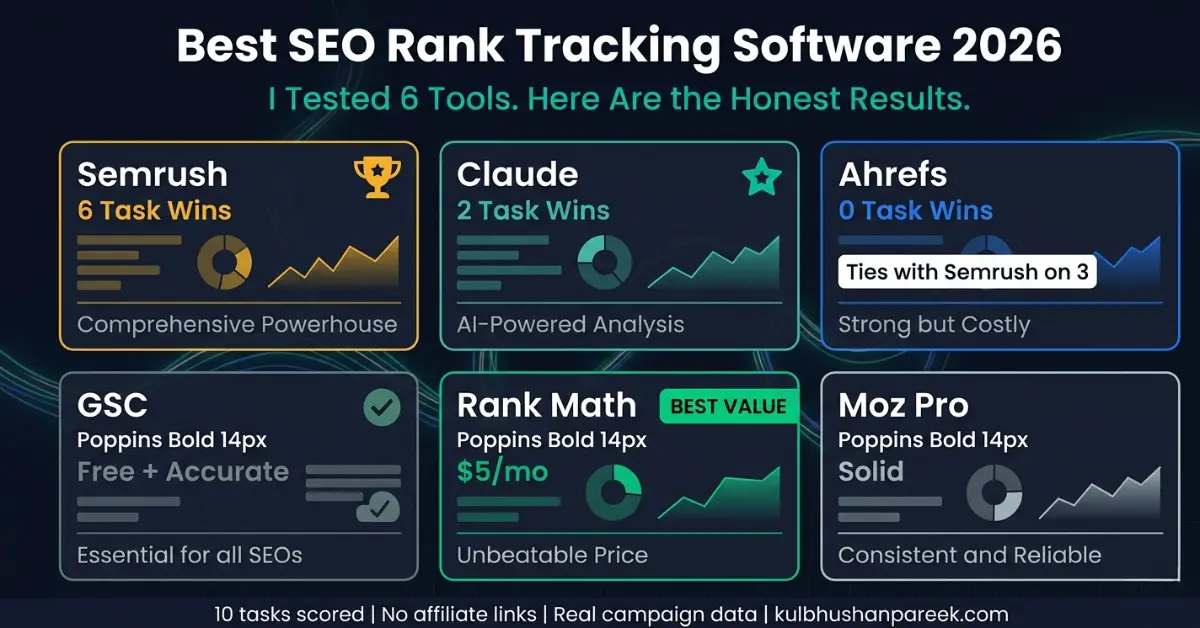
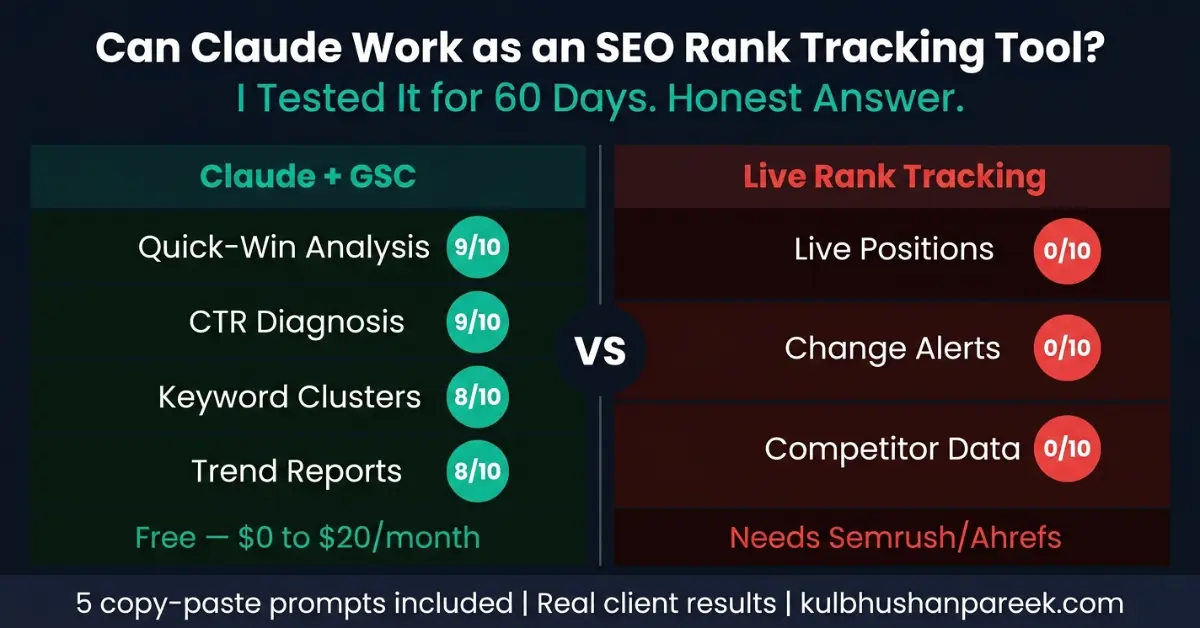
If you'd rather track without an API, see my 60-day test of Claude as a rank tracker.
DIY vs. buying: cost per 1,000 AI answers
| Option | Per 1,000 answers | Price | AI answers a month |
|---|---|---|---|
| SE Visible Basic | ~$3.30 | $99/mo | ~30,000 (vendor figure) |
| Otterly.AI Lite | ~$16 | $29/mo | ~1,800 (15 × 4 engines × daily) |
| Ahrefs prompt package | $20 | $50/mo + an Ahrefs plan | 2,500 checks |
| Peec AI Starter | ~$21 | $95/mo | ~4,500 (50 × 3 models × 30 days) |
| DIY API, my 4-engine average | ~$52 | about $0.05 per answer | Pay per answer |
Treat this as a rough guide. Vendors count answers differently, the Otterly and Peec figures are my arithmetic from published limits, and browser-captured answers are not the same product as API answers. The direction is still clear: once you track more than a few dozen prompts daily, a subscription costs less than calling the APIs yourself. DIY makes sense for a small prompt set checked weekly, for research, and when you need the raw data.
What I found running 40 AI answers through 4 engines (24 September 2026)
Method. On September 24, 2026, I sent 10 buyer-style prompts to four engines through DataForSEO's LLM Responses API with web search switched on: ChatGPT (gpt-5.5), Claude (claude-sonnet-5), Gemini (gemini-3.5-flash) and Perplexity (sonar-pro), with a US search location where the API accepted one.
Four prompts asked for a consultant recommendation, two for tools (one was "What are the best tools to track my brand visibility in ChatGPT and AI search?"), three were how-to questions and one asked which websites AI engines cite most. The 40 answers cost $1.97 in total.
I logged every cited URL and every search query the engines reported, then resolved redirects, stripped tracking parameters and removed duplicates before counting. Forty answers from one day is a small sample, so treat these numbers as directional.
| Engine (model) | Avg cost per answer | Pages cited per answer | Answers with no citations | Search queries reported | Citation link format |
|---|---|---|---|---|---|
| ChatGPT (gpt-5.5) | $0.092 | 3.8 | 2 of 10 | 28 | Direct URL + ?utm_source=openai |
| Claude (claude-sonnet-5) | $0.042 | 3.9 | 3 of 10 | 14 | Direct URL |
| Gemini (gemini-3.5-flash) | $0.047 | 11.2 | 1 of 10 | 28 | Google redirect link |
| Perplexity (sonar-pro) | $0.016 | 19.2 | 0 of 10 | None returned | Direct URL |
| All four | $0.049 | 9.5 | 6 of 40 | 70 |
"Pages cited" counts unique pages per answer. Gemini attached 41.7 citation links per answer on average, but it repeated the same pages many times.
1. "Best X" lists dominate recommendation answers
For the six prompts that asked for a recommendation, 51.5% of the 264 cited pages were "best" or "top" list articles. Vendor product and service pages made up 22.7%, and Reddit, LinkedIn, YouTube and Medium together 6.8%. For the tools prompt that matches this article, 25 of the 44 cited pages (57%) were published by companies that sell SEO or AI-visibility software. Semrush was the only tool all four engines named in the first 1,500 characters of their answers, which is the part my script saved.
What to do with it: treat an AI engine's tool recommendation as a summary of vendor content, and check prices on the vendor's own page. If you sell something, the lists the engines lean on are where your brand needs to appear. My breakdown of which websites ChatGPT and Perplexity cite most often and my list of the websites LLMs cite most are good starting points.
If what you sell is B2B software, your own comparison, alternatives and integration pages matter just as much, because buyers and AI assistants use them to shortlist tools, and building those pages is the core of my SaaS SEO consulting for B2B software companies.
2. The engines rarely agree on sources
Across the 10 prompts, the engines cited 283 distinct domain-and-prompt combinations. Only 42 of them (14.8%) were cited by two or more engines for the same prompt, and only one domain, semrush.com, was cited by all four for any prompt. Tracking ChatGPT alone tells you little about Gemini or Perplexity. Perplexity cited the most sources (19.2 pages per answer) and ChatGPT and Claude the fewest (under 4), which makes each ChatGPT citation slot more competitive.
3. Gemini hides its sources behind redirect links
All 417 citation links Gemini returned pointed to vertexaisearch.cloud.google.com/grounding-api-redirect/, not to the cited site. My first pass matched domains in those links and reported that Gemini never cited kulbhushanpareek.com. Once the 116 unique redirects were resolved, it turned out Gemini had cited this site after all. You can get the real address two ways: DataForSEO's response also carries it in a direct_url field (my script didn't save that field at first), and a HEAD request to the redirect returns it in the Location header. All 116 resolved on the same day; I haven't tested how long they stay valid. If you buy a tracker, ask how it handles these links. ChatGPT had its own quirk: all 46 of its citation links carried ?utm_source=openai.
4. Web search isn't guaranteed, even when it's switched on
Six of the 40 answers cited nothing because the model chose not to search. ChatGPT's reasoning summary said so directly: "It doesn't seem necessary to browse the web for this." Five of the six were how-to prompts; the sixth was Claude declining to recommend individual freelancers. For the six recommendation prompts, 23 of 24 answers included citations. Citation tracking is most useful for recommendation and comparison prompts; for how-to questions, you're often competing with what the model already learned in training. The October runs showed the same pattern: 10 of 80 answers skipped search.
5. Fan-out queries show the words engines search with
ChatGPT, Claude and Gemini reported 70 search queries between them; Perplexity's API returned none. For the tools prompt, they searched phrases like "AI search visibility monitoring tools ChatGPT Perplexity Google AI Overviews brand tracking" and "how to track brand mentions in LLM search." ChatGPT and Claude added "2026" to 8 of their 42 queries even though the prompt never mentioned a year. Pages that use the same vocabulary and show a current date have a better chance of matching those searches. My guide on how to get cited in Google AI Overviews covers the on-page side.
Free options: GA4 and Bing Webmaster Tools
Prompt trackers tell you whether AI engines mention you. They don't tell you whether anyone clicks. For that, use two free tools:
- Google Analytics 4: create a custom channel group (Admin > Data display > Channel groups) with an "AI assistants" channel whose source matches a regex such as
chatgpt|openai|perplexity|gemini.google|copilot.microsoft|claude.ai. Standard GA4 properties allow two custom channel groups, and Google applies them to past data too. ChatGPT often, but not always, tags its links with utm_source=chatgpt.com, according to Seer Interactive's testing (updated June 2026). The API citations in my test carried utm_source=openai, so match both. - Bing Webmaster Tools: the AI Performance report, in public preview since February 2026, shows how often Microsoft Copilot and Bing's AI-generated summaries cite your pages and which grounding queries led to those citations. It's the only first-party AI citation report from a major engine that I know of. It doesn't cover ChatGPT.
A side effect you may see in Search Console
Google counts AI Overviews and AI Mode activity inside the "Web" totals of Search Console's Performance report, according to its documentation. Between August 1 and September 23, 2026, this page picked up 78 queries that read like templated prompts, such as "i am an seo professional, recommend me chatgpt tracker. my location is united states." (there is a German version with the same English suffix). They logged 557 impressions at an average position of 8.3, against 25.3 for the page's other queries. That looks like automated persona prompts, most likely someone's AI-visibility tool querying a Google AI surface, but Search Console can't say whose. If you see the same pattern, don't read those impressions as human demand.
Inflated impressions can come from your own setup too: in my Indigo Software case study, a broken Merchant Center feed flooded Search Console with junk impressions, so I excluded those months and report the $583,956 in organic revenue from GA4, which the defect did not affect.
How to choose an AI visibility tracker: 7 checks
- Engines on your plan, not the top plan. SE Visible and SE Ranking no longer list Perplexity, Peec Starter covers three models, and Otterly Lite charges extra for Claude, Gemini and AI Mode.
- Answers per month, not prompts. Multiply prompts × engines × runs per month. 500 prompts checked weekly and 50 prompts checked daily are different products.
- How answers are captured. API answers, like the ones in my tracker, can differ from what people see in the ChatGPT app, which layers in memory, personalization and location. Ask each vendor whether it captures answers through the interface or an API.
- URL-level citations. You need the exact pages cited, including resolved Gemini links, to know which page to fix or which publisher to pitch.
- Competitor share of voice by prompt and topic, with history you can export.
- Fan-out queries. The searches an engine runs behind a prompt are the closest thing to keyword research for AI answers. LLMrefs lists them in its plan; ask other vendors whether they show them.
- Exports and API access if you report to clients or want to join the data with GA4.
Common mistakes
- Reading one run as the truth. The same prompt can return different sources on different days. Judge trends over several weeks, not single results.
- Tracking only branded prompts. "What is [your brand]?" will usually mention you. The opportunity is in category prompts where you're missing.
- Confusing mentions with traffic. A citation is not a visit, so pair any tracker with the GA4 channel above.
- Buying on headline price. Compare the cost per answer and the engines included on the plan you would actually buy.
- Treating AI tool recommendations as neutral. More than half of the pages cited for the tools question in my test came from companies that sell SEO or AI-visibility software.
Methodology and disclosure
- Prices and plan limits were read from each vendor's own pricing page on 23 October 2026 (first checked 24 September 2026), in US dollars on monthly billing unless noted. Vendors change plans often, so check the linked pages before you buy.
- What I didn't do: I did not run paid trials of these nine tools. Tool descriptions come from vendor pricing pages and documentation.
- AI answer data: a 24 September 2026 test (10 prompts × 4 engines, $1.97) and my weekly tracker runs of 5 and 12 October 2026 (80 answers, $2.14 and $2.05), all through DataForSEO's LLM Responses API in live mode with web search on, one answer per prompt per engine per run. Page types were labeled by URL pattern; the labels are my judgment calls.
- Search Console data: this page's own performance from August 1 to September 23, 2026.
- Disclosure: this page has no affiliate links. SE Ranking, whose traffic study I cite, sells two of the tools listed.
Want to see how your own pages score for AI search first? The free 31-check SEO and AI audit tool checks the on-page GEO signals in one pass. If you want help turning AI visibility data into a content and PR plan, that is part of my GEO consulting work.
Frequently Asked Questions

Leave a Comment
Your email address will not be published. Comments are moderated before appearing.