Gemini for SEO: 8 Workflows and How to Earn AI Overview Citations
Key Takeaways
Gemini's real SEO advantage is proximity to Google. It shares a model family with AI Overviews and AI Mode, so it is the closest read you can get on how Google summarises your topic.
Ranking in the top 20 organically is still the entry ticket. Pages outside it are cited in AI answers far less often, so GEO does not replace SEO, it sits on top of it.
A 40 to 60 word direct answer under a question-shaped heading is the single highest-leverage on-page change for citation.
Gemini reads Google Sheets, Docs and YouTube natively, which removes the export-and-upload step from most SEO analysis.
Gemini invents search volumes when asked. Bring real data from Search Console or a paid tool and use Gemini only for the reasoning layer.
Most "Gemini for SEO" advice is a list of prompts that would
work in any chatbot. That misses the only thing that makes
Gemini structurally different for search work: it is built by
the company that runs the search engine, and the same model
family generates the AI Overviews now sitting above the
organic results you are trying to win.
This page covers the eight workflows where that proximity
actually pays, tested across client campaigns over
14 years of SEO practice.
8
SEO Workflows
1M
Token Context Window
Top 20
Rank Needed to Get Cited
$0
Free Tier Covers Most of This
Why Gemini Is Different From Every Other AI Tool for SEO
Three differences matter for search work, and only one of
them is about the model being clever.
It Shares a Model Family With AI Overviews
Gemini is not a simulator for AI Overviews, and
anyone selling it as one is overstating the case.
The systems are tuned differently and the search
surface applies its own retrieval and quality
layers. But it is the nearest consumer-accessible
proxy that exists, it is free, and asking it your
money questions tells you which framings and which
sources Google's own family gravitates toward.
It Reads Your Google Data Where It Already Lives
Search Console exports, GA4 pulls and rank
trackers all end up in Sheets. Gemini reads them
there. No CSV download, no upload, no truncation
to fit a context window, and with a million-token
window, twelve months of query data goes in whole
rather than sampled.
It Watches Video Natively
Competitor webinars, conference talks and
YouTube tutorials are content gaps hiding in a
format most SEOs never audit. Gemini reads a
YouTube URL directly and will tell you every
claim, statistic and objection handled in a
40-minute video in about a minute.
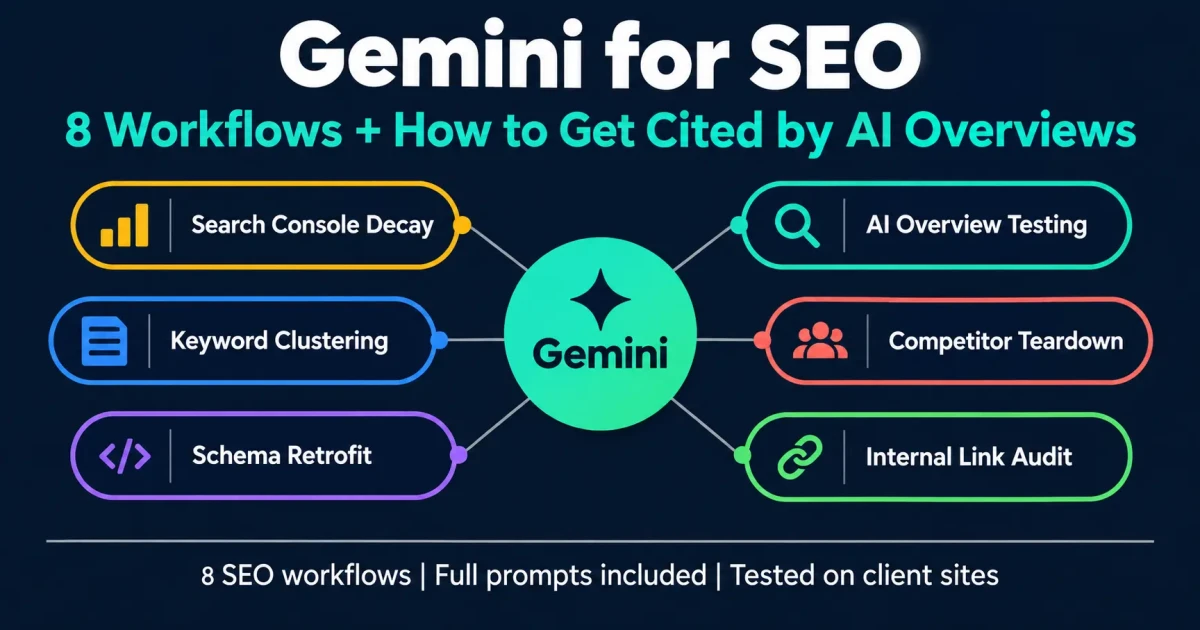
The 8 Gemini Workflows That Save the Most SEO Time
1. Search Console Decay Analysis
What it does: Finds pages that are
quietly losing impressions while holding position, the
earliest signal that a page is being replaced in an AI
answer rather than outranked.
Input needed: A Search
Console performance export covering 16 months, left in
Google Sheets. No download step.
Output: A ranked list of
URLs with impression trend, position trend, and a
diagnosis of which pattern each one fits.
PromptUsing the Search Console export in this Sheet, compare the last 3 months against the previous 3 months for every URL.
Return a table of pages where impressions fell more than 20% but average position moved less than 1.5 places. For each one, state which of these patterns it fits:
(a) query lost to an AI Overview, (b) seasonal decline, (c) cannibalised by another URL on this site, (d) SERP layout change.
Cite the specific queries driving each conclusion. Do not guess where the data is ambiguous, say so.
2. AI Overview Citation Gap Test
What it does: Tells you whether your
brand shows up when Google's model family answers your
money questions, and which competitors it reaches for
instead.
Input needed: Your ten to
twenty highest-intent questions, phrased the way a buyer
would ask them, not the way a keyword tool writes them.
Output: A citation
scorecard per question, and a concrete reason for each
absence.
PromptAnswer this question as you normally would, then audit your own answer: "[your target question]"
After answering, tell me:
1. Which sources did you draw on, and why those?
2. Was [yourdomain.com] among them? If not, what is missing from that site that the sources you used have?
3. Rewrite the ideal 50-word passage that would have made you cite a page on this topic.
Be specific about format and structure, not just "better content".
Why it works: The third
question is the useful one. It returns the passage shape
the model wants, which you can then go and write.
3. Keyword Clustering From Real Data
What it does: Groups an exported
keyword list by search intent and maps each cluster to a
page type and URL.
Input needed: A real
export with volume and difficulty columns. This matters:
asked for volumes without data, Gemini will invent
plausible numbers and present them confidently.
PromptCluster the keywords in this Sheet by search intent. Use only the volume and difficulty values present in the data. Never estimate a number that is not there, mark it "unknown" instead.
Output a table: cluster name | primary keyword | supporting keywords | intent (informational/commercial/transactional/navigational) | page type | suggested URL slug.
Flag any cluster where two of our existing URLs would compete for the same intent.
4. A Reusable SEO Gem
What it does: Saves your standards (
brand voice, target market, banned phrases, schema
conventions) as a Gem so you stop re-explaining them
every session. Gems are Gemini's equivalent of custom
GPTs and, unlike custom GPTs, they work on the free
tier.
Input needed: One page of
standing instructions plus two or three reference files:
a style guide, a strong published page, and your ICP
definition.
Gem instructionsYou are an SEO editor for [brand], a [what you do] serving [market].
Standing rules:
- Answer-first. Every H2 that asks a question is followed by a 40-60 word direct answer.
- Specific over general. Every claim carries a number, a date, or a named method.
- Never use: "in today's digital landscape", "unlock", "leverage", "game-changer", "dive into".
- British spelling. Sentence case headings.
- Flag any claim you cannot source. Do not invent statistics.
When I paste a draft, return it edited, then list what you changed and why.
5. Deep Research Competitor Teardown
What it does: Sends Gemini across
dozens of sources to build a cited competitive brief.
Deep Research is on the free tier, which makes it the
cheapest serious research tool available to an SEO right
now.
Output: A multi-page
report with sources you can verify, and you should
verify them, because agentic research still
misattributes.
PromptResearch how [competitor 1], [competitor 2] and [competitor 3] position themselves for buyers searching "[your core commercial term]".
For each: the promise on their main landing page, proof they offer, pricing transparency, content topics covered in depth, and topics they visibly avoid.
Finish with the three subtopics all of them under-serve, ranked by how buyer-relevant the gap is. Cite every claim.
6. Video Content Gap Mining
What it does: Extracts the questions,
objections and claims from competitor video content,
the content library almost nobody audits because it used
to take an hour per video.
Input needed: A YouTube
URL. That is the whole input.
PromptWatch this video: [YouTube URL]
Extract:
1. Every question the presenter answers, in their words.
2. Every statistic or claim, with the timestamp.
3. Every objection they pre-empt.
4. Which of these are NOT covered on [yourdomain.com]. Treat that list as a content brief queue, ordered by search demand you would expect.
7. Schema and Answer-Block Retrofit
What it does: Takes an existing page
and returns the FAQ pairs and answer block it is
missing: the two changes that most reliably move a page
from ignored to cited.
Caveat: Validate the
JSON-LD before shipping. Gemini writes schema that is
usually correct and occasionally confidently malformed,
and structured data fails silently.
PromptHere is the full text of [URL].
1. Write a 40-60 word answer to the page's core question, in the page's own voice, using only facts already present in the text.
2. Draft 4 FAQ pairs from questions a buyer would actually type, not questions the page wishes they asked.
3. Output valid FAQPage JSON-LD for those pairs.
4. List every claim in the page that has no supporting number or source.
8. Internal Link and Cannibalisation Audit
What it does: Reads a full crawl
export and finds pages competing for the same intent,
plus the internal links that should exist and do not.
The million-token window means a mid-size site's whole
crawl fits in one pass.
PromptThis Sheet is a full crawl export (URL, title, H1, meta description, word count).
1. Group URLs that target the same search intent and would cannibalise each other. For each group, recommend keep / merge / redirect, with reasoning.
2. Propose 3 internal links per orphan or weakly-linked page, giving source URL and exact anchor text.
3. List pages whose title and H1 promise different things.
Gemini SEO Prompts Library: 12 to Copy Right Now
The eight workflows above are the full versions. These are the
short ones worth keeping in a notes file, the prompts that
answer a single question in one paste. Swap the bracketed
parts for your own and run them on the free tier.
1
Find the pages Google already almost ranks
From this Search Console export, list every query at average position 8 to 20 with more than 100 impressions and a CTR below 2%. For each, name the URL that ranks and the one change most likely to move it onto page one. Rank the list by impressions won per hour of work.
2
Write the answer block that gets lifted
Here is my page on [topic]. Write a 45-word answer to its core question, using only facts already in the text. It must read correctly with no surrounding context, because that is how an AI answer will quote it. No preamble, no "in this article".
3
Audit a page for extractable facts
Read [URL]. List every sentence that makes a claim with no number, date, source or named method attached. For each one, tell me what evidence would make it citable. Do not rewrite anything yet.
4
Test whether an AI answer knows you
Answer this as you normally would: "[buyer question]". Then list which sources you drew on and why. If [yourdomain.com] was not among them, say exactly what those sources have that it lacks.
5
Turn a transcript into a content brief
Watch [YouTube URL]. Extract every question answered, every statistic with its timestamp, and every objection pre-empted. Output the ones a page on [yourdomain.com] does not cover, ordered by how commercially relevant each is.
6
Find cannibalisation in a crawl
This Sheet is a crawl export. Group URLs targeting the same search intent, then for each group recommend keep, merge or redirect with a one-line reason. Flag any page whose title and H1 promise different things.
7
Draft FAQs a buyer would actually type
From this page text, write 5 FAQ pairs. Use questions a buyer would type into Google, not questions the page wishes they asked. Answers 40 to 60 words, no marketing language. Then output valid FAQPage JSON-LD.
8
Cluster keywords without invented data
Cluster the keywords in this Sheet by intent. Use only the volume and difficulty values present in the data. Never estimate a number that is not there, mark it "unknown" instead. Output: cluster, primary keyword, intent, page type, URL slug.
9
Spot the decay before rankings move
Compare the last 90 days against the previous 90 in this export. Show pages where impressions fell over 20% while position moved under 1.5 places. Say which pattern each fits: lost to an AI answer, seasonal, cannibalised, or SERP layout change.
10
Pressure-test a title against the SERP
My target query is "[query]". Here are the 10 titles currently ranking. Write 5 alternatives for my page that promise something none of them promise, each under 60 characters including the brand suffix. Print the character count for each.
11
Find the internal links you never added
Here is my sitemap and the text of [URL]. Suggest 5 internal links this page should contain, giving the target URL and the exact anchor text, using phrases already present in the copy. Skip anything that would read as forced.
12
Strip the tells out of a draft
Edit this draft. Cut every hedge, every sentence that says nothing, and these phrases: "in today's landscape", "unlock", "leverage", "seamless", "game-changer", "dive into". Keep the argument and the opinions. List what you cut and why.
What Actually Makes AI Overviews Cite a Page
No prompt makes Google cite you. What makes Google cite you
is a page shaped so the answer is trivial to lift and safe to
attribute. Across client sites, these are the changes that
move the needle, in the order I would make them:
Rank in the top 20 first. Pages outside the first two pages of organic results are cited far less often. GEO is a layer on top of SEO, not an alternative to it. If the page cannot rank, no amount of formatting rescues it.
Put a 40 to 60 word answer under every question heading. Not an introduction, not a promise to explain later. The complete answer, immediately, in a passage that survives being lifted out of context.
Replace general claims with specific ones. "Significantly improves rankings" is unciteable. "Moved 14 pages from position 11 to page one in nine weeks" is a sentence a model can quote and attribute.
Ship FAQPage and Article schema. Structured data does not force a citation, but it removes ambiguity about what the page asserts and who wrote it.
Make the author real. Person schema, a genuine bio, and consistent identity across your site and profiles. Attribution requires something to attribute to.
Get corroborated elsewhere. Models prefer claims they can verify in more than one place. A statistic that exists only on your site is a risk they route around.
Keep the HTML boring. Clean heading order, real text in the HTML, no answer hidden behind a tab or a click. Retrieval reads markup, not intentions.
This is the same checklist behind my
SEO and GEO consulting work,
and the free SEO audit tool
checks the technical half of it automatically (AI crawler
access, schema, llms.txt and 28 other signals) if you want a
baseline before changing anything.
What Gemini Replaces and What It Does Not
Gemini Replaces
Manual keyword clustering and intent tagging
Reading long Search Console exports by hand
Watching competitor videos for research
First-draft content briefs and outlines
Writing FAQ pairs and answer blocks
Summarising crawl exports into an action list
Still Needs Real Tools
Search volume and difficulty: Keyword Planner, Ahrefs, Semrush
Backlink data: Ahrefs, Majestic
Rank tracking: a real tracker, not a prompt
Crawl data: Screaming Frog, Sitebulb
Index status: Search Console
Schema validation: Rich Results Test
The split is consistent: Gemini is strong wherever the job is
reading and reasoning, and unreliable wherever the job is
knowing a number. Feed it real data and it is excellent. Ask
it for the data and it will make some up. For the same
comparison against other models, see
Gemini vs ChatGPT
and the ChatGPT SEO workflows.
Frequently Asked Questions
Gemini does not control what appears in AI Overviews, and no prompt makes Google cite you. What Gemini gives you is the closest available read on how Google's own model family summarises a topic. Run your target questions in Gemini, note which sources it leans on and how it phrases the answer, then restructure your page so the answer it wants is easy to lift. The mechanical prerequisite still applies: pages that rank in the top 20 organically are cited far more often than pages that do not, so classic SEO remains the entry ticket.
Four things consistently separate cited pages from ignored ones. First, a direct answer of roughly 40 to 60 words placed immediately under a question-shaped heading, so the passage can be lifted whole. Second, specific extractable facts such as numbers, dates and named methods, rather than general marketing language. Third, machine-readable structure: clean headings, FAQPage or Article schema, and a sane HTML outline. Fourth, corroboration, meaning the same claim appears on other reputable sites so the model can verify it.
Gemini is good at the thinking layer of keyword research and unreliable at the data layer. It clusters an exported list by intent, spots missing subtopics, and maps clusters to page types well. It cannot give you trustworthy search volume or difficulty scores, and asking it for those numbers produces confident invented figures. Pull the data from Search Console, Keyword Planner, Ahrefs or Semrush, then hand it to Gemini for the grouping and prioritisation.
No. Google's guidance targets low-value content produced at scale to manipulate rankings, not the tool used to write it. Content generated with Gemini or any other model ranks fine when it carries real expertise, original data, and a point of view. The practical risk is not detection. It is publishing generic output that says nothing a hundred other pages do not already say, which fails on merit rather than on penalty.
Generative engine optimization, or GEO, is the practice of making a site easy for AI systems to retrieve, quote and attribute, whether that is Google AI Overviews and AI Mode, ChatGPT, Perplexity and Claude. It overlaps heavily with technical SEO and content quality, but the success metric is different: you measure how often an engine names or links your brand for the questions that matter, not where you sit in a list of blue links.
Want to Know Why AI Answers Skip Your Site?
Book a free 30-minute call. I will run your top questions through the AI engines live and show you exactly which pages need restructuring.