Best Tools to Track Your Brand Visibility in ChatGPT and AI Search (2026): 9 Compared + a DIY Tracker
Small budget: Otterly.AI Lite ($29/mo). On an SEO suite: SE Ranking Core ($129/mo) or Semrush One Starter ($199/mo)....
Read ArticleDigital Marketing Consultant
14+ years helping businesses in US, UK, Canada, Australia, UAE & India grow through SEO and AI-powered marketing.
Information
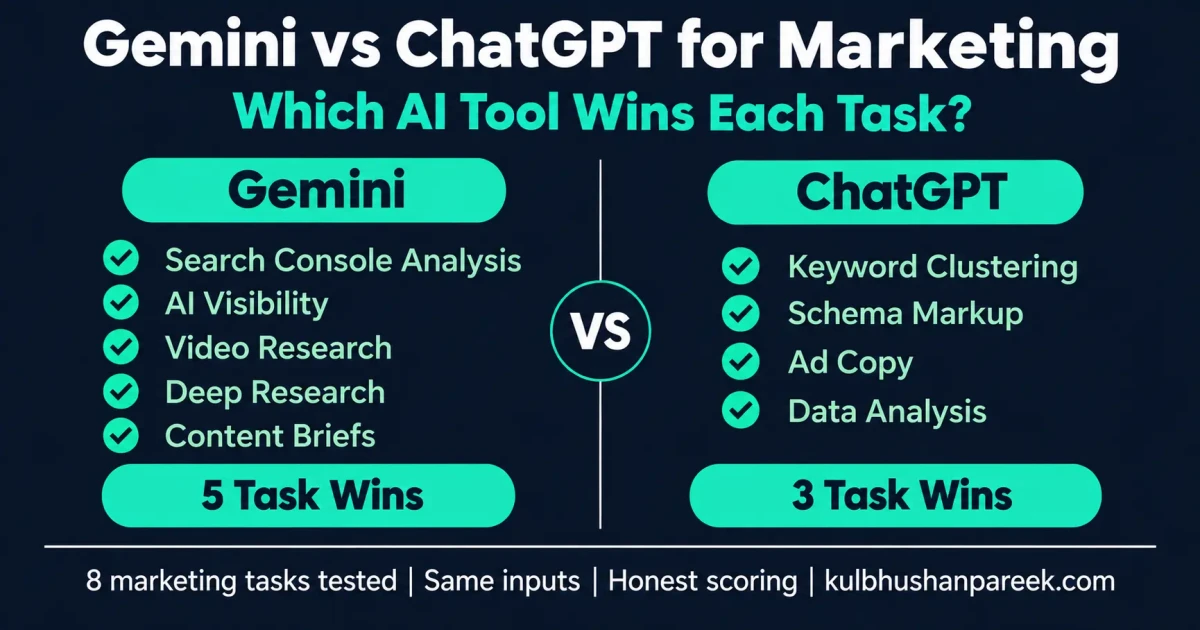
Most comparisons of these two tools are written from feature lists. This one is written from running both on the same client work: the same keyword exports, the same Search Console pulls, the same content briefs, over 14 years of hands-on marketing practice. Where one tool clearly produces better output for a task, this page says so. Where the difference is marketing noise, it says that too.
Current as of September 2026. Highlighted cells mark the tool with the clearer advantage for marketing work.
| Feature | Gemini (Google AI Pro) | ChatGPT (Plus) |
|---|---|---|
| Price | $19.99/month | $20/month |
| Cheaper paid tier | Google AI Plus at $7.99 | None |
| Context window | 1M tokens (Gemini 3.1 Pro) | ~128K tokens |
| Saved assistants | Gems (free tier included) | Custom GPTs (paid only) |
| Agentic research | Deep Research, free tier included | Deep research, paid only |
| Office suite integration | Native in Gmail, Docs, Sheets, Drive | Connectors, not native |
| Spreadsheet / data analysis | Good, less reliable on large files | Advanced Data Analysis (Python) |
| Image generation | Built in | Built in |
| YouTube / video understanding | Native, including long video | Limited |
| Shareable workflows | Gems shared within Workspace | Public GPT directory |
| Relevance to AI Overviews | Same family powers Google AI answers | No relationship to Google surfaces |
This is Gemini's clearest win and it is not close. A Search Console export lives in Google Sheets, and Gemini reads it there without an upload step. Twelve months of query data, the kind of file that forces you to sample before pasting into ChatGPT, fits inside a million-token context whole. Asking "which queries lost impressions but held position" against the full dataset returns a usable answer instead of an answer about the rows that happened to fit.
Clustering 5,000 keywords is a computation, not a reading task. ChatGPT's Advanced Data Analysis writes and runs Python against the file, so the grouping is deterministic and you can ask to see the code. Gemini reasons about the list in language, which is fine for a few hundred terms and drifts on a few thousand. When the output has to be reproducible, use the tool that shows its working.
Both write competent briefs. Gemini takes this narrowly for one workflow reason: the brief ends up in Google Docs, where the writer already works, and Gemini edits it in place. Quality of the draft itself is a wash, and both still need a practitioner to strip the hedging and add the specifics that make a page worth publishing. See the content marketing workflows for the editing pass that matters more than the model choice.
If you care whether your pages get cited in Google's AI Overviews and AI Mode, the model family behind those answers is the one worth testing prompts against. Gemini is not a simulator for AI Overviews and nobody should claim it is, but it is the closest consumer proxy available, and it is free. Run your target questions in Gemini, see whether your brand appears, and treat absence as a generative engine optimization gap to close.
Structured data is unforgiving: a malformed JSON-LD block fails silently in Search Console. ChatGPT validates its own output by executing it, which catches the trailing comma before Google does. Gemini produces schema that is usually right and occasionally confidently wrong, which is the worse failure mode. Whichever you use, run the result through the Rich Results Test before shipping.
Gemini reads YouTube videos natively. For competitive research this is a genuine time saving: paste a competitor's 40-minute webinar and ask what claims they make about pricing, or summarise a conference talk into talking points. ChatGPT has no comparable native path. If video is part of your content research, this alone can justify the subscription.
Volume-and-variation work suits ChatGPT's output style. Ask for thirty Google Ads headlines under thirty characters and you get thirty usable headlines. Gemini tends to return fewer, longer, more cautious lines and needs a second prompt to loosen up. For social content at volume, the faster iteration loop wins.
Both ship an agentic research mode that browses many sources and returns a cited report. The difference is access: Gemini's Deep Research is available on the free tier, ChatGPT's equivalent is not. For a competitor landscape or a market brief, that makes Gemini the sensible first call even if you pay for both.
Google's Pro model has been stuck on Gemini 3.1 Pro since February 2026 while the cheaper Flash line has shipped four releases in roughly a hundred days, reaching Gemini 3.8 Flash in September. The promised 3.5 Pro has not arrived.
That matters for planning. If you are choosing a tool for reasoning-heavy work on a twelve-month horizon, you are buying into a frontier model that has not moved in seven months. It does not make Gemini the wrong choice, since 3.1 Pro is still strong and the ecosystem advantages are real, but anyone telling you Gemini is pulling ahead on raw capability is not reading the release notes.
Gemini 3.1 Pro with higher limits, Deep Research, Gems, Canvas, and Gemini working natively inside Gmail, Docs, Sheets and Drive. Bundles cloud storage, which offsets part of the cost if you already pay Google for it. A cheaper AI Plus tier at $7.99 covers lighter use, and AI Ultra at $200 exists for heavy agentic workloads.
Higher rate limits, image generation, Advanced Data Analysis with real Python execution, custom GPTs you can publish, and the largest ecosystem of third-party prompts and integrations. No cheaper paid tier: the step below Plus is the free plan.
At a $0.01 monthly difference, price is not a decision input. The real cost question is the free tiers: Gemini gives away Deep Research and Gems, so a marketer on zero budget gets meaningfully more from Gemini than from free ChatGPT. If you are evaluating before committing, start there.
Run your business on Google Workspace. Work with Search Console or GA4 exports weekly. Care about visibility in AI Overviews. Research competitors through video. Need to hand a model a very large document. Or want the strongest free tier available.
Do heavy spreadsheet analysis and need reproducible output. Produce ad and social copy at volume. Write structured data regularly. Want to build workflows a whole team can reuse. Or need the deepest library of third-party integrations.
The practical answer for most working marketers is both, on the free tiers, until one of them becomes the tool you open first, then pay for that one. Forty dollars a month for two overlapping subscriptions is a real cost that very few marketing workflows earn back. If you are also weighing Claude, the ChatGPT vs Claude comparison covers that pairing, and the three-way AI SEO tools comparison puts all of them side by side.
Book a free 30-minute call. I will map Gemini, ChatGPT and Claude to your actual workflow and tell you which subscriptions are worth paying for.
Small budget: Otterly.AI Lite ($29/mo). On an SEO suite: SE Ranking Core ($129/mo) or Semrush One Starter ($199/mo)....
Read Article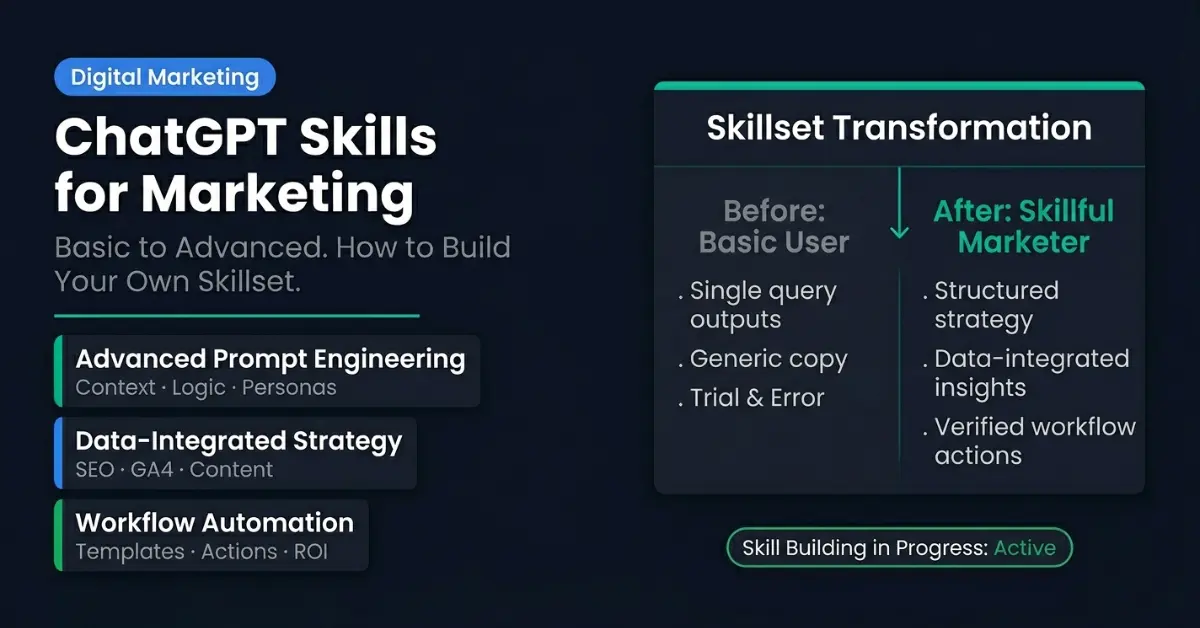
ChatGPT Skills turn your best prompts into repeatable workflows. Here's what they really are, who can use them...
Read Article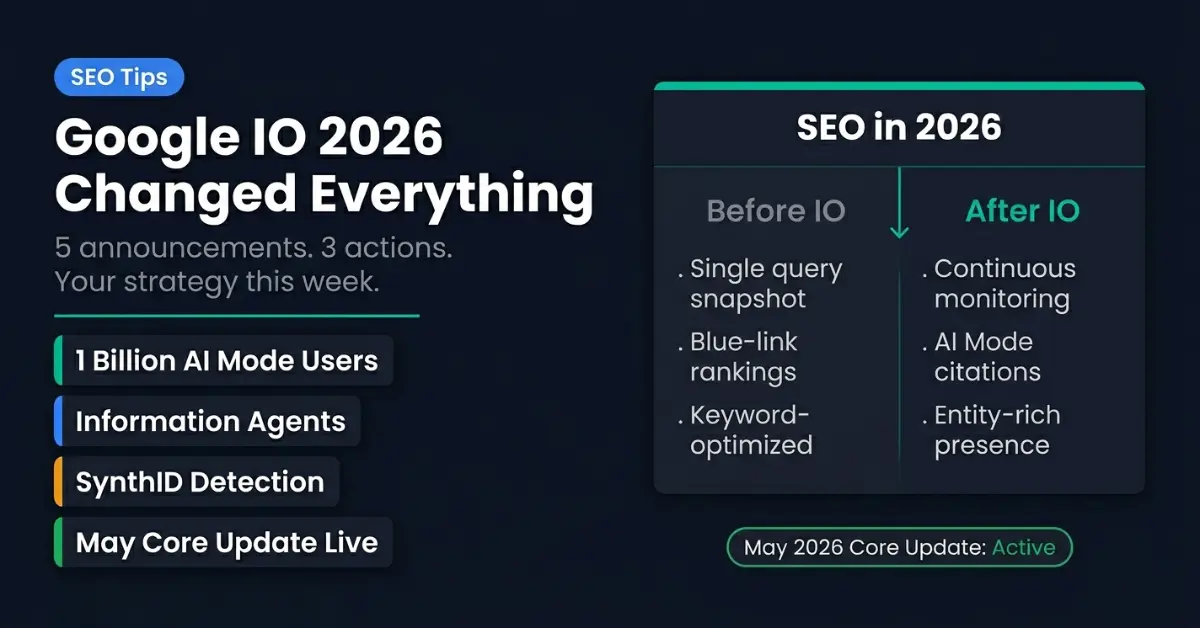
Google IO 2026 announced AI Mode at 1B users, Information Agents launching this summer, SynthID content detection in...
Read Article